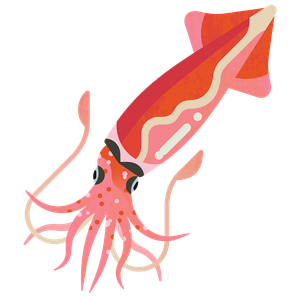
Japanese flying squid
Todarodes pacificus
What to check for
Location
Japan Sea and Pacific Coast
Technical location
Pacific, Northwest, All areas
Caught by
Net (pelagic trawl)
Rating summary
Japanese flying squid is a resilient species, but there is concern for fishing pressure and biomass. In China, there are very few management measures to control fishing for Japanese flying squid. Monitoring and enforcement of legislation is poor. Midwater trawls for squid in Chinese waters can make contact with the sea floor, and therefore may have habitat impacts. In addition, there is the potential for bycatch of vulnerable species.Rating last updated: December 2021.
Technical consultation summary
There is concern for fishing pressure and biomass of Japanese flying squid. Route 2 scoring has been applied to this rating owing to the lack of a stock assessment for the stock as a whole. Japanese flying squid (JFS) is considered to have high resilience to fishing pressure. The Fisheries Research and Education Agency of Japan (FRA) conducts annual assessments for stocks in Japanese waters but there is shortage of information in Chinese and Korean waters. A 2020 study has estimated the stock status for the species as a whole. A combination of this study and the Japanese assessments have been used to apply stock scoring. In Japanese waters, the spawning biomass (SB) of the winter stock in 2020 was estimated to be 56,000 tons. This is well below target levels (SBMSY, 234,000t). The spawning biomass of the autumn stock in 2020 was 225,000t, which is also below target levels (SBMSY, 329,000t). A 2020 study indicates that the population of the species is below sustainable levels. Therefore, there is concern for the biomass. In Japanese waters, fishing mortality (F) has been higher than levels associated with Maximum Sustainable Yield (FMSY) since 2014 (except in 2017). Therefore, there is concern for the fishing pressure. In China, there are very few management measures to control fishing for Japanese flying squid. There is no squid-specific management. Catch data are not species-specific, but are recorded for all squid species combined. As China does not conduct stock assessments for JFS in its waters, there is no information available to ensure that management prevents overexploitation. Fishing is banned in some areas from June-August to protect spawning fish. As soon as the summer closure has ended, there is a race to fish, resulting in intense exploitation of marine species in autumn. Enforcement of the closure appears to be weak. Midwater trawls for squid in Chinese waters can make contact with the sea floor, and therefore may have habitat impacts. In addition, there is the potential for bycatch of vulnerable species.
How we worked out this Rating
Japanese flying squid is a resilient species, but there is concern for fishing pressure and biomass. Route 2 scoring has been applied to this rating owing to the lack of a stock assessment for the stock as a whole. Japanese flying squid (JFS) is considered to have high resilience to fishing pressure.There are three JFS stocks or cohorts, based on their spawning seasons: summer, autumn (fall) and winter. Autumn and winter are the largest and most important stocks. They are found in the Japan Sea, the Pacific coast of Japan, the East China Sea, and the Yellow Sea of China. The Fisheries Research and Education Agency of Japan (FRA) conducts annual assessments for stocks in Japanese waters but there is shortage of information in Chinese and Korean waters. A 2020 study has estimated the stock status for the species as a whole. A combination of this study and the Japanese assessments have been used to apply stock scoring.In Japanese waters, the spawning biomass (SB) of the winter stock appears to have increased significantly from 40,000 tons in the 1980s to 400,000t in 2010. It has since decreased and in 2020 was estimated to be 56,000 tons. This is well below target levels (SBMSY, 234,000t). The spawning biomass of the autumn stock increased from 70,000t in the 1980s to around 900,000t in the late 1990s, and has since fluctuated widely. In 2020 it was 225,000t, which is also below target levels (SBMSY, 329,000t). A 2020 study indicates that the population of the species is below sustainable levels. Therefore, there is concern for the biomass.Catches of JFS have increased since the 1980s. For the winter stock, they peaked in 1996 at around 250,000t and started to decrease in 2016. Catch in 2019 was around 64,000t. In Japanese waters, fishing mortality (F) has been higher than levels associated with Maximum Sustainable Yield (FMSY) since 2014 (except in 2017). For the autumn stock, catches peaked in 2005-2006 at nearly 400,000t, and have been declining since. The catch in 2019 in was an estimated 198,000 tons. Fishing mortality has fluctuated but is currently above FMSY. Therefore, there is concern for the fishing pressure.
In China, there are very few management measures to control fishing for Japanese flying squid. Monitoring and enforcement of legislation is poor.Japanese flying squid (JFS) is caught in the northwest Pacific, Sea of Japan, Yellow Sea, and East China Sea by Japan, North Korea, South Korea, China, Taiwan, and Russia. There is limited information about Chinese catches and so the impact of the different fleets and management measures on the stock as a whole is difficult to determine. There is no joint management plan that covers all areas and all fleets. Stock assessments are carried out for JFS in Japanese waters, but not elsewhere.In China, fisheries are subject to the general fisheries management system, and there is no squid-specific management. In addition, catch data are not species-specific, but are recorded for all squid species combined. As China does not conduct stock assessments for JFS in its waters, there is no information available to ensure that management prevents overexploitation.The most important management tools are a minimum mesh size for trawlers (54mm), and a range of input control measures. These include seasonal closures, licensing, and limits on engine power. Fishing is banned in the Bohai, Yellow, East, and South China Seas from June-August, which protects some spawning fish. However, the only output control is a nation-wide total catch limit for all species combined. As a result, as soon as the summer closure has ended, there is a race to fish, resulting in intense exploitation of marine species in autumn. In addition, enforcement of the closure appears to be weak.In April 2021, the Chinese government allowed fishing during the summer closure for 5 fisheries, including JFS. There was a species-specific TAC of 8,000 tonnes and catches were low (1,300t) owing to unpredicted squid distribution. This appears to be the first time that TACs and catches are recorded for JFS in Chinese waters. It is unclear if it will be repeated in future, and fishing during the rest of the year remains unrecorded.The Chinese coast guard has one of the largest patrol fleets in the world, and Vessel Monitoring Systems are used for up to 60,000 Chinese vessels operating in the area. However, enforcement of the above management measures seems to be weak. Illegal fishing continues within the Yellow Sea and the South China Sea.In 2019, the North Pacific Fisheries Commission (NPFC) adopted a conservation and management measure for the Japanese flying squid fishery. However, it is unclear how this resolution is being applied. It includes a requirement to freeze the number of vessels fishing for JFS, use Vessel Monitoring Systems, and support work to develop stock assessments.A Fishery Improvement Project was underway for part of the Chinese JFS trawl fishery. Phase 1 was running from 2019-2023, but in 2022 the FIP was declared inactive because "Major changes in the nature of the fishery have led to the need for re-assessing the scope of improvements and work plan actions."
Midwater trawls for squid in Chinese waters can make contact with the sea floor, and therefore may have habitat impacts. In addition, there is the potential for bycatch of vulnerable species.Midwater trawls (both single and pair) are the main gears used to catch Japanese flying squid (JFS) in Chinese waters.Information about the impact on the habitat is scarce. Taking into consideration the range of species caught as a bycatch, which includes pelagic and benthopelagic species, it seems that the gear can contact the seabed, mainly during daytime trawling when JFS is found deeper in the water column.Qualitative information from limited trips indicates that bycatch species in the JFS fishery includes Japanese Spanish mackerel, Japanese anchovy, Largehead hairtail, and Pacific chub mackerel. The non-selective nature of trawl gear used seems to be supported by the diverse species observed, but the percentage of these species are relatively low.Seventeen species of whales and dolphins and four species of seals and sea lions are found in the Yellow and Bohai seas. This includes the endangered narrow-ridged finless porpoise. Although no data is available for China, trawl fisheries were the main cause of bycatch of this porpoise in the south area of the Yellow Sea (Republic of Korea). However, reports for the now-closed Chinese JFS Fishery Improvement Project indicate interactions with only one at-risk species, the smooth hammerhead shark, which is listed as vulnerable.A number of marine protected areas have been also declared in Chinese waters. According to a 2021 study, 4.5% of China’s marine and coastal habitats are protected by MPAs. A total of 12.98% are protected when also including Aquatic germplasm reserves (AGRs). AGRs are designed to protect genetic diversity of marine species. Some MPAs are designated to protect marine mammals, but no other mitigation measures have been found. It is not clear whether fishing takes place within MPAs. Given the important role that MPAs have in recovering the health and function of our seas, MCS encourages the supply chain to identify if their specific sources are being caught from within MPAs. If sources are suspected of coming from within designated and managed MPAs, MCS advises businesses to establish if the fishing activity is operating legally inside a designated and managed MPA; and to request evidence from the fishery or managing authority to demonstrate that the activity is not damaging to protected features or a threat to the conservation objectives of the site(s).
References
Arkhipkin, A.I., Rodhouse, P.G.K., Pierce, G.J., Warwick Sauer, Mitsuo Sakai, Louise Allcock, Juan Arguelles, John R. Bower, Gladis Castillo, Luca Ceriola, Chih-Shin Chen, Xinjun Chen, Mariana Diaz-Santana, Nicola Downey, Angel F. González, Jasmin Granados Amores, Corey P. Green, Angel Guerra, Lisa C. Hendrickson, Christian Ibáñez, Kingo Ito, Patrizia Jereb, Yoshiki Kato, Oleg N. Katugin, Mitsuhisa Kawano, Hideaki Kidokoro, Vladimir V. Kulik, Vladimir V. Laptikhovsky, Marek R. Lipinski, Bilin Liu, Luis Mariátegui, Wilbert Marin, Ana Medina, Katsuhiro Miki, Kazutaka Miyahara, Natalie Moltschaniwskyj, Hassan Moustahfid, Jaruwat Nabhitabhata, Nobuaki Nanjo, Chingis M. Nigmatullin, Tetsuya Ohtani, Gretta Pecl, J. Angel A. Perez, Uwe Piatkowski, Pirochana Saikliang, Cesar A. Salinas-Zavala, Michael Steer, Yongjun Tian, Yukio Ueta, Dharmamony Vijai, Toshie Wakabayashi, Tadanori Yamaguchi, Carmen Yamashiro, Norio Yamashita & Louis D. Zeidberg (2015) World Squid Fisheries, Reviews in Fisheries Science & Aquaculture, 23:2, 92-252. https://www.tandfonline.com/doi/full/10.1080/23308249.2015.1026226.Bohorquez, J.J., Xue, G., Frankstone, T., Grima, M.M., Kleinhaus, K., Zhao, Y., Pikitch, E.K., 2021. China’s little-known efforts to protect its marine ecosystems safeguards some habitats but omits others. Science Advances. 7: 46. https://doi.org/10.1126/sciadv.abj1569.FisheryProgress, 2021. East China Sea and Yellow Sea Japanese flying squid – trawl. Available at https://fisheryprogress.org/fip-profile/east-china-sea-and-yellow-sea-japanese-flying-squid-trawl-0 [Accessed on 01.12.2021].FRA, 2021a. Japanese flying squid (winter outbreak system group). Available at: http://abchan.fra.go.jp/digests2020/simple/2020_18.pdf [Accessed on 01.12.2021].FRA, 2021b. Japanese flying squid (autumn outbreak system group). Available at: http://abchan.fra.go.jp/digests2020/simple/2020_19.pdf [Accessed on 01.12.2021].Jereb, P. & Roper, C.F.E. (2010). Cephalopods of the world: An annotated and illustrated catalogue of cephalopod species known to date. Volume 2. Myopsid and Oegopsid Squids. FAO 2010. 649 pp. Available at https://www.fao.org/3/i1920e/i1920e.pdf [Accessed on 02.12.2021].NPFC 2019: North Pacific fisheries Commission. CONSERVATION AND MANAGEMENT MEASURE FOR JAPANESE SARDINE AND JAPANESE FLYING SQUID. CMM 2019-11 (Entered into force 29 November 2019). Available at: https://www.npfc.int/system/files/2019-11/CMM%202019-11%20FOR%20JAPANESE%20SARDINE%20AND%20JAPANESE%20FLYING%20SQUID.pdf [Accessed on 01.12.2021].SeaLife Base (2021). Japanese flying squid (Todarodes pacificus). Available at https://www.sealifebase.se/summary/Todarodes-pacificus.html [Accessed 09.03.2021].Shen, G. & Heino, M., 2014. An overview of marine fisheries management in China. Marine Policy: 44. pp 265-272. https://doi.org/10.1016/j.marpol.2013.09.012Sustainable Fisheries Partnership, 2018. Japanese flying squid: East China Sea and Japan Sea. FishSource profile. In: FishSource [online]. Updated 16th October 2018. Available at https://www.fishsource.org/stock_page/1183 [Accessed 09.03.2021].Wang, Y., Liang, C., Wang, Y., Xian, W. and Palomares, M., 2020. Stock Status Assessments for 12 Exploited Fishery Species in the Tsushima Warm Current Region, Southwest Japan and East China, Using the CMSY and BSM Methods. Frontiers in Marine Science. https://doi.org/10.3389/fmars.2020.00640.
Sustainable swaps
Learn more about how we calculate our sustainability ratings.
How our ratings work