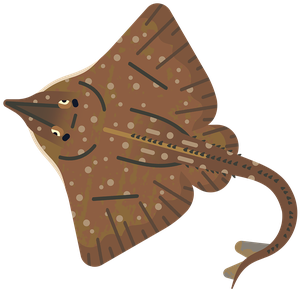
Longnosed skate
Dipturus oxyrinchus
What to check for
Location
Northeast Atlantic
Technical location
Atlantic, Northeast, Azores Grounds, Barents Sea, Bay of Biscay, Iceland and Faeroes Grounds, Irish Sea, Porcupine Bank, English Channel, Bristol Channel, Celtic Seas, West and Southwest of Ireland, North Sea, Norwegian Sea, Spitzbergen, and Bear Island, Portuguese Waters, Rockall, West of Scotland, Skagerrak, Kattegat, Transition Area, Baltic Sea
Caught by
Net (gill or fixed)
Rating summary
Longnosed skate has low resilience to fishing, there are no reference points are defined for this stock and it is severely data limited. There is no specific management plan in place and greater protection is needed. Skate species are often bycatch in other fisheries. Some longnosed skate is caught by gill nets, which can be very size selective for the target fish but can be unselective at the species level for both non-target fish and for mammals, birds and turtles.Rating last updated October 2023.
Technical consultation summary
Longnosed skate has low resilience to fishing, there are no reference points are defined for this stock and it is severely data limited. There is no specific management plan in place and greater protection is needed. Skate species are often bycatch in other fisheries. Some longnosed skate is caught by gill nets, which can be very size selective for the target fish but can be unselective at the species level for both non-target fish and for mammals, birds and turtles.
How we worked out this Rating
Longnosed skate has low resilience to fishing, there are no reference points defined for this stock and it is severely data limited.Route 2 (data limited) scoring has been applied to this rating owing to the lack of reference points for biomass and fishing pressure. Longnosed skate is considered to have low resilience to fishing.No information about longnosed skate stock status is available for this area due to a lack of reliable survey and catch data. Longnosed skate are only included in reports that cover several species of rays and skates with no detailed information about the individual species. Nothing is known about the current population trends in the Northeast Atlantic region. Therefore, there is concern for biomass.Landings data for skate species in the area are not reliable as landings are often reported as generic skates and are considered to be confounded with landings of Norwegian, flapper and blue skate. There are concerns that landings of prohibited and endangered skate species are misreported as longnosed skate because this species is not included in fishery regulations. Therefore, there is concern for fishing pressure.In 2015 IUCN reported that the population was Near Threatened with declining populations in Europe. Longnosed skate is thought to have declined by 30% from 1984 - 2014. A separate assessment in the Irish Sea identified the species as locally Vulnerable.Large specimens are sometimes retained and used for human consumption; smaller specimens are often discarded. ICES cannot quantify the corresponding catches or discard survival. The species occurs across a wide depth range and is therefore vulnerable as by-catch in almost all mixed demersal fisheries.
There is no direct management plan for skates and rays in these waters. They are usually caught as bycatch.There are a lack of reference points for the stock, which prevents the development of management plans. ICES advises that the collection of species-specific landings data should be introduced for more species of rays and skates to help inform on the status of these stocks. However, species-specific quotas may increase misreporting or discarding.Identification of skate and ray species at the point of sale is difficult as they are commercially valued for their wings and so the bodies are often discarded and the wings skinned. However, DNA analysis of skate wings on sale in the UK suggests that longnosed skate do not often reach the market.There is no direct management plan for longnosed skate in these waters. They are usually targeted and caught as bycatch in otter, tangle and gillnet and beam trawl fisheries. There are gear restrictions in place in Northern waters for vessels although it is not clear how these support skate management. Some protected areas have been designated in these waters but offshore areas are not managed.In North Sea waters, vessels larger than 15m, are only permitted to land a maximum of 25% of the catch (whole weight) as skates and rays.Skates and rays caught in the Northwest waters (ICES subareas 6 and 7) and North Sea waters (ICES subareas 2a, 3a and 4) with all fishing gears, are exempt from the landing obligation, based on their high survivability rates. Any skates and rays that are discarded are required to be released immediately and below the sea surface.There is no official minimum conservation reference size (MCRS) in place but some of the UK's Inshore Fisheries and Conservation Authorities (IFCAs) have an MCRS of 40cm disc width for skates and rays.Both the EU and UK have fishery management measures in place, which can include catch limits, targets for population sizes and fishing mortality, and controls on what fishing gear can be used and where. In the EU, compliance with regulations has been variable, and there are ongoing challenges with implementing some of them. There was a target for fishing to be at Maximum Sustainable Yield by 2020, but this was not achieved.In the UK, it is too early to tell how effective management is, as the Fisheries Act only came into force in January 2021. The Act requires the development of Fisheries Management Plans (FMPs) (replacing EU Multi-Annual Plans) but there are no details yet on how and when these will be developed. FMPs have the potential to be very important tools for managing UK fisheries, although data limitations may delay them for some stocks. MCS is keen to see FMPs for all commercially exploited stocks, especially where stocks are depleted, that include:Targets for fishing pressure and biomass, and additional management when those targets are not being metTimeframes for stock recoveryTechnologies such as Remote Electronic Monitoring (REM) to support data collection and improve transparency and accountabilityConsideration of wider environmental impacts of the fishery
Gillnets can be very size selective for the target fish but can be unselective at the species level for both non-target fish and for mammals, birds and turtles.Longnosed skate are usually targeted and caught as bycatch in otter, gillnet and beam trawl fisheries which have impacts on the wider environment and species. Data for targeted and bycatch landings and discards are limited.Gillnets and fixed nets can be very size selective, but can bycatch species such as sharks, cetaceans and other marine mammals. Reports indicate that there is concern regarding the bycatch of cetaceans, particularly harbour porpoise, by gillnets. The IUCN lists harbour porpoise as being of least concern globally, but vulnerable in Europe. They are also classified as a priority species under the UK Post-2010 Biodiversity Framework and are protected under the European Union (EU) Habitats Directive and Habitats Regulations as transposed into UK law, under which there are explicit bycatch requirements. To comply with the Habitats Directive, the UK has recently designated five Special Areas for Conservation for harbour porpoises, however, there is currently no management in place for these.One of the areas of most concern is off the South West of England, where areas of higher gillnet fishing effort coincide with areas of larger harbour porpoise populations. While cetacean bycatch has been a long-term problem around Cornwall, the occurrence of stranded cetaceans has increased over the last two decades. In 2019, 24% of stranded cetaceans exhibited features consistent with bycatch or entanglement in fishing gear, a further 19% were assessed as being possible bycatch, and 52% had an unknown cause of death. However, this stock does not cover the Western English Channel, and harbour porpoise bycatch is not considered to be a problem in the Eastern English Channel.Because of gillnets' durability (they are made of nylon), if lost, they can continue to fish for several weeks before becoming tangled and bundled up, a phenomenon known as 'ghost fishing'. However, static nets, as with all gear, represent an investment by fishermen, and therefore there are incentives to avoid losing or damaging gear. Fish caught in trammel nets are often very good quality as they are not damaged by the capture process.
References
ASCOBANS, 2009. Conservation Plan for Harbour Porpoises in the North Sea as adopted at the 6th Meeting of the Parties to ASCOBANS, Bonn, Germany. 16 - 18 September 2009. Available at https://www.ascobans.org/sites/default/files/document/ASCOBANS_NorthSeaPlan_MOP6.pdf [Accessed on 05.10.2023].British Sea Fishing. Undulate ray. Available at https://britishseafishing.co.uk/undulate-ray/ [Accessed on 04.10.2023].Calderan, S. and Leaper, R., 2019. Review of harbour porpoise bycatch in UK waters and recommendations for management. January 2019, WWF. Available at https://www.wwf.org.uk/sites/default/files/2019-04/Review_of_harbour_porpoise_in_UK_waters_2019.pdf [Accessed on 05.10.2023].Carlén, I., Nunny, L. and Simmonds, M. P. 2021. Out of Sight, Out of Mind: How Conservation Is Failing European Porpoises. Frontiers in Marine Science. Available at https://www.frontiersin.org/articles/10.3389/fmars.2021.617478/full [Accessed on 05.10.2023].Chadwick, H., Clear, N., Crosby, A., Hawtrey-Collier, A. and Williams, R. 2019 Annual Report. Marine Strandings in Cornwall and the Isles of Scilly. Available at https://www.cornwallwildlifetrust.org.uk/sites/default/files/2020-12/2019%20Summary%20Report%20-%20Marine%20Strandings%20in%20Cornwall%20and%20the%20Isles%20of%20Scilly.pdf [Accessed on 05.10.2023].Dedman, S., Officer, R. Brophy, D., Clarke, M. Reid, D. G. 2017. Towards a flexible Decision Support Tool for MSY-based Marine Protected Area design for skates and rays, ICES, 74 (2) pp. 576-587. Available at https://academic.oup.com/icesjms/article/74/2/576/2669563 [Accessed on 04.10.2023].Clean Catch UK. Joint Action To Reduce Wildlife Bycatch. Available at https://www.cleancatchuk.com/ [Accessed on 05.10.2023].Ellis, J., Abella, A., Serena, F., Stehmann, M.F.W. and Walls, R., 2015. Dipturus oxyrinchus. The IUCN Red List of Threatened Species 2015: e.T63100A48908629. Available from: https://dx.doi.org/10.2305/IUCN.UK.2015-1.RLTS.T63100A48908629.en. [Accessed on 10.10.2023].Ellis, J. R., Burt, G.J., Grilli, G., McCully Phillips, S.R., Catchpole, T.L., Maxwell, D.L. 2018. At-vessel mortality of skates (Rajidae) taken in coastal fisheries and evidence of longer-term survival. Journal of Fish Biology. 92, 1702-1719. Available at https://pubmed.ncbi.nlm.nih.gov/29675895/ [Accessed on 04.10.2023].Figueiredo, I., Maia, C. and Carvalho, L. 2020. Spatial distribution and abundance of the by-catch coastal elasmobranch Raja undulata: Managing a fishery after moratorium. Fisheries Management and Ecology, 27(5), pp 454-463. Available at https://onlinelibrary.wiley.com/doi/abs/10.1111/fme.12426 [Accessed on 04.10.2023].Froese R. and Pauly D. (Editors), 2021. Longnosed skate, Dipturus oxyrinchus - Fishbase. Available at https://www.fishbase.se/summary/Dipturus-oxyrinchus [Accessed on 10.10.2023].ICES, 2018. ICES Advice: Bycatch of small cetaceans and other marine animals - review of national reports under Council Regulation (EC) No. 812/2004 and other information. Published 11 September 2018. Available at https://www.ices.dk/sites/pub/Publication%20Reports/Advice/2018/2018/byc.eu.pdf [Accessed on 05.10.2023].ICES. 2022. Working Group on Elasmobranch Fishes(WGEF).ICES Scientific Reports. 4:74. 848pp. Available at http://doi.org/10.17895/ices.pub.21089833 [Accessed on 04.10.2023].Leeney, R. H., Amies, R., Broderick, A.C., Witt, M. J., Loveridge, J., Doyle, J. and Godley, B. J. 2008. Spatio-temporal analysis of cetacean strandings and bycatch in a UK fisheries hotspot. Biodiversity and Conservation. 17, 2323. Available at https://link.springer.com/article/10.1007/s10531-008-9377-5#citeas [Accessed on 05.10.2023].Leeney, R. H., Witt, M. J., Broderick, A. C., Buchanan, J., Jarvis, D. S., Richardson, P. B. and Godley, B. J. 2011. Marine megavertebrates of Cornwall and the Isles of Scilly: relative abundance and distribution. Journal of the Marine Biological Association of the United Kingdom, 92(8), 1823-1833. Available at https://www.cambridge.org/core/journals/journal-of-the-marine-biological-association-of-the-united-kingdom/article/marine-megavertebrates-of-cornwall-and-the-isles-of-scilly-relative-abundance-and-distribution/7981AA197C2320B6A9E2C01BD7A1F7B7 [Accessed on 05.10.2023].Moan, A., Skern-Mauritzen, M., Vølstad, J. H., Bjørge, A. 2020. Assessing the impact of fisheries-related mortality of harbour porpoise (Phocoena phocoena) caused by incidental bycatch in the dynamic Norwegian gillnet fisheries, ICES Journal of Marine Science, Volume 77, Issue 7-8, Pages 3039–3049. Available at https://doi.org/10.1093/icesjms/fsaa186 [Accessed on 05.10.2023].North Atlantic Marine Mammal Commission and the Norwegian Institute of Marine Research. 2019. Report of Joint IMR/NAMMCO International Workshop on the Status of Harbour Porpoises in the North Atlantic. Tromsø, Norway. Available at https://www.ascobans.org/sites/default/files/document/ascobans_ac25_inf.4.3a_joint-imr-nammco-ws-harbour-porpoise.pdf [Accessed on 05.10.2023].Omeyer, L. C. M., Doherty, P. D., Dolman, S., Enever, R., Reese, A., Tregenza, N., Williams, R. and Godley, B. J. 2020. Assessing the Effects of Banana Pingers as a Bycatch Mitigation Device for Harbour Porpoises (Phocoena phocoena). Frontiers in Marine Science. Available at https://www.frontiersin.org/articles/10.3389/fmars.2020.00285/full [Accessed on 05.10.2023].OSPAR, 2017. Intermediate Assessment 2017: Harbour Porpoise Bycatch. Available at https://oap.ospar.org/en/ospar-assessments/intermediate-assessment-2017/biodiversity-status/marine-mammals/harbour-porpoise-bycatch/ [Accessed on 05.10.2023].Peverley. M., Stewart, J.E., 2021. Fisheries Research & Management Plan: Skates & Rays in the North of Devon and Severn IFCA’s District. Devon and Severn Inshore Fisheries and Conservation Authority & North Devon Biosphere.. Available from: https://www.devonandsevernifca.gov.uk/Environment-and-Research/Fisheries-Research-Management-Plans/FRMP-Documents [Accessed on 10.10.2023].Shark Trust. 2023. Fisheries Advisories. Available at https://www.sharktrust.org/pages/category/fisheries-advisories [Accessed on 04.10.2023].Silva, F., Ellis, J. & Catchpole, T., 2012. Species composition of skates (Rajidae) in commercial fisheries around the British Isles and their discarding patterns. J Fish Biol., 80:1678–1703. Available at https://www.nwwac.org/_fileupload/Papers%20and%20Presentations/2016/06%20FG%20Skates%20and%20Rays/Silva,%20Ellis%20&%20Catchpole_2012_Skate%20catches.pdf [Accessed on 04.10.2023].Sguotti, C., Lynam, C. P., Garcia-Carreras, B., Ellis, J. R. and Engelhard, G. H. 2016. Distribution of skates and sharks in the North Sea: 112 years of change. Glob Change Biol, 22: 2729-2743. doi:10.1111/gcb.13316. Available at https://onlinelibrary.wiley.com/doi/full/10.1111/gcb.13316 [Accessed 04.10.2023].UK Government. 2023. Category A (10 metre and under) Licence: Schedule (91) Non Sector. Available at https://assets.publishing.service.gov.uk/government/uploads/system/uploads/attachment_data/file/1181749/Cat_A_Licence_Schedule_91_V6_01_August_2023__1_.pdf [Accessed on 04.10.2023].

Sustainable swaps
Learn more about how we calculate our sustainability ratings.
How our ratings work