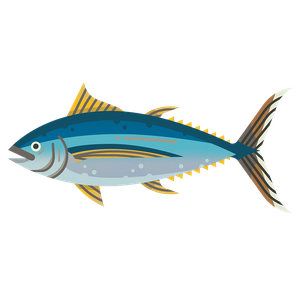
Mackerel
Scomber scombrus
What to check for
Location
Northeast Atlantic and adjacent waters
Technical location
Atlantic, Northeast, Barents Sea, Bay of Biscay, East Greenland, Iceland and Faeroes Grounds, Irish Sea, Porcupine Bank, English Channel, Bristol Channel, Celtic Seas, West and Southwest of Ireland, North Sea, Norwegian Sea, Spitzbergen, and Bear Island, Portuguese Waters (East), Rockall, West of Scotland, Skagerrak, Kattegat, Transition Area, Baltic Sea
Caught by
Hook & line (handline)
Rating summary
Northeast Atlantic mackerel are below safe biological levels and there is no recovery plan in place to help the population recover. Therefore, it receives a critical fail for stock status and is a default red rating.Rating last updated November 2025.
Technical consultation summary
The Northeast Atlantic mackerel stock has been declining since 2015, but is not yet in an overfished state. Spawning-stock biomass in 2025 was 2,740,823 tonnes this was 10% below Blim (3,067,017 tonnes).The stock is therefore in a very overfished state, and suffering reduced reproductive capacity. Therefore, it receives a critical fail for stock status and is a default red rating. Fishing pressure (F) was below the level associated with Maximum Sustainable Yield (FMSY, 0.26) between 2011 and 2020, but has since increased. In 2024 was 0.27, which is 41% above FMSY. Therefore, fishing mortality is above target levels and the stock is not being harvested sustainably. For the Northeast Atlantic fishery in general, management is inadequate. However, in southwest England, there are a number of controls on fishing. The handline fishery has a ring-fenced quota that is a very small proportion (0.15%) of total catches. Juvenile mackerel are protected within an area known as the Mackerel Box, where there are important nursery grounds. In this area, targeted fishing for mackerel by trawlers with net mesh sizes of less than 80mm, or any purse seiners, is prohibited. A 2002 review of the Mackerel Box by ICES concluded that it is an important tool in protecting juvenile mackerel. Handlining is a low impact method, as there are no habitat impacts and bycatch can be released alive.
How we worked out this Rating
Northeast Atlantic mackerel are below safe biological levels and there is no precautionary recovery plan in place. Therefore, it receives a critical fail for stock status and is a default red rating. Stock assessments are carried out annually by the International Council for the Exploration of the Sea (ICES). The most recent assessment was published in 2025 using data up to the same year. The next assessment is expected in 2026.The stock assessment defines reference points for fishing pressure (F) and biomass (B). For fishing pressure, there is a target to keep F at or below Maximum Sustainable Yield (MSY). For biomass, there is no target. However, there is a trigger point (MSY BTrigger). Below this level, F should be reduced to allow the stock to increase. Because BMSY is not defined, the Good Fish Guide applies its own definition of 1.4 x MSY BTrigger.A benchmark assessment was held in 2025 and reference point values for the mackerel stock were adjusted.Mackerel has been fished for centuries in the northeast Atlantic. Catches averaged 680,000 tonnes in the 1980s and 1990s, although they are thought to be under-reported during this time. Catches peaked at 1.4 million tonnes in 2014, and the recent average is around 1 million tonnes.Spawning-stock biomass (SSB) was close to its lowest safe biological limits (Blim: 2 million tonnes) during the late 1990s and early 2000s, the population was recovering until 2015 when the populations began to decline. This decline has continued and the estimated 2025 SSB (2,740,823 tonnes) was 10% below Blim (3,067,017 tonnes).The stock is therefore in a very overfished state, and suffering reduced reproductive capacity. Fishing pressure (F) exceeded upper limits during the early 2000s and then declined. It was below the level associated with Maximum Sustainable Yield (FMSY, 0.191) between 2011 and 2020, but has since increased. The estimated total catch in 2024 was 897,701 tonnes. F in 2024 was 0.27, which is 41% above FMSY. Therefore, fishing mortality is above target levels and the stock is not being harvested sustainably.ICES advises that when the MSY approach is applied, catches in 2026 should be no more than 174,347 tonnes. This is a 70% decrease on the previous year's advice due to the decline in stock size, this advised reduction of fishing pressure is to achieve a 50% probability of SSB being above Blim in 2027 and the change in the perception of the stock after the benchmark.Catch data for 2021 and 2022 for the Russian Federation was estimated, but there is confidence in the estimates.Catch and survey data from recent years indicate that the stock has expanded north-westwards during spawning and the summer feeding migration. The change may be linked to changes in food availability, increased water temperature, and / or increased stock size.
References
EU, 2021. Regulation (EU) 2019/1241 of the European Parliament and of the Council of 20 June 2019 on the conservation of fisheries resources and the protection of marine ecosystems through technical measures (Amended 15.07.2021). Available at https://eur-lex.europa.eu/legal-content/EN/TXT/?uri=CELEX%3A02019R1241-20210716 [Accessed on 24.11.2025].ICES, 2002. ICES Cooperative Research Report No. 255: Report of the ICES Advisory Committee on Fishery Management, 2002. Copenhagen. 21-30 May and 9-17 October 2002. Available at https://www.ices.dk/sites/pub/Publication%20Reports/Cooperative%20Research%20Report%20(CRR)/CRR255_2.pdf [Accessed on 24.11.2025].ICES, 2025. Mackerel (Scomber scombrus) in subareas 1-8 and 14 and Division 9.a (the Northeast Atlantic and adjacent waters). In Report of the ICES Advisory Committee, 2025. ICES Advice 2025, mac.27.nea. Available at: https://doi.org/10.17895/ices.advice.27202689 [Accessed on 24.11.2025].ICES, 2025. Working Group on Widely Distributed Stocks (WGWIDE). ICES Scientific Reports. 07:96. 921 pp. Available at: https://doi.org/10.17895/ices.pub.30233824 [Accessed on 24.11.2025].ICES, 2025. Benchmark workshop on Mackerel and Norwegian spring-spawning herring (WKBMACNSSH). ICES Scientific Reports. 7:64. 509pp. Available at: https://doi.org/10.17895/ices.pub.29279615 [Accessed on 24.11.2025].ICES, 2021. NEAFC request on discarding of mackerel in the NEAFC Regulatory Area. In Report of the ICES Advisory Committee, 2021. ICES Advice 2021, sr.2021.13. Available at https://doi.org/10.17895/ices.advice.8393 [Accessed on 18.12.2024].Seafish, 2025. Fishing Gear Database: Hand lines. Available at https://www.seafish.org/responsible-sourcing/fishing-gear-database/gear/hand-lines/ [Accessed on 24.11.2025] .SWHFA, 2022. About Mackerel. Available at https://www.linecaught.org.uk/about/about-mackerel/ [Accessed on 25.10.2022].UK Government, 2025. Fishing quota allocations for 2025 for England and the UK. Last updated 5 August 2025 . Available at https://www.gov.uk/government/statistical-data-sets/fishing-quota-allocations-for-england-and-the-uk [Accessed on 24.11.2025]
Sustainable swaps
Learn more about how we calculate our sustainability ratings.
How our ratings work