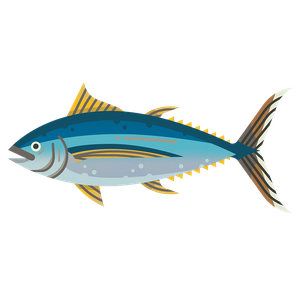
Mackerel
Scomber scombrus
What to check for
Location
Northeast Atlantic and adjacent waters
Technical location
Atlantic, Northeast, Barents Sea, Bay of Biscay, East Greenland, Iceland and Faeroes Grounds, Irish Sea, Porcupine Bank, English Channel, Bristol Channel, Celtic Seas, West and Southwest of Ireland, North Sea, Norwegian Sea, Spitzbergen, and Bear Island, Portuguese Waters (East), Rockall, West of Scotland, Skagerrak, Kattegat, Transition Area, Baltic Sea
Caught by
Net (pelagic trawl), Net (purse seine or ring)
Rating summary
Northeast Atlantic mackerel are below safe biological levels and there is no recovery plan in place to help the population recover. Therefore, it receives a critical fail for stock status and is a default red rating.Rating last updated November 2025.
Technical consultation summary
The Northeast Atlantic mackerel stock has been declining since 2015, but is not yet in an overfished state. Spawning-stock biomass in 2025 was 2,740,823 tonnes this was 10% below Blim (3,067,017 tonnes).The stock is therefore in a very overfished state, and suffering reduced reproductive capacity. Therefore, it receives a critical fail for stock status and is a default red rating. Fishing pressure (F) was below the level associated with Maximum Sustainable Yield (FMSY, 0.26) between 2011 and 2020, but has since increased. In 2024 was 0.27, which is 41% above FMSY. Therefore, fishing mortality is above target levels and the stock is not being harvested sustainably. Some management measures are in place for Northeast Atlantic mackerel. However, enforcement is poor. This stock is fished by numerous countries and there is no joint management plan that covers the whole fishery to prevent overfishing. The combined catch limits (Total Allowable Catches, TACs) set by all parties have exceeded the scientifically recommended limits by between 5% and 80% since 2009. Between 2021 and 2025, TACs)were, on average, 42% higher than scientific advice. Although actual catches have typically fallen below these TACs, they still exceeded recommended levels by an average of 25% (204,939 tonnes). While there is agreement that catches should match scientific advice, there is no agreement on how to share quotas between the countries. All parties must work together to develop an appropriate harvest strategy. Most mackerel (around 71%) is caught by pelagic trawling, with purse seining making up most of the rest at around 28%. These are relatively low-impact fishing methods, with little bycatch and no habitat impacts.
How we worked out this Rating
Northeast Atlantic mackerel are below safe biological levels and there is no precautionary recovery plan in place. Therefore, it receives a critical fail for stock status and is a default red rating. Stock assessments are carried out annually by the International Council for the Exploration of the Sea (ICES). The most recent assessment was published in 2025 using data up to the same year. The next assessment is expected in 2026.The stock assessment defines reference points for fishing pressure (F) and biomass (B). For fishing pressure, there is a target to keep F at or below Maximum Sustainable Yield (MSY). For biomass, there is no target. However, there is a trigger point (MSY BTrigger). Below this level, F should be reduced to allow the stock to increase. Because BMSY is not defined, the Good Fish Guide applies its own definition of 1.4 x MSY BTrigger.A benchmark assessment was held in 2025 and reference point values for the mackerel stock were adjusted.Mackerel has been fished for centuries in the northeast Atlantic. Catches averaged 680,000 tonnes in the 1980s and 1990s, although they are thought to be under-reported during this time. Catches peaked at 1.4 million tonnes in 2014, and the recent average is around 1 million tonnes.Spawning-stock biomass (SSB) was close to its lowest safe biological limits (Blim: 2 million tonnes) during the late 1990s and early 2000s, the population was recovering until 2015 when the populations began to decline. This decline has continued and the estimated 2025 SSB (2,740,823 tonnes) was 10% below Blim (3,067,017 tonnes).The stock is therefore in a very overfished state, and suffering reduced reproductive capacity. Fishing pressure (F) exceeded upper limits during the early 2000s and then declined. It was below the level associated with Maximum Sustainable Yield (FMSY, 0.191) between 2011 and 2020, but has since increased. The estimated total catch in 2024 was 897,701 tonnes. F in 2024 was 0.27, which is 41% above FMSY. Therefore, fishing mortality is above target levels and the stock is not being harvested sustainably.ICES advises that when the MSY approach is applied, catches in 2026 should be no more than 174,347 tonnes. This is a 70% decrease on the previous year's advice due to the decline in stock size, this advised reduction of fishing pressure is to achieve a 50% probability of SSB being above Blim in 2027 and the change in the perception of the stock after the benchmark.Catch data for 2021 and 2022 for the Russian Federation was estimated, but there is confidence in the estimates.Catch and survey data from recent years indicate that the stock has expanded north-westwards during spawning and the summer feeding migration. The change may be linked to changes in food availability, increased water temperature, and / or increased stock size.
References
Anon., 2021. Agreed record of conclusions of fisheries consultations between the Faroe Islands, the European Union, Greenland, Iceland, Norway and the United Kingdom on the management of mackerel in the North-East Atlantic for 2022. Available at https://scottishpelagic.co.uk/wp-content/uploads/2021/11/Mackerel-Agreed-Record-27-Oct-2021.pdf [Accessed on 24.11.2025].ASCOBANS, 2022. Report of the ASCOBANS Resource Depletion Working Group (August 2022). ASCOBANS/AC27/Doc.2.2. 27th Meeting of the Advisory Committee, Online, 28-30 September 2022. Available at https://www.ascobans.org/sites/default/files/document/ascobans_ac27_doc2.2_report-resource-depletion-wg.pdf [Accessed on 24.11.2025].Bonizzoni, S., Hamilton, S., Reeves, R.R.Genov, T. and Bearzi, G., 2022. Odontocete cetaceans foraging behind trawlers, worldwide. Rev Fish Biol Fisheries 32. pp. 827–877. https://doi.org/10.1007/s11160-022-09712-z.ICES, 2021. NEAFC request on discarding of mackerel in the NEAFC Regulatory Area. In Report of the ICES Advisory Committee, 2021. ICES Advice 2021, sr.2021.13. Available at https://doi.org/10.17895/ices.advice.8393 [Accessed on 24.11.2025].ICES, 2025. Mackerel (Scomber scombrus) in subareas 1-8 and 14 and Division 9.a (the Northeast Atlantic and adjacent waters). In Report of the ICES Advisory Committee, 2025. ICES Advice 2025, mac.27.nea. Available at: https://doi.org/10.17895/ices.advice.27202689 [Accessed on 24.11.2025].ICES, 2025. Working Group on Widely Distributed Stocks (WGWIDE). ICES Scientific Reports. 07:96. 921 pp. Available at: https://doi.org/10.17895/ices.pub.30233824 [Accessed on 24.11.2025].ICES, 2025. Benchmark workshop on Mackerel and Norwegian spring-spawning herring (WKBMACNSSH). ICES Scientific Reports. 7:64. 509pp. Available at: https://doi.org/10.17895/ices.pub.29279615 [Accessed on 24.11.2025].Jansen, T, Nielsen, E, Rodriguez-Ezpeleta, N, Arrizabalaga, H, Post, S. and MacKenzie, B., 2020. Atlantic bluefin tuna (Thunnus thynnus) in Greenland — mixed-stock origin, diet, hydrographic conditions, and repeated catches in this new fringe area. Canadian Journal of Fisheries and Aquatic Sciences 78:4. pp. 400-408. https://doi.org/10.1139/cjfas-2020-0156.NEAFC, 2024. Recommendation 04 2024: Recommendation on Conservation and Management Measures for Mackerel in the NEAFC Regulatory Area for 2024. Available at https://faolex.fao.org/docs/pdf/mul224124.pdf [Accessed on 24.11.2025].Skern-Mauritzen, M., Lindstrøm, U., Biuw, M., Elvarsson, B., Gunnlaugsson, T., Haug, T., Kovacs, K., Lydersen, C., McBride, M., Mikkelsen, B., Øien, N., and Víkingsson, G., 2022. Marine mammal consumption and fisheries removals in the Nordic and Barents Seas, ICES Journal of Marine Science. 79:5, pp. 1583–1603. https://doi.org/10.1093/icesjms/fsac096.Zollett, E., 2005. A Review of Cetacean Bycatch in Trawl Fisheries. Prepared for the Northeast Fisheries Science Center, September 2005. Available at https://apps-nefsc.fisheries.noaa.gov/rcb/publications/reports/EN133F04SE1048.pdf [Accessed on 24.11.2025].
Sustainable swaps
Learn more about how we calculate our sustainability ratings.
How our ratings work