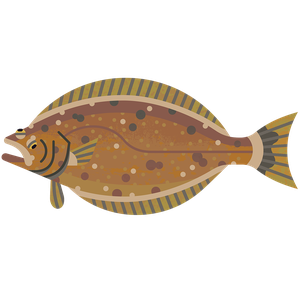
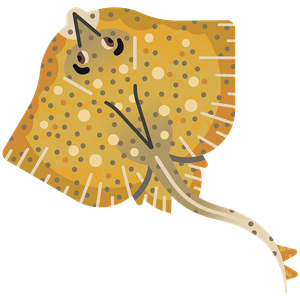
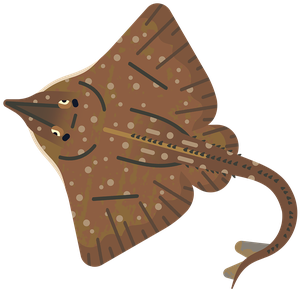
Megrim
Lepidorhombus whiffiagonis, Lepidorhombus boscii
What to check for
Location
Celtic Sea, west and southwest of Ireland, Bay of Biscay
Technical location
Atlantic, Northeast, Bay of Biscay (Central), Bay of Biscay (North), Bay of Biscay (Offshore), Bristol Channel, Celtic Sea (North), Celtic Sea (South), English Channel (East), English Channel (West), Porcupine Bank, Southwest of Ireland (East), Southwest of Ireland (West), West of Ireland
Caught by
Bottom trawl (otter)
Rating summary
Megrim in the Celtic Sea, West of Ireland, and Bay of Biscay is in a healthy state and fishing pressure is within sustainable limits. Two species of megrim are landed, with Lepidorhombus whiffiagonis being more common. There are management measures in place, but, catch limits apply to both species of megrim which hinders the ability to prevent overexploitation of either species. Total catches have been equal to or below the advice. Otter trawling is likely to cause some damage to the seabed. Bycatch is moderate and may include vulnerable species.Rating last updated July 2022.
How we worked out this Rating
The stock is in a healthy state and fishing pressure is within sustainable limits.
The spawning-stock biomass (SSB) has been increasing above MSY Btrigger (40,444 tonnes) since 2017 and continues to increase. SSB is now at its highest point in the time series (1984-2022) at 99,557 tonnes in 2022.Fishing mortality (F) has decreased in recent years and in 2021 it was 0.179, below Maximum Sustainable Yield (FMSY) (0.233).ICES advises that when the MSY approach is applied, catches in 2023 should be no more than 24,176 tonnes. This is higher than the advice for 2022 due to a re-estimation of FMSY.Two species of megrim are landed to the West of Britain and in the Bay of Biscay, megrim (Lepidorhombus whiffiagonis) and four-spot megrim (L. boscii). The former is more common and the only one assessed.
There are management measures in place, but, catch limits apply to both species of megrim which hinders the ability to prevent overexploitation of either species. Total catches have been equal to or below the advice.The EU multiannual plan (MAP) for stocks in in the Western Waters and adjacent waters applies to this stock. The plan specifies conditions for setting fishing opportunities depending on stock status and making use of the FMSY range for the stock. ICES considers the FMSY range for this stock used in the MAP as precautionary. According to the MAP, for data-limited species such as four-spot megrim (L. boscii), fishing opportunities should be based on the best available scientific advice, but no ICES assessment has been requested and therefore there is no advice for this species.Megrim species (Lepidorhombus spp.) are not totally separated within landings data, although, species-specific landings are estimated by ICES. Total Allowable Catch (TAC) limits apply to megrim species combined. Stock structure and even species identification/differentiation in landings is problematic for megrim. ICES considers that management of catches of the two megrim species, L. whiffiagonis and L. boscii, under a combined species TAC prevents effective control of the single-species exploitation rates, and could lead to overexploitation of either species. Currently L. whiffiagonis is in a healthy state and, as of 2019, is not being overfished, but, L. boscii is data deficient and the state of the stock is unknown.The TAC covers the stock area, but also includes Divisions 7a and 8e which are not part of the assessment area. In 2020 and 2021, the advice was given as a range and the TAC was set within that range. In 2022, the TAC has been set below advice. Landings have been significantly below advice in recent years.Beyond TACs, the fishery is managed by a Minimum Conservation Reference Size (MCRS) of 20 cm (25 cm in Skagerrak/Kattegat) for megrim, which was lowered from 25cm in 2000. Males reach the first maturity at a lower length and age than females. For both sexes combined, fifty percent of the individuals mature at about 20 cm and about 2.5-years. Although, dependant on distribution, length at first maturity can range between 19 and 28 cm, and consequently, megrim may be being caught before they have had chance to reproduce.Megrim is both a targeted and valuable bycatch species, in the mixed demersal trawl fishery in Divisions 7b-k, 8a-b and 8d. The reduction in fishing effort and fishing mortality on Megrim since the early 2000s may have contributed to the increase in biomass. A workplan began in 2019 under the Irish White Fish FIP, to improve the demersal trawl and seine fishery, for whitefish within division 7. The FIP objectives are to improve data for management decisions and to co-ordinate progress efforts towards MSY in whitefish fisheries.For more information about this fishery in Cornwall, see: https://www.cornwallgoodseafoodguide.org.uk/fish-guide/cornish-sole-megrim.phpBoth the EU and UK have fishery management measures in place, which can include catch limits, targets for population sizes and fishing mortality, and controls on what fishing gear can be used and where. In the EU, compliance with regulations has been variable, and there are ongoing challenges with implementing some of them. There was a target for fishing to be at Maximum Sustainable Yield by 2020, but this was not achieved. The Landing Obligation (LO), an EU law that the UK has kept after Brexit, requires all quota fish to be landed, even if they are unwanted (over-quota or below minimum size). It aims to promote more selective fishing methods, reduce bycatch, and improve recording of everything that is caught, not just what is wanted. Compliance with the LO is generally poor and actual levels of discards are difficult to quantify using the current fisheries observer programme. UK administrations are in the process of replacing the landing obligation with country-specific Catching Policies.In the UK, it is too early to tell how effective management is, as the Fisheries Act only came into force in January 2021. The Act requires the development of Fisheries Management Plans (FMPs) (replacing EU Multi-Annual Plans). FMPs are currently in development, but the scope of them remains unclear. They have the potential to be very important tools for managing UK fisheries, although data limitations may delay them for some stocks. MCS is keen to see publicly available FMPs for all commercially exploited stocks, especially where stocks are depleted, that include:Targets for fishing pressure and biomass, and additional management when those targets are not being met, based on the best available scientific evidenceTimeframes for stock recoveryImproved data collection, transparency and accountability, supported by technologies such as Remote Electronic Monitoring (REM)Consideration of wider environmental impacts of the fishery
Otter trawling is likely to cause some damage to the seabed. Bycatch is moderate and may include vulnerable species.Megrim is caught by demersal otter trawls in the Celtic Sea, West and southwest of Ireland, and Bay of Biscay as bycatch in the mixed demersal trawl fishery, and in association with anglerfish (monkfish) by some fleets.Megrim are predominately taken by trawls (beam and otter trawls), which accounted for 98% of catch in 2018.Otter trawlers account for the majority of Spanish landings from ICES area 7. Most UK landings of megrim are made by beam trawlers fishing in the southwest of England and Wales. Irish megrim landings are largely made by multi-purpose vessels fishing in to the west and south of Ireland for gadoids such as cod and haddock, as well as plaice, sole and anglerfish.Demersal otter trawls have the potential to take relatively high quantities of bycatch. In the Northeast Atlantic there are reported catches of demersal elasmobranchs and endangered, threatened and protected (ETP) species (e.g. sharks, rays and marine mammals). Bycatch data is limited in many UK and EU fisheries as they are generally not well monitored.Demersal trawls have contact with the seabed resulting in penetration and abrasion of habitat features. The impact of trawling on the seabed depends on the location and scale in which trawling occurs. For example, areas that are used to natural disturbance through tides and waves, are less sensitive to habitat impacts. Areas not used to mobile towed gears are typically more sensitive to trawling. Trawl gears are known to have some of the greatest impacts on Vulnerable Marine Ecosystems (VMEs).An estimated 45% of the Celtic Sea region was trawled in 2018. Fishing effort in the area has been decreasing since the early 2000s. This has reduced the spatial fishing footprint and the average number of times the seabed is trawled per year. Most habitats are mud and sand, which are less vulnerable to trawling. However, in the Celtic Seas, 95% of areas where VMEs such as cold-water corals and sponges occur or are likely were found to have been fished between 2009 and 2011.Mitigation measures include a ban on bottom trawling below 800m, and restrictions from 400-600m – the areas where most VMEs are found. There remains some uncertainty about the location of some sensitive seabed habitats, so these remain at risk.There are Marine Protected Areas (MPAs) in this area, some of which are designated to protect seabed features from damaging activities. This fishery overlaps with parts of these MPAs, but the proportion of the catch coming from these areas is expected to be relatively low in relation to the unit of assessment (i.e. less than 20% of the catch or effort), and so these impacts have not been assessed within the scale of this rating. Given the important role that MPAs have in recovering the health and function of our seas, MCS encourages the supply chain to identify if their specific sources are being caught from within MPAs. If sources are suspected of coming from within designated and managed MPAs, MCS advises businesses to establish if the fishing activity is operating legally inside a designated and managed MPA, and request evidence from the fishery or managing authority to demonstrate that the activity is not damaging to protected features or a threat to the conservation objectives of the site(s).To improve monitoring and reporting of fishing activity, MCS would like to see remote electronic monitoring (REM) with cameras implemented, used and enforced. To reduce the impacts of fishing on the marine environment we would like to see a just transition to the complete removal of bottom towed gear from offshore Marine Protected Areas designated to protect the seabed. We also want to see reduction and mitigation of environmental impacts including emissions and blue carbon habitat damage.
References
Abad, E., Pennino, M., Valeiras, J., Vilela, R., Bellido, J., Punzon, A. and Velasco, F. 2020. Integrating spatial management measures into fisheries: TheLepidorhombus spp. case study. Marine Policy, 116 (103739), Available at https://www.sciencedirect.com/science/article/pii/S0308597X18308509?via%3Dihub [Accessed 20.07.2022].Cook, R., Gaudian, G., des Clers, S. and Seip- Markensteijn, C.M., 2022. Marine Stewardship Council (MSC) Public Certification Report: Scottish Fisheries Sustainable Accreditation Group (SFSAG) Northern Demersal Stocks. Prepared by Control Union (UK) Limited on behalf of Scottish Fisheries Sustainable Accreditation Group (SFSAG). May 2022. Available at https://cert.msc.org/FileLoader/FileLinkDownload.asmx/GetFile?encryptedKey=BdxOJoY7Sf4DmNJEB/m47M6xx0rRfgP/niGx3vj5Ud8hadYI3XCNrnlSFL/jlTgK [Accessed on 13.07.2022].Eigaard, O.R., Bastardie, F., Breen, M., Dinesen, G.E., Hintzen, N.T., Laffargue, P., Mortensen, L.O., Nielsen, J.R., Nilsson, H.C., O'Neill, F.G., Polet, H., Reid, D.G., Sala, A., SkOld, M., Smith, C., Sorensen, T.K., Tully, O., Zengin, M., Rijnsdorp, A.D., 2016. Estimating seabed pressure from demersal trawls, seines, and dredges based on gear design and dimensions. ICES Journal of Marine Science, Volume 73, Issue suppl 1. Pages i27-i43. Available at https://academic.oup.com/icesjms/article/73/suppl_1/i27/2573989 [Accessed on 12.07.2022].Hiddink, J., Jennings, S., Sciberras, M., Szostek, C.L., Hughes, K.M., Ellis, N., Rijnsdorp, A.D., McConnaughey, R.A., Mazor, T., Hilborn, R., Collie, J.S., Pitcher, C.R., Amoroso, R.O., Parma, A.M., Suuronen, P. and Kaiser, M.J. 2017. Global analysis of depletion and recovery of seabed biota after bottom trawling disturbance. PNAS. 114:31, pp. 8301-8306. https://doi.org/10.1073/pnas.1618858114.ICES. 2022. Megrim (Lepidorhombus whiffiagonis) in divisions 7.b–k, 8.a–b, and 8.d (west and southwest of Ireland, Bay of Biscay). In Report of the ICES Advisory Committee, 2022. ICES Advice 2022, meg.27.7b– k8abd. Available at https://doi.org/10.17895/ices.advice.19448057 [Accessed on 22.07.2022].ICES. 2022. Working Group for the Bay of Biscay and the Iberian Waters Ecoregion (WGBIE). ICES Scientific Reports. 4:52. Available at http://doi.org/10.17895/ices.pub.20068988 [Accessed on 22.07.2022].ICES. 2018. Report of the Working Group for the Bay of Biscay and the Iberian Waters Ecoregion (WGBIE), 3–10 May 2018, ICES HQ, Copenhagen, Denmark. ICES CM 2018/ACOM:12. 569 pp. Available at https://doi.org/10.17895/ices.pub.5343 [Accessed on 22.07.2022].Kennelly, S. J. & Broadhurst, M. K., 2021. A review of bycatch reduction in demersal fish trawls. Rev Fish Biol Fisheries 31, 289–318. https://doi.org/10.1007/s11160-021-09644-0.Kynoch, R., Fryer, R. & Neat, F., 2015. A simple technical measure to reduce bycatch and discard of skates and sharks in mixed-species bottom-trawl fisheries. ICES J Mar Sci,72(6):1861.Macdonald, P. 2014. Increasing understanding of a data poor species to improve resource management: megrim (lepidorhumbus whiffiagonis) in the Northern North Sea, University of Aberdeen, UK, pp.11-198. Available at https://www.nafc.uhi.ac.uk/t4-media/one-web/nafc/research/document/report-2014-paul-macdonald-megrim-thesis.pdf [Accessed 20.07.2022].MMO. 2019. Fishing Gear requirements and Landing Obligation exemptions 2019 Applicable to Demersal Towed Gears Fishing in the Celtic Sea (Excluding Nephrops Vessels and Beam Trawlers). Available at https://assets.publishing.service.gov.uk/government/uploads/system/uploads/attachment_data/file/824987/Gear_use_-_Celtic_Sea_-_General_Dem_and_Pel_Tow__v2_final_draft.pdf[Accessed 16.07.2020].Rainer, F. and Luna, S. 2020. Megrim, Lepidorhumbus whiffiagonis. Available at https://www.fishbase.se/summary/Lepidorhombus-whiffiagonis.html [Accessed 20.07.2022.].Silva, F., Ellis, J. & Catchpole, T., 2012. Species composition of skates (Rajidae) in commercial fisheries around the British Isles and their discarding patterns. J Fish Biol., 80:1678–1703.van Denderen, P. Bolam, S., Hiddink, J.G., Jennings, S., Kenny, A., Rijnsdorp, A., and van Kooten, T., 2015. Similar effects of bottom trawling and natural disturbance on composition and function of benthic communities across habitats. Mar Ecol Prog Ser. 2015;541:31–43.

Sustainable swaps
Learn more about how we calculate our sustainability ratings.
How our ratings work