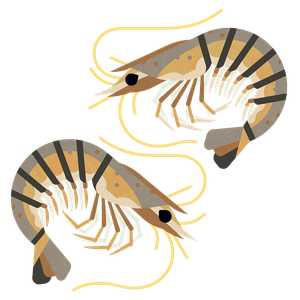
Northern prawn
Pandalus borealis
What to check for
Location
Northeast Arctic (Barents Sea)
Technical location
Atlantic, Northeast, Barents Sea, Norwegian Sea, Spitzbergen, and Bear Island
Caught by
Bottom trawl (otter)
Certification
Marine Stewardship Council (MSC)
Rating summary
The population (or stock) is in a good state and fishing pressure is within sustainable limits. There is no precautionary management plan in place for this fishery, but the stock has been buoyant and harvested sustainably since the fishery began. The majority of this fishery is certified by the Marine Stewardship Council (MSC). Otter trawlers interact with the seabed and can modify bottom topography, and cause damage to, or removal of, vulnerable marine habitats and benthic communities.Rating last updated June 2023.
Technical consultation summary
The population (or stock) is in a good state (B:BMSY 1.71) and fishing pressure (F:FMSY 0.18) is within sustainable limits. There is no precautionary management plan in place for this fishery, but the stock has been buoyant and harvested sustainably since the fishery began. The majority of this fishery is certified as responsibly managed fisheries by the Marine Stewardship Council (MSC). The fishery is also managed through a series of regulations including effort limitations and technical conservation measures. Otter trawlers interact with the seabed and can modify bottom topography, and cause damage to, or removal of, vulnerable marine habitats and benthic communities.
How we worked out this Rating
The population (or stock) is in a good state and fishing pressure is within sustainable limits. Stock biomass has been buoyant and harvested sustainably since the fishery began in 1970.The stock is assessed as having full reproductive capacity and throughout the history of the fishery (1970-2021) estimates of stock biomass (B/BMSY) have remained above maximum sustainable yield trigger point (MSY Btrigger - below this level, F should be reduced to allow the stock to increase) and fishing mortality (F) has been very low, well below FMSY.The most recent ICES stock assessment (winter 2021) displays a decline in fishing mortality and increase in stock biomass from 2019. In 2021, the ratio of B:BMSY was 1.71.ICES advises that when the MSY approach is applied, catches should be no more than 140,000 tonnes (2021-22). The forecast indicates that the advised catch is sustainable, however, it is above historical landings. Since 2006 the total catch in the fishery has been significantly below catch advice recommended by ICES, except 2019. Total catch in 2021 was estimated to be 57,000 tonnes, the ratio of F:FMSY was 0.18.A further assessment of the stock was conducted in 2022, by IMR-PINRO, which determined no change in the overall status of the stock in recent years.As the fishery in the Barents Sea developed, catches peaked at 128,000 tonnes in 1984, in more recent years catch has ranged 56,000-76,000 tonnes. Declines in landings have been previously linked to reductions in fishing effort caused by increased vessel operating costs, primarily high fuel prices and low market prices, and consequent low profitability of the fishery.
There is no precautionary management plan in place for this fishery, but the stock has been buoyant and harvested sustainably since the fishery began. Most of this fishery is Marine Stewardship Council (MSC) certifed.No Total Allowable Catch (TAC) has been established for the stock overall, however Russia set an annual TAC for the Russian portion of northern prawn fishery in the Barents Sea. In 2019, 28,000 tonnes (TAC), ~30% above the 11,700 tonnes caught the year previous and >3 times the catch of the year prior. Of Russia’s 2019 TAC, 11,500 tonnes were allocated to Norway, the Faroe Islands (4,000t, 2021) and Greenland (500t, 2021) under intergovernmental agreements. ICES recommends that an overall TAC is implemented to improve management of the fishery. ICES advised catch is rarely exceeded (one occurrence: ~11% in 2019) and catches remain well below advice.The fishery is also managed through a series of regulations including effort limitations and technical conservation measures (minimum landing size, mesh size and sorting grid regulations, closed areas, move-on rules). Vessel fishing activity is monitored rigorously through recording of fishing position by VMS and log book data (some electronic (ERS)) and they are subject to inspections at sea.Norwegian and Russian vessels exploit the northern prawn stock across the entire region; Barents Sea and Svalbard Fishery Protection Zone (FPZ). Other non-Norwegian and non-Russian vessels from Estonian, Danish, Lithuanian, and UK are not permitted to fish in Norwegian and Russian EEZs and so are restricted to fishing within the Svalbard FPZ and in an area of international waters managed by NEAFC to the south east of Svalbard known as the ‘Loop Hole’. Management regulations differ across various fishing zones and vessels require licences from relevant Ministries to fish in each of the two areas. Activity of third country fleets operating in the Svalbard zone are also restricted by the number of effective fishing days and the number of vessels by country, set by the Norwegian authorities. Although there is no overall limit on fishing effort in the international zone, individual countries may limit the number of licences for vessels to fish in the zone.Discarding is considered to be negligible. Shrimp minimum landing size is 6 cm, the average size of Northern prawn caught by Faroese vessels is 7-8 cm.The majority of this fishery is MSC certified. MSC certified fisheries generally meet stricter requirements for monitoring and enforcement. In this area, there are some conditions that the fisheries must work to improve. This includes:Implementation of regulations that limit fishing effort in international watersA well-defined harvest control rule to be implemented for the stock as a wholeDemonstrate that fishing is highly unlikely to reduce structure and function of the Vulnerable Marine Ecosystem (VME) habitats located in the different fishing grounds, to a point where there would be serious or irreversible harmProvide evidence that the management measures (designed to ensure that fishing does not pose a risk of serious or irreversible harm to the habitats) are successfully implemented and working effectivelyIn the EU, compliance with regulations has been variable, and there are ongoing challenges with implementing some of them.In the UK, it is too early to tell how effective management is, as the Fisheries Act only came into force in January 2021. The Act requires the development of Fisheries Management Plans (FMPs). FMPs are currently in development, but the scope of them remains unclear. They have the potential to be very important tools for managing UK fisheries, although data limitations may delay them for some stocks. MCS is keen to see publicly available FMPs for all commercially exploited stocks, especially where stocks are depleted, that include:Targets for fishing pressure and biomass, and additional management when those targets are not being met, based on the best available scientific evidenceTimeframes for stock recoveryImproved data collection, transparency and accountability, supported by technologies such as Remote Electronic Monitoring (REM)Consideration of wider environmental impacts of the fishery
Otter trawlers interact with the seabed and can modify bottom topography, and cause damage to, or removal of, some biogenic features including vulnerable marine habitats and benthic communities.The northern prawn fishery occurs mainly in the central Barents Sea (the Hopen area) and on the Svalbard Shelf.Northern prawn is a marine benthic species, inhabiting soft mud bottoms. They are generally caught on soft seabed areas (often in the same areas, limiting habitat impact), ranging from 250 metres to 400 metres in offshore and coastal areas. Although some fishing operates up to 700m, deep-sea fishing is heavily regulated by NEAFC and Norwegian regulation, and VME habitats are identified and closures exist within the fishery.Although otter trawling can catch several unwanted species, there have been no reports of bycatch of endangered, threatened or protected species. This fishery is associated with low bycatch of non-target species. Bycatch regulations include limit on mesh size (35mm (44mm MSC)) and mandatory use of sorting grids which direct undersized prawns and other species out of the net. The fishery is limited by extensive use of area closures when small shrimp (<15mm) or small fish (redfish, Greenland halibut, cod and haddock) are present in catches above defined limits, which has reduced bycatch. The increasing effort beyond historical maximum landings, may lead to increased bycatch of juvenile fish including redfish, cod, haddock and Greenland halibut in the 5–25 cm size range.Some vessels operating in areas with harder substrate, and most (MSC UoC) use rock-hopper gear to prevent the ground rope at the base of the net from making contact with the seafloor; reducing the damage significantly to a standard trawl. In both cases, trawl doors make contact with the seabed and directly impact habitat structure. Vulnerable Marine Ecosystem (VME) habitats are particularly vulnerable to trawling, however, in an area as large as the Barents Sea, there may not be sufficient information on the distribution of habitats to fully evaluate the likely impact of northern prawn trawling.Legislation (regulation J-39-2019) for the protection of sensitive habitats:Applies to all Norwegian waters including the Svalbard Fishery Protection Zone.Introduced to minimise the impact of trawl fisheries on VME species.In addition to already existing closed areas (such as cold-water coral reefs) the regulation introduced 10 more (areas inhabiting soft corals, sea lilies and sponge and sea pen aggregations).Defines areas where there is currently no fishing for which any proposed new fishery and/or gears must gain approval for a fishing permit.Any proposed new fishery will not be permitted if there are known areas of VME species.
References
FISKERIDIREKTORATET. 2019. J-39-2019: (utgatt) Utovelsesforskriften (English: (Discontinued) exercise regulations). Available at https://www.fiskeridir.no/Yrkesfiske/Regelverk-og-reguleringer/J-meldinger/Utgaatte-J-meldinger/J-39-2019 [Accessed on 26.06.2023].ICES. 2021. Northern shrimp (Pandalus borealis) in subareas 1 and 2 (Northeast Arctic). In Report of the ICES Advisory Committee, 2021. ICES Advice 2021, pra.27.1-2. Available at https://doi.org/10.17895/ices.advice.7833 [Accessed on 26.06.2023].MSC. 2022a. Estonia North East Arctic cold water prawn and cod fishery, Surveillance Report No.3. Available for download at https://fisheries.msc.org/en/fisheries/estonia-north-east-arctic-cold-water-prawn-and-cod/@@assessments [Accessed on 26.06.2023].MSC. 2022b. FISF Faroe Islands North East Arctic cold water prawn fishery, Surveillance Report No.4. Available for download at https://fisheries.msc.org/en/fisheries/fisf-faroe-islands-north-east-arctic-cold-water-prawn/@@assessments [Accessed on 26.06.2023].MSC. 2023. Norway North East Arctic cold water prawn fishery, Surveillance Report No.4. Available for download at https://fisheries.msc.org/en/fisheries/norway-north-east-arctic-cold-water-prawn/@@assessments [Accessed on 26.06.2023].Vovchenko, E. 2019. Russian companies make play for coldwater shrimp in Barents Sea. Available at https://www.intrafish.com/fisheries/russian-companies-make-play-for-coldwater-shrimp-in-barents-sea/2-1-542848 [Accessed on 26.06.2023].
Sustainable swaps
Learn more about how we calculate our sustainability ratings.
How our ratings work