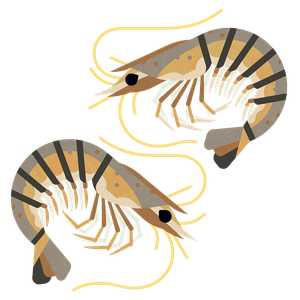
Northern prawn
Pandalus borealis
What to check for
Location
North Sea (Norwegian Deep), Skagerrak and Kattegat
Technical location
Atlantic, Northeast, North Sea (North), Skagerrak and Kattegat
Caught by
Bottom trawl (otter)
Rating summary
There is concern for the stock levels of the Norwegian Deep northern prawn stock, however fishing pressure is within sustainable limits. There is a long-term management plan in place for this fishery but catch has been above the catch limits. Demersal trawling can damage the seafloor and catch vulnerable deep-sea species such as roundnose grenadier and sharks.Rating last updated January 2025.
Technical consultation summary
There is concern for the stock levels of northern prawn in this region (B:BMSY 0.58) however B is no longer below Blim (B:Blim 1.05) and fishing pressure (F:FMSY 0.75) is within sustainable limits. There is a long-term management plan in place for this fishery but catch has been above TAC and advice and the stock is of concern (B above and below targets respectively). Demersal trawling can damage the seafloor and catch vulnerable deep-sea species such as roundnose grenadier and sharks.
How we worked out this Rating
There is concern for the stock levels of the Norwegian Deep northern prawn stock, however fishing pressure is within sustainable limits.Stock assessments are carried out annually by the International Council for the Exploration of the Sea (ICES). The most recent assessment was published in 2024 using data up to the same year. The next assessment is expected in 2025.The stock assessment defines reference points for fishing pressure (F) and biomass (B). For fishing pressure, there is a target to keep F at or below Maximum Sustainable Yield (MSY). For biomass, there is no target. However, there is a trigger point (MSY BTrigger). Below this level, F should be reduced to allow the stock to increase. Because BMSY is not defined, the Good Fish Guide applies its own definition of 1.4 x MSY BTrigger.The populations’ spawning-stock biomass (SSB) significantly declined after 2008 and fell below Blim (a level at which the population is at greater risk of suffering impaired recruitment) for more than a decade, but is slightly above Blim in 2024.The ratio of SSB:MSYBtrigger was estimated at 0.58 for 2024. Because the ratio is lower than 1 it means the stock size is lower than the maximum sustainable yield trigger point. However, B is slightly above the limit (Blim ≤0.6) before the population might crash (SSB2024/Blim = 1.05). Therefore, there is concern for stock levels.Fishing mortality (F) has been above maximum sustainable yield (FMSY - 1) since 2007. However, in 2023 the ratio of F:FMSY was 0.75, dropping below 1, therefore F is below FMSY and therefore is being harvested sustainably.Due to a revision of reference points, reduced SSB, increased fishing mortality, as well as, a downward revision of incoming recruitment compared to last year, the catch advice for 2024 is 11.1% less than the 2023 catch advice. When the EU/Norway long-term management strategy (LTMS) is applied, catches should be no more than 4,557 tonnes from 1 July 2024 to 30 June 2025.
There is a good management plan in place for this fishery, but catches have been above advised limits and there is concern for the stock.In April 2018, a long-term management strategy (LTMS) was agreed by the EU and Norway. The LTMS has been applied since 2019. ICES has evaluated and recently (March 2023) reviewed this strategy and found it to be precautionary.The EU and Norway set annual TACs with an agreed split between the two parties. TACs have been split between areas 3a (Skagerrak and Kattegat) and 4a (Northern North Sea in the Norwegian Deep). TAC is shared according to historical landings, giving Norway 59%, Denmark 27%, and Sweden 14% between 2011 and 2024. TACs have been set in line with advice since the implementation of the LTMS in 2019. However, TACs were set 18% above advice for the 2023/2024 assessment year and and the 2023 catch was 36% above TACs. On average (2018 to 2022) total annual catch has been above scientific advice and over the TAC by 11%.The fishery is also managed through a series of regulations including:Effort limitations: Real Time Closure system, Norwegian waters.Technical conservation measures: Minimum legal catch size (Norway only, 6.5cm, with 10% allowance for undersized shrimp), mesh size (35mm stretched) and sorting grid (19mm bar spacing) regulations.Restrictions in the amount of bycatch that can be landed.Since 2016, the EU landing obligation applies for shrimp in EU waters.Norway has had a discard ban for many years.The average discard rates of the total annual catch, 2019-2023, is 4%. The discard rate since 2018 has been at or less than 6% of the total annual catch.The EU has fishery management measures, which can include catch limits, population targets, and gear restrictions. However, compliance in the EU has been inconsistent, with ongoing challenges in implementing some regulations. The goal of reaching Maximum Sustainable Yield (MSY) by 2020 was missed. In 2024, the EU reaffirmed their commitment to sustainable fisheries by aligning management with scientific advice to gradually approach MSY. However, no new target date has been set for achieving MSY across all fisheries. The Landing Obligation (LO), an EU law requires all quota fish to be landed, even if unwanted (over-quota or below minimum size). It aims to encourage more selective fishing methods, reduce bycatch, and improve catch reporting. However, compliance is poor, and accurate discard levels are hard to quantify with current monitoring programmes.The Marine Conservation Society views Remote Electronic Monitoring (REM) with cameras is one of the most cost-effective tools for providing reliable fisheries data and aiding informed management decisions. Fully monitored fisheries enhance collaboration, data accuracy, stock recovery, and reduce impacts on marine wildlife and habitats. However, the full potential of REM may only be achieved when it tracks fishing location and documents catch and bycatch, particularly where vulnerable species and habitats are at risk. As of January 2024, the EU is introducing a Remote Electronic Monitoring (REM) mandate for EU vessels, including CCTV cameras on vessels 18m or more that pose a potential risk of non-compliance, within the next 4 years.
Bottom trawling for shrimp can have high levels of bycatch of commercially important species and frequently catch other non-commercial species. Trawling can also damage the seafloor.Northern prawn is a marine benthic species, inhabiting soft mud bottoms. They are generally caught on soft seabed areas (often in the same areas, limiting habitat impact), ranging from 250 metres to 400 metres in offshore and coastal areas. Vulnerable Marine Ecosystem (VME) habitats are identified, and closures exist within the fishery.Otter trawling can catch several unwanted species and this fishery is associated with bycatch (25% of catch) of non-target human consumption (HC) species (Cod (a vulnerable stock), Haddock, anglerfish, saithe and witch flounder). All legal to land if quotas allow. Bycatch regulations include minimum mesh size in the codend (35mm), allowing a considerable amount of bycatch to be caught, and mandatory use of fish selection grids (commonly Nordmore) to direct undersized and unwanted fish out of the net, which has significantly reduced bycatch. Despite this, it is legal to cover the grid-outlet with a netting tunnel (collecting bag) of 120mm square mesh to allow for the retention of larger HC fish, when TACs allow. Deep-sea species such as lantern sharks, roundnose grenadier (Endangered) and greater silver smelt are frequently caught as bycatch. However, the bycatch of non-commercial, mainly discarded species, is currently not recorded on a trip-by-trip basis. Thus, no quantitative data is available and the impact on populations is difficult to assess.There are concerns as cod biomass is currently outside safe biologically limits in the area. Currently, there is no indication that cod catches represent significant levels of bycatch (at 1.7% of total catch, 2020-21) to impact the North Sea cod population.Demersal trawls penetrate the seabed, resulting in the abrasion of habitat features. The impact of trawling on the seabed depends on where trawling happens, and on what scale. For example, habitats that are used to natural disturbance through tides and waves are less sensitive to impacts. Areas not used to mobile towed gears are typically more sensitive.The main mitigation measures are Marine Protected Areas, some of which are designated for benthic features. If those MPAs were found to be subjected to bottom trawling, the Marine Conservation Society would consider it a default red rating unless there is evidence (e.g., environmental impact assessment) indicating the activity does not damage the integrity of the site.UK regulations to reduce the impacts of fishing on marine habitats and wider species are under development, in the meantime most EU regulation have been adopted. Under EU legislation, bycatch species should be managed within scientifically defined or, where data isn’t available, suitability precautionary sustainable exploration limits. If stocks fall below a certain threshold, measures can be brought in such as gear limitations (e.g., mesh size or depth of use), time and/or areas closures, and Minimum Conservation Reference Sizes (MCRS).
References
Eigaard, O.R., Francois Bastardie, Breen, M., Dinesen, G.E., Hintzen, N.T., Pascal Laffargue, Mortensen, L.O., Nielsen, J.R., Nilsson, H.C., O’Neill, F.G., Polet, H., Reid, D.G., Sala, A., Mattias Sköld, Smith, C., Sørensen, T.K., Tully, O., Mustafa Zengin and Rijnsdorp, A.D, 2015. Estimating seabed pressure from demersal trawls, seines, and dredges based on gear design and dimensions. ICES Journal of Marine Science, [online] 73(suppl_1), pp.i27–i43. Available at: doi:https://doi.org/10.1093/icesjms/fsv099Hiddink, J.G., Jennings, S., Sciberras, M., Szostek, C.L., Hughes, K.M., Ellis, N., Rijnsdorp, A.D., McConnaughey, R.A., Mazor, T., Hilborn, R., Collie, J.S., Pitcher, C.R., Amoroso, R.O., Parma, A.M., Petri Suuronen and Kaiser, M.J, 2017. Global analysis of depletion and recovery of seabed biota after bottom trawling disturbance. Proceedings of the National Academy of Sciences, 114(31), pp.8301–8306. Available at: doi:https://doi.org/10.1073/pnas.1618858114.ICES, 2024. Celtic Seas Ecoregion – Ecosystem overview. In Report of the ICES Advisory Committee, 2024. ICES Advice 2024, Section 7.1, Available at: https://doi.org/10.17895/ices.advice.27900132 [Accessed on 17.01.2025]ICES, 2022. Stock Annex: Northern shrimp (Pandalus borealis) in Division 4.a East and Subdivision 20 (northern North Sea in the Norwegian Deep and Skagerrak). Available at https://ices-library.figshare.com/articles/report/Stock_Annex_Northern_shrimp_Pandalus_borealis_in_Division_4_a_East_and_Subdivision_20_northern_North_Sea_in_the_Norwegian_Deep_and_Skagerrak_/19722667 [Accessed on 17.01.2025]ICES, 2023. EU/Norway request to ICES for a revision of the Long-Term Management Strategy for northern shrimp (Pandalus borealis) in divisions 3.a and 4.a East (Skagerrak and Kattegat and northern North Sea in the Norwegian Deep). In Report of the ICES Advisory Committee, 2023. ICES Advice 2023, sr.2023.05, https://doi.org/10.17895/ices.advice.22494589 [Accessed on 29.06.2023]ICES, 2024. Joint NAFO/ICES Pandalus Assessment Working Group (NIPAG). ICES Scientific Reports. 6:50. 38 pp. Available at: https://doi.org/10.17895/ices.pub.25772121 [Accessed on 24.01.2025].ICES, 2024. Northern shrimp (Pandalus borealis) in divisions 3.a and 4.a East (Skagerrak and Kattegat and northern North Sea in the Norwegian Deep). In Report of the ICES Advisory Committee, 2024. ICES Advice 2024, pra.27.3a4a. Available at: https://doi.org/10.17895/ices.advice.25019483 [Accessed 24.01.2025]Van Denderen, Bolam, S., JG Hiddink, Jennings, S., Kenny, A., AD Rijnsdorp and T van Kooten (2015). Similar effects of bottom trawling and natural disturbance on composition and function of benthic communities across habitats. Marine Ecology Progress Series, [online] 541, pp.31–43 Available at: https://doi.org/10.3354/meps11550.

Sustainable swaps
Learn more about how we calculate our sustainability ratings.
How our ratings work