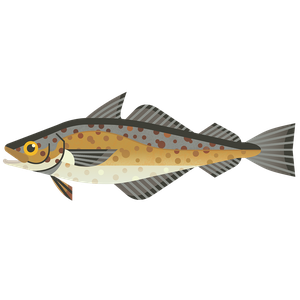
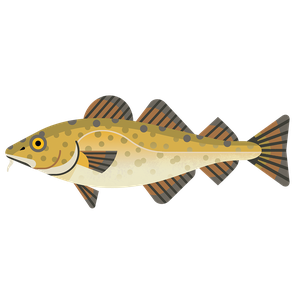
Pacific cod
Gadus macrocephalus
What to check for
Location
Gulf of Alaska
Technical location
Pacific, Northeast, All areas
Caught by
Hook & line (longline)
Certification
Marine Stewardship Council (MSC)
Rating summary
Pacific cod in the Gulf of Alaska is depleted, but is not subject to overfishing. A number of management measures are in place and compliance is good. Catches are below scientifically recommended limits. The majority of the fishery is Marine Stewardship Council certified. Some Gulf of Alaska cod is caught by demersal longline. Bycatch is monitored. Seabird bycatch occurs at low levels. It does not appear to be having population-level impacts.Rating last updated April 2025.
Technical consultation summary
Pacific cod in the Gulf of Alaska is depleted, but is not subject to overfishing. The most recent stock assessment was published by NOAA in 2024 using data up to 2024. In 2024, the female spawning biomass was estimated to be 51,959t, which equates to B30%. This is above the point of reproductive impairment, B17.5%. However it is below the proxy for Maximum Sustainable Yield (MSY), B35% (61,315t). The stock is therefore still in an overfished state. As it is above the halfway point between Blim and BMSY (B27%), there is slightly reduced concern for the stock. Estimated catch in 2024 was 23,171t - below the proxy for MSY (OFL). Therefore, the stock is not subject to overfishing. A number of management measures are in place and compliance is good. Catches are below scientifically recommended limits. The majority of the fishery is Marine Stewardship Council certified, although certification is conditional on making some improvements. Some Gulf of Alaska cod is caught by demersal longline. Bycatch is monitored. Seabird bycatch occurs at low levels. It does not appear to be having population-level impacts.
How we worked out this Rating
Pacific cod in the Gulf of Alaska is depleted, but is not subject to overfishing.There are four Pacific cod stocks in the north Pacific. In the east, they are: Aleutian Islands (AI), Bering Sea (BS), and Gulf of Alaska (GOA). In the west is the Bering Sea (West) and Chukotskaya, Karaginskaya & Petropavlovsko-Komandorskaya subzones stock. This rating covers the Gulf of Alaska.A small fishery for GOA Pacific cod began in the 1950s. It fluctuated between 50,000t and 80,000t in the 1990s and 2000s, declining to just 7,000t in 2020. In 2024, 23,000 tonnes were caught.The most recent stock assessment was published by NOAA in 2024 using data up to 2024. The approach to setting targets and reference points for the stock varies depending on which tier the stock is listed as. They also vary from one year to the next, depending on the most recent stock assessment data.The GOA stock is Tier 3b, indicating there are some data limitations, but there are reference points for biomass and fishing pressure.In the Gulf of Alaska, very warm waters are having a large negative effect on recruitment and may be reducing adult survival as well. The threshold for closing the fishery is set at 20% of the biomass that would exist in the absence of fishing (B20%). This is to protect Steller sea lions, for which cod is important prey. In 2020, the stock was below this point and the federal fishery was closed, although a small state fishery continued. In 2021, the stock had recovered to above B20% and the fishery was reopened. However, long-term warming in the Gulf of Alaska and a predicted increase in the frequency of heatwave events means that conditions will likely become increasingly unfavourable for Pacific cod.In 2024, the female spawning biomass was estimated to be 51,959t, which equates to B30%. This is above the point of reproductive impairment, B17.5%. However it is below the proxy for Maximum Sustainable Yield (MSY), B35% (61,315t). The stock is therefore still in an overfished state. As it is above the halfway point between Blim and BMSY (B27%), there is slightly reduced concern for the stock.The proxy for Maximum Sustainable Yield with regard to fishing mortality is the overfishing limit (OFL). For 2024, it is set at 0.52, increasing to 0.57 in 2025 and 0.51 in 2026. The Acceptable Biological Catch (ABC), which is used to decide catch limits, is calculated as a proportion of the OFL, and was 0.42 in 2024. This equates to a catch of 32,272 tonnes. The total catch of Pacific cod has been less than the OFL and ABC in every year since 1997. Estimated catch in 2024 was 23,171t - below ABC and therefore below OFL. Therefore, the stock is not subject to overfishing.In 2025 the stock is projected to decline to 46,920t. As a result, the ABC for 2025 (32,141t) has only slightly decreased (<1%) from 2024.
A number of management measures are in place and compliance is good. Catches are below scientifically recommended limits. The majority of the fishery is Marine Stewardship Council certified, although certification is conditional on making some improvements.There are three Pacific cod stocks in the eastern north Pacific: Aleutian Islands, Bering Sea, and Gulf of Alaska. They are managed by the North Pacific Fishery Management Council. There are two separate but complementary fishery management plans (FMPs) for them: the Bering Sea and Aleutian Islands (BSAI) Groundfish FMP and the Gulf of Alaska (GOA) Groundfish FMP. The FMPs cover a number of species, which are managed using various measures to protect stocks and ecosystem. These include catch limits and spatial and temporal closures.The BSAI and GOA fishery is Marine Stewardship Council certified. In 2024, approximately 37% of the total GOA was by certified fisheries. The certification is conditional on developing clear, fishery-specific objectives.The BSAI cod fisheries mainly happen in US waters and are managed by the National Marine Fisheries Service (NMFS). Stock assessments are carried out regularly. The overfishing limit (OFL), equivalent to the Maximum Sustainable Yield, is based on the estimated stock biomass. Catch limits are based on the Acceptable Biological Catch (ABC), which is set below the OFL. This keeps catch limits below the level at which the stock would be put at risk by the fishery.However, very warm waters in the Gulf of Alaska have caused significant stock declines. Following the first heat wave, biomass fell by more than half from 113,830 tonnes in 2014 to 46,080 tonnes in 2017. This resulted in the MSC certification for GOA being suspended in April 2020, although it has since been reinstated.The threshold for closing the fishery is set at 20% of the biomass that would exist in the absence of fishing (B20%). This is to protect Steller sea lions, for which cod is important prey. In 2020, the stock was below this point and the federal fishery was closed, although a small state and bycatch fishery continued. However, there is evidence to suggest that the fishery should have been closed a year earlier following the 2018 stock assessments.In 2021, the stock recovered to above B20% and the fishery was reopened. Biomass has increased, but remains below the level associated with Maximum Sustainable Yield. The recommended catch limit for 2025 (32,141t) is a slight decrease from 2024 levels.Management therefore appears to be following scientific advice and is responsive to stock status.There is a federal and a state fishery. The ABC is divided between the two: the federal fishery is limited by a Total Allowable Catch (TAC) and the state fishery is limited by a Guideline Harvest Level (GHL). In 2024 the ABC was 32,272t, with the federal TAC set at 23,766 t and state GHL set at 8,506 t. As of 17 October 2024, a total of 23,171t (72% of the ABC) had been harvested. The total catch of Pacific cod has been less than the OFL and ABC in every year since 1997.Therefore, the fishery appears to be complying well with catch limits.Stock assessments and management advice are based on a tiered system, where Tier 1 indicates the most data rich, and Tier 6 is the least. The BS stock is Tier 3b, indicating that there are reference points. There are some uncertainties in the assessment. Environmental conditions are improving for Pacific cod as temperatures cool, which indicate stock improvements in future.Other management measures include spatial and temporal closures. There are bycatch limits to protect juveniles and species of concern, such as Steller sea lions, chinook salmon and herring.In the Gulf of Alaska, all vessels in the groundfish fisheries must have a permit. Vessel monitoring systems track locations. Scientifically trained observers monitor catch and bycatch. Dockside monitoring, and electronic monitoring systems ensure compliance. Fishermen must retain their entire catch of Pacific cod - it cannot be discarded at sea. This improves accuracy of catch data.
Some Gulf of Alaska cod is caught by demersal longline. Bycatch is monitored. Seabird bycatch occurs at low levels. It does not appear to be having population-level impacts.Pacific cod in the Gulf of Alaska are caught by longline, trawl, pot and jig. Longlining accounted for around 28% in 2024.Longlining uses baited hooks set along a long fishing line to attract the target fish. This bait, and the fish that have been hooked, can attract other animals such as seabirds and sharks, which are also then caught on the lines.Management measures include seasons, gear restrictions, and multiple area closures. Certain locations only permit the use of trawling gear while fishing for Pacific cod, and vessels employing hook-and-line gear must comply with restrictions regarding seabird avoidance.According to MSC reports, Pacific cod accounted for 78% of the average longline catch from 2014-2018. Over 50 species or species groups are bycaught in the GOA longline fishery. The key species are skates, and a number of other fish species are caught as minor bycatch. Skates are managed using a combined multi-species catch limit of 39,000t. GOA longline catches have been around 866t. These species do not appear to be overexploited, but individual species catch rates and population trends are not known.There may also be bycatch of Endangered, Threatened and Protected (ETP) species.The sablefish longline fishery is responsible for most seabird bycatch in the Gulf of Alaska, averaging 577 birds per year. The GOA longline cod fishery has a smaller bycatch of birds, at 67 per year according to MSC reports. The main species ae gulls, and catches are within sustainable limits. In 2020, 11 short-tailed albatross mortalities were recorded. There had previously been none from this endangered species since 2014. More information may be needed to better understand impacts.Some success has been obtained in devising measures to mitigate fishery-seabird interactions. For example, on vessels larger than 60 ft. LOA, paired streamer lines of specified performance and material standards have been found to significantly reduce seabird incidental take.In regard to marine mammals, the Gulf of Alaska Pacific cod longline fishery is listed as Category III (remote likelihood/no interactions) for harbor seal (Cook Inlet/Shelikof Strait) and Steller sea lion (Western U.S.).Management measures have been implemented to protect the direct and indirect impact on Steller sea lion, for which cod is a prey species. These include establishing fishery exclusion zones around rookery or haul out sites, phased-in reductions in the proportions of the catch that can be taken from critical habitat, and additional seasonal TAC releases to disperse the fishery in time.Longline fisheries have much lower impact on habitats than bottom-towed gear such as trawls. However, if they are bottom longlines or are dragged across the seabed during fishing and hauling they can negatively impact on vulnerable species such as corals and sponges, which can be slow to recover.Bait is used by the longline fishery, but usage is considered to be too small to have impacts on the bit species.
References
Anderson, O.R.J., Small, C.J., Croxall, J.P., Dunn, E.K., Sullivan, B.J., Yates, O. and Black, A., 2011. Global seabird bycatch in longline fisheries, Endang Species Res 14. p 91-106. Available at https://doi.org/10.3354/esr00347.Bostrom, J., Knapman, P., Scarcella, G., 2024. Marine Stewardship Council Third Surveillance Audit: Bering Sea and Aleutian Islands (BSAI) and Gulf of Alaska (GOA) Pacific Cod. Carried out by DNV Business Assurance on behalf of Alaska Fisheries Development Foundation (AFDF). Published 24 May 2024. Available at: https://fisheries.msc.org/en/fisheries/bsai-and-goa-pacific-cod/@@assessments [Accessed on 25.04.2025].Clark, M., Althaus, F., Schlacher, T., Williams, A., Bowden, D., Rowden, A., 2016. The impacts of deep-sea fisheries on benthic communities: a review. ICES Journal of Marine Science 73: suppl_1. P. i51–i69. Available at https://doi.org/10.1093/icesjms/fsv123.Ferriss, B.E., 2024. Ecosystem Status Report 2024: Gulf of Alaska. Stock Assessment and Fishery Evaluation Report, North Pacific Fishery Management Council. Available at https://apex.psmfc.org/akfin/r/akfin/151/files/static/v148/2024/GOA_ESR_2024.pdf [Accessed on 25.04.2025].Gilman, E., Chaloupka, M., Benaka, L.R., Bowlby, H., Fitchett, M., Kaiser, M. and Michael Musyl, M., 2022. Phylogeny explains capture mortality of sharks and rays in pelagic longline fisheries: a global meta-analytic synthesis. Sci Rep 12: 18164. https://doi.org/10.1038/s41598-022-21976-w.Hulson, P.-J. F., S. J. Barbeaux, B. Ferriss, K. Echave, J. Nielsen, S. McDermott, B. Laurel, A. Abookire, I. Spies, and S. K. Shotwell. 2024. Assessment of the Pacific cod stock in the Gulf of Alaska. November 2024. North Pacific Fishery Management Council, Anchorage, AK. Available at: https://www.npfmc.org/wp-content/PDFdocuments/SAFE/2024/GOApcod.pdf [Accessed on 25.04.2025].NOAA, 1999. Amendment 56 to the Fishery Management Plan for the Groundfish Fishery of the Bering Sea and Aleutian Islands Area. Available at https://media.fisheries.noaa.gov/dam-migration/5656bfmp-akr.pdf.NOAA, 2022. Steller Sea Lion Protection Measures. Available at: https://www.fisheries.noaa.gov/alaska/commercial-fishing/steller-sea-lion-protection-measuresNOAA, 2024. Pacific Cod Trawl and Non-Trawl Fisheries Closed Areas - Steller Sea Lion Protection Measures. Available at: https://www.fisheries.noaa.gov/resource/map/pacific-cod-trawl-and-non-trawl-fisheries-closed-areas-steller-sea-lion-protectionNOAA, 2025. MARINE MAMMAL PROTECTION: List of Fisheries Summary Tables. Available at: https://www.fisheries.noaa.gov/national/marine-mammal-protection/list-fisheries-summary-tables#table-1-category-iii.NOAA. 2025. Pacific Cod – NOAA Fisheries Profile. Available at: https://www.fisheries.noaa.gov/species/pacific-cod [Accessed on 25.04.2025].NPFMC, 2024. Fishery Management Plan for Groundfish of the Gulf of Alaska, October 2024, North Pacific Fishery Management Council, USA. Available at: https://www.npfmc.org/wp-content/PDFdocuments/fmp/GOA/GOAfmp.pdf [Accessed on 25.04.2025].Pham, C., Diogo, H., Menezes, G., Porteiro, F., Braga-Henriques, A., Vandeperre F. and Morato, T., 2014. Deep-water longline fishing has reduced impact on Vulnerable Marine Ecosystems. Sci Rep 4, 4837. https://doi.org/10.1038/srep04837.Wilson, E., Rice, J., Knapman, P. and Bowen, D., 2020. Marine Stewardship Council Public Certification Report: BSAI and GOA Pacific Cod. Carried out by MRAG Americas, Inc. on behalf of Alaska Fisheries Development Foundation. Published on 17 December 2020. Available at https://fisheries.msc.org/en/fisheries/bsai-and-goa-pacific-cod/@@assessments.Wilson, E., Stern-Pirlot, A., and Scarcella, G., 2022. Marine Stewardship Council 1st Surveillance Report: Bering Sea and Aleutian Islands and Gulf of Alaska Cod. March 2022. Carried out by MRAG Americas, Inc. on behalf of Alaska Fisheries Development Foundation (AFDF). Published on 22 March 2022. Available at https://fisheries.msc.org/en/fisheries/bsai-and-goa-pacific-cod/@@assessments.
Sustainable swaps
Learn more about how we calculate our sustainability ratings.
How our ratings work