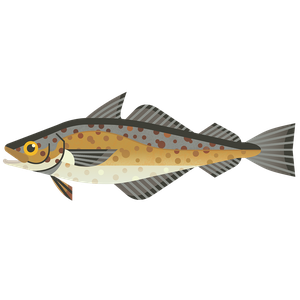
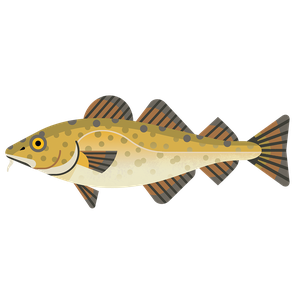
Pacific cod
Gadus macrocephalus
What to check for
Location
Bering Sea (West) and Chukotskaya, Karaginskaya & Petropavlovsko-Komandorskaya subzones
Technical location
Pacific, Northwest, All areas
Caught by
Net (demersal seine)
Rating summary
Pacific cod in the western north Pacific is abundant and not subject to overfishing. A number of management measures are in place and compliance is good. Catches are below scientifically recommended limits. Some west Bering Sea cod is caught by demersal seine, which can have seabed impacts. Data on this fishery is scarce.Rating last updated January 2023.
How we worked out this Rating
Pacific cod in the western north Pacific is abundant and not subject to overfishing.There are four Pacific cod stocks in the north Pacific. In the east, they are: Aleutian Islands (AI), Bering Sea (BS), and Gulf of Alaska (GOA). In the west is the Bering Sea (West) and Chukotskaya, Karaginskaya & Petropavlovsko-Komandorskaya subzones stock.This rating covers the western stock. It is divided into three separate stock components: west Bering Sea, Karaginskaya subzone, and Petropavlovsk-Komandorskaya subzone.The stock as a whole is in a good state and fishing pressure is within sustainable limits. In 2020 the catch limit was set at 155,000 tons for all components combined. No cases of exceeding the total allowable catch (TAC) have been reported.Western Bering Sea and Chukotskaya subzones:In this area, research surveys and models demonstrate increasing spawning stock biomass (SSB), biomass (B) and catch per unit effort (CPUE). From 1993-2003, SSB ranged from 226–331 thousand tonnes. In 2018 and 2019, this had increased to 2.09-2.56 million tonnes. In 2021, the SSB is expected to be around 3.21 million tons, well above BMSY (1.12 million tonnes). Therefore, the stock is not in an overfished state.A figure for current fishing mortality (F) was not provided. FMSY is set at 0.105. This would equate to a catch limit of 320,000t, which would have been 2.5 times the 2020 limit. Owing to uncertainties in future stock projections, a limit of 120,000 tonnes was recommended - similar to previous years. From 2012-2019, catches have been 75% of the TACs. Therefore, the stock does not appear to be subject to overfishing.Karaginskaya subzone:Around 30% of the total fishing effort takes place in the Karaginskaya area. Research surveys and models show that the biomass has been stable in this zone, with the stock in 2019 close to the highest in the time series. Since 2000, Pacific cod biomass has consistently been above BMSY. In 2021, SSB is estimated to be at 58,780 tons, above the proxy for MSY (Btr, 52,650 tonnes). Therefore, the stock is not in an overfished state.Fishing mortality (F) was 0.294, equal to the target (Ftr) and corresponding to a catch limit of 20,000 tons. With that F, the risk of overfishing is very low, below 0.1. Therefore, the stock is not subject to overfishing.Petropavlovsk-Komandorskaya subzone:Around 10% of the total fishing effort takes place in the Petropavlovsho-Komandorskaya area. Simulations show that in this zone, Pacific cod biomass (B) and SSB are showing an upward trend, with the biomass now the highest in the time series. In 2021, SSB was estimated at 69,500 tons, above the BMSY (64.1 thousand tons).A figure for current fishing mortality (F) was not provided. FMSY is set at 0.296. This would equate to a catch limit of 15,400 tons. The fishing mortality rate in 2020 was estimated at F0.257, corresponding to a catch of 14,200 tons. Therefore, the stock does not appear to be subject to overfishing.
A number of management measures are in place and compliance is good. Catches are below scientifically recommended limits. There are some limitations on the information available from Russian fisheries. Fishing for Pacific cod in the West Bering Sea takes place within the Russian Exclusive Economic Zone (EEZ). The stock is separated into three management areas by the Russian authorities: East Kamchatka (Petropavlovsk-Komandor), Karaginsk, and Anadyr-Navarin. Russian fisheries management is coordinated by the Federal Fisheries Agency.There are a number of fishery management tools in place. The main measure is a catch limit (Total Allowable Catch, TAC) for each area. These are based on stock assessments, which are carried out by scientific agency VINRO. TACs are set using harvest control rules, with fishing mortality being reduced when stocks fall below certain thresholds. In recent years, TACs have not been surpassed. Management therefore appears to follow scientific recommendations, and compliance with catch limits appears to be good. Since 2015, the harvest strategy has been significantly revised with new requirements including analysis of stock size, life history, fishing technologies, determination of long-term goals of exploitation, determination of target and limit reference points in terms of spawning or commercial biomass and fishing mortality. The harvest strategy in place is thought to be responsive to the status of the stock and has been designed to meet stock management objectives. There is limited information on gear specific fisheries regulations implementation for bottom trawl and demersal seine fishery in Russian waters. Other management tools include a mesh size limit on bottom trawl fishery, prohibition of target fishery for Pacific cod in Petropavlovsko-Komandorskaya subzone at depths less than 200m, and a minimum landing size 40 cm of standard length. Closure of subzones also occur on a seasonal basis due to biological activities or sensitive habitats or species in the area at specific times. All Pacific cod caught as a target species must be completely utilised.Monitoring and enforcement is carried out by the FFA through its regional offices, and the Coast Guard, which falls under the Federal Security Service (FSB). Fish caught in Russian waters must be landed in Russian ports. Other measures include random inspections at sea, electronic logbooks, and satellite tracking of boats (VMS and AIS). Quota rights are revoked if a fishing firm commits two serious infringements of regulations within one calendar year. According to FSB reports, violations were discovered in around 5% of inspections.
Some west Bering Sea cod is caught by demersal seine, which can have seabed impacts. Data on this fishery is scarce.Pacific cod in the western Bering Sea (WBS) are caught by longline, otter trawl, and demersal (Danish) seine. Pacific cod is taken both as a target species and a bycatch of fisheries targeting other species, such as pollock.Demersal otter trawl and Danish seine make up 53.9% of the total catch on average in the Western Bering Sea zone and 11.4% in the Chukotskaya zone. In the Karaginskaya subzone, Danish seine and trawls made up 68.4% of the total catch from 2001 to 2014, however in 2013-2014, an increase in catches by longliners occurred and now 50% is being caught by longliners or mobile gears.In Danish seine fisheries, bottom seines can be improperly deployed, causing dragging on the seafloor which could lead to the destruction of benthic organisms and disturbance of physical features. However, when deployed correctly and legally, they can be pulled close to the sea floor, without touching it. They are generally considered to be less destructive than other demersal gear types, such as otter trawling.Information about the bycatch (including ETP species) in the seine in the area is not available.Closed areas have been declared around rookeries of otters, Steller sea-lions and seals to protect these species.
References
Eigaard, O. R., Bastardie, F., Breen, M., Dinesen, G. E., Hintzen, N. T., Laffargue, P., Mortensen, L. O., Nielsen, J. R., Nilsson, H. C., O- Neill, F. G., Polet, H., Reid, D. G., Sala, A., Skold, M., Smith, C., Sorensen, T. K., Tully, O., Zengin, M. and Rijnsdorp, A. D., 2016. Estimating seabed pressure from demersal trawls, seines, and dredges based on gear design and dimensions. ICES Journal of Marine Science, 73:1, pp. i27- i43. https://doi.org/10.1093/icesjms/fsv099.Hiddink, J., Jennings, S., Sciberras, M., Szostek, C.L., Hughes, K.M., Ellis, N., Rijnsdorp, A.D., McConnaughey, R.A., Mazor, T., Hilborn, R., Collie, J.S., Pitcher, C.R., Amoroso, R.O., Parma, A.M., Suuronen, P. and Kaiser, M.J. 2017. Global analysis of depletion and recovery of seabed biota after bottom trawling disturbance. PNAS. 114:31, pp. 8301-8306. https://doi.org/10.1073/pnas.1618858114.Hønneland, G., Giuseppe Scarcella, G.. and Huntington, T., 2022. 2022. Marine Stewardship Council Public Certification Report: KZB herring JSC Western Bering Sea and East Kamchatka Pacific cod. April 2022. Carried out by UCSL United Certification Systems Limited on behalf of KZB-herring JSC (Russian Federation). Published on 18 April 2022. Available at https://fisheries.msc.org/en/fisheries/kzb-herring-jsc-western-bering-sea-and-east-kamchatka-pacific-cod/@@assessments.Lajus, D., Safronova, D., Orlov, A and Blyth-Skyrme, R., 2019. Marine Stewardship Council Public Certification Report: Western Bering Sea Pacific cod and Pacific halibut longline. October 2019. Carried out by Marine Certification on behalf of Longline Fishery Association. Available at https://fisheries.msc.org/en/fisheries/western-bering-sea-pacific-cod-and-pacific-halibut-longline/@@assessments.Pramod, G., 2020. Russia – Country Report, 9 pages, In: Policing the Open Seas: Global Assessment of Fisheries Monitoring Control and Surveillance in 84 countries, IUU Risk Intelligence - Policy Report No. 1, Canada, 840 pages. https://iuuriskintelligence.com/wp-content/uploads/2020/04/Russia-Country-Report-Global-Fisheries-MCS-Report-2020.pdf [Accessed 12/8/22].Radchenko V.I. 2017. Russian Fisheries Management System Performance (The Sea of Okhotsk Walleye Pollock Fishery Case Study). North Pacific Anadromous Fish Commission, Vancouver.Saltykov, M.A., & Krasova, E.V. 2021. Trends in development of Russian Far East’s fishing industry in context of strategic regional growth. Revista Amazonia Investiga, 10(47), 93-106. https://dialnet.unirioja.es/descarga/articulo/8320608.pdf [Accessed 11/8/22].TINRO 2020. FEDERAL FISHING AGENCY. Federal State Budgetary Scientific Institution "All-Russian Research Institute of Fisheries and Oceanography" (Kamchatka Branch). 133 pp.TINRO 2020. TAC Materials for Fisheries Located in Inner Sea Waters of Russia, Territorial Seas of Russia, the Continental Shelf of Russia, in the EEZ of Russia and in the Caspian Sea (including assessment of environmental impact) for 2021. Part 2: Fish of the Far Eastern Seas.van Denderen, P. Bolam, S., Hiddink, J.G., Jennings, S., Kenny, A., Rijnsdorp, A., and van Kooten, T., 2015. Similar effects of bottom trawling and natural disturbance on composition and function of benthic communities across habitats. Mar Ecol Prog Ser. 2015;541:31–43. https://doi.org/10.3354/meps11550.Vasilets, P. and Sendek, D., 2023. Marine Stewardship Council Surveillance Report: Western Bering Sea Pacific cod and Pacific halibut longline. January 2023. Carried out by UCSL United Certification Systems Limited on behalf of Longline Fisheries Association (LFA). Published on 16 January 2023. Available at https://fisheries.msc.org/en/fisheries/western-bering-sea-pacific-cod-and-pacific-halibut-longline/@@assessments.

Sustainable swaps
Learn more about how we calculate our sustainability ratings.
How our ratings work