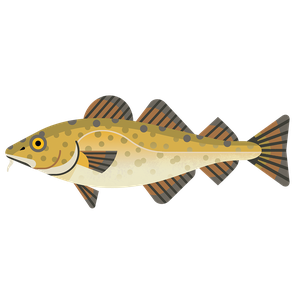
Pacific cod
Gadus macrocephalus
What to check for
Location
Bering Sea
Technical location
Pacific, Northeast, All areas
Caught by
Bottom trawl (otter)
Certification
Marine Stewardship Council (MSC)
Rating summary
Pacific cod in the Bering Sea is abundant and not subject to overfishing. A number of management measures are in place and compliance is good. The majority of the fishery is Marine Stewardship Council certified. Some Bering Sea cod is caught by otter trawls, which are likely to cause some damage to the seabed. However, the footprint of this fishery is small, and bycatch is low.Rating last updated April 2025.
Technical consultation summary
Pacific cod in the Bering Sea is abundant and not subject to overfishing. The most recent stock assessment was published by NOAA in 2024 using data up to 2024. The BS stock is Tier 3b, indicating there are some data limitations, but there are reference points for biomass and fishing pressure. Female spawning biomass is at B39% - above the proxy for Maximum Sustainable Yield, which is B35% for Tier 3 stocks. The stock is therefore not in an overfished state. Estimated catch in 2024 was 127,097 tonnes - below the proxy for MSY (OFL). Therefore, the stock is not subject to overfishing. A number of management measures are in place and compliance is good. Catches are below scientifically recommended limits. The majority of the fishery is Marine Stewardship Council certified, although certification is conditional on making some improvements. Some Bering Sea cod is caught by otter trawls, which are likely to cause some damage to the seabed. However, the footprint of this fishery is small, and bycatch is low.
How we worked out this Rating
Pacific cod in the Bering Sea is abundant and not subject to overfishing.There are four Pacific cod stocks in the north Pacific. In the east, they are: Aleutian Islands (AI), Bering Sea (BS), and Gulf of Alaska (GOA). In the west is the Bering Sea (West) and Chukotskaya, Karaginskaya & Petropavlovsko-Komandorskaya subzones stock. This rating covers the eastern Bering Sea.A small fishery for east BS Pacific cod began in the 1960s. It grew to over 240,000 tonnes in 2016 but has since declined. In 2024, 127,000 tonnes were caught.The most recent stock assessment was published by NOAA in 2024 using data up to 2024. The approach to setting targets and reference points for the stock varies depending on which tier the stock is listed as. They also vary from one year to the next, depending on the most recent stock assessment data.The BS stock is Tier 3b, indicating there are some data limitations, but there are reference points for biomass and fishing pressure.Female spawning biomass has fluctuated over the years, reaching a high of around 300,000t in the 1980s, and then declining to below 250,000t in the 1990 and 2000s. In 2024 it was projected to be 223,107 tonnes. This equates to 39% of the biomass that would exist in the absence of fishing (B39%). It is above the proxy for Maximum Sustainable Yield with regard to biomass, which is B35% for Tier 3 stocks. Spawning biomass is projected to decline slightly to 215,747t in 2025 (B38.4%) and 206,498t in 2026 (B36.7%), but will remain above MSY proxy. The stock is therefore not in an overfished state.The proxy for Maximum Sustainable Yield with regard to fishing mortality is the overfishing limit (OFL). For 2024, it is set at 0.46, declining to 0.43 in 2025 and 0.41 in 2026. The Acceptable Biological Catch (ABC), which is used to decide catch limits, is calculated as a proportion of the OFL, and was 0.37 in 2024. This equates to a catch of 167,952 tonnes. The total catch of Pacific cod has been less than the OFL in every year since 1993. Estimated catch in 2024 was 127,097 - below ABC and therefore below OFL. Therefore, the stock is not subject to overfishing.
A number of management measures are in place and compliance is good. Catches are below scientifically recommended limits. The majority of the fishery is Marine Stewardship Council certified, although certification is conditional on making some improvements.There are three Pacific cod stocks in the eastern north Pacific: Aleutian Islands, Bering Sea, and Gulf of Alaska. They are managed by the North Pacific Fishery Management Council. There are two separate but complementary fishery management plans (FMPs) for them: the Bering Sea and Aleutian Islands (BSAI) Groundfish FMP and the Gulf of Alaska (GOA) Groundfish FMP. The FMPs cover a number of species, which are managed using various measures to protect stocks and ecosystem. These include catch limits and spatial and temporal closures.The BSAI and GOA fishery is Marine Stewardship Council certified. In 2023, 85% of the total BS catch was by certified fisheries. The certification is conditional on developing clear, fishery-specific objectives.The BSAI cod fisheries mainly happen in US waters and are managed by the National Marine Fisheries Service (NMFS). Stock assessments are carried out regularly. The overfishing limit (OFL), equivalent to the Maximum Sustainable Yield, is based on the estimated stock biomass. Catch limits are based on the Acceptable Biological Catch (ABC), which is set below the OFL. This keeps catch limits below the level at which the stock would be put at risk. Management therefore appears to be following scientific advice and is responsive to stock status.There is a federal and a state fishery. The ABC is divided between the two: the federal fishery is limited by a Total Allowable Catch (TAC) and the state fishery is limited by a Guideline Harvest Level (GHL). In 2024, the GHL was set at 8% of the ABC, equating to 20,154t. The TAC was set at 147,753. The combined limits are near equal to the ABC of 167,952t. Total catch by both federal and state fishery was 127,097t, which was below the ABC. From 2019-2023, combined limits have been set near equal to ABC, and average catches have been 98% of it, in 2024 catches were approximately 76% of the ABC. Therefore, the fishery appears to be complying well with catch limits.Stock assessments and management advice are based on a tiered system, where Tier 1 indicates the most data rich, and Tier 6 is the least. The BS stock is Tier 3b, indicating that there are reference points. There is a low risk that the ABC could exceed the OFL.Other management measures include spatial and temporal closures. There are bycatch limits to protect juveniles and species of concern, such as Steller sea lions, chinook salmon and herring.In the Bering Sea and Aleutian Islands, all vessels in the groundfish fisheries must also have a Federal groundfish license and carry scientifically trained observers (100% observer coverage) who monitor bycatch. Onboard observers, dockside monitoring, and electronic monitoring systems ensure compliance. Fishermen must retain their entire catch of Pacific cod - it cannot be discarded at sea. This improves accuracy of catch data.Some of the east Bering Sea stock may occur within Russian waters, although connectivity between the areas seems uncertain. Catch data was supplied by Russia in the past, but as of March 2022 NOAA reports that it is no longer available. Harvest rates in Russian waters were thought to be low, but this is now more difficult to monitor.
Some east Bering Sea cod is caught by otter trawls, which are likely to cause some damage to the seabed. However, the footprint of this fishery is small, and bycatch is low.Pacific cod in the Bering Sea are caught by longline, trawl, pot and jig. Trawling accounted for around 32% from 2019-2023.Demersal trawls have contact with the seabed, resulting in penetration and abrasion of habitat features. The impact of trawling on the seabed depends on the where trawling happens, and on what scale. For example, habitats that are used to natural disturbance through tides and waves are less sensitive to impacts. Areas not used to mobile towed gears are typically more sensitive. The Bering Sea and Aleutian Islands Pacific cod trawl fishery generally occurs over sand, mud, or cobble, which are lower risk.The Bering Sea fishery has a relatively small footprint. The area disturbed by commercial fishing (pelagic and non-pelagic trawl, longline, and pot) was 10% in 2008. At that point the footprint of the trawl fishery was frozen, so that it could not expand into new areas. Disturbance has since declined to 8%. Catches of vulnerable seabed species, such as sea pens, are very low.Demersal otter trawls have the potential to take relatively high quantities of bycatch. Around 44 species are caught in the Bering Sea trawl fishery for Pacific cod. Many are managed under the BSAI Groundfish management plan. According to MSC reports, Pacific cod accounted for 91% of the average catch from 2014-2018. Bycatch species include yellowfin sole, rock sole, flathead sole, Arrowtooth flounder, Alaska plaice, starry flounder and pollock. In most cases, catches are at low levels compared to the catch limits for these species. Starry flounder is managed using a combined multi-species catch limit of 39,000t. Trawl catches averaged 100t. This species do not appear to be overexploited, but individual species catch rates and population trends are not known.Bycatch of Endangered, Threatened and Protected (ETP) species can include Pacific halibut, chinook salmon and some crab species. Catches by this fishery appear to be very low, and MSC reports indicate that it is unlikely to be having a population-level impact. Steps to decrease bycatch of these species include gear changes, closed areas and closed seasons.Catches of ringed seal and Steller sea lion have been known. However, NOAA lists the Bering Sea, Aleutian Islands Pacific cod trawl fishery as Category III, for Bearded seal (AK), Ribbon seal, and Steller sea lion (Western U.S.) which means that there is remote likelihood of, or no known, incidental mortality or serious injury of marine mammals.Management measures have been implemented to protect the direct and indirect impact on Steller sea lion, for which cod is a prey species. These include establishing fishery exclusion zones around rookery or haul out sites, phased-in reductions in the proportions of the catch that can be taken from critical habitat, and additional seasonal TAC releases to disperse the fishery in time.Seabird bycatch is thought to be low. Northern fulmar is the only main species occasionally taken in this fishery, with an average of only 11 birds per year in the Bering Sea and Aleutian Islands.The North Bering Sea (NBS), including the BS cod fishery area, was in a warm phase between 2014 to 2021, delaying sea ice formation. From 2022 to 2024 temperatures have cooled to near average temperatures based on the time series (1972-2024). Additionally, cooler temperatures are predicted to occur in the spring of 2025 due to the transition from El Nino to La Nina conditions. Benthic productivity in 2024 showed mixed trends, with increases in some species like echinoderms and sea anemones, but declines in others like sponges and sea stars; crab populations showed slight improvement. A strong summer phytoplankton bloom and an early fall bloom were driven by storm-induced water mixing. Over the northern shelf, zooplankton quality has improved, yet juvenile salmon condition declined and overall biomass trends of forage fish were mixed in 2024.
References
Barbeaux, S., Barnett, L., Hulson, P., Nielson, J., Shotwell, SK., Siddon, E. and Spies, I., 2024. Assessment of the Pacific Cod Stock in the Eastern Bering Sea. 16 November 2024. Alaska Fisheries Science Center, National Marine Fisheries Service, National Oceanic and Atmospheric Administration. Seattle, WA. Available at: https://www.npfmc.org/wp-content/PDFdocuments/SAFE/2024/EBSpcod.pdf [Accessed on 25.04.2025].Bostrom, J., Knapman, P., Scarcella, G., 2024. Marine Stewardship Council Third Surveillance Audit: Bering Sea and Aleutian Islands (BSAI) and Gulf of Alaska (GOA) Pacific Cod. Carried out by DNV Business Assurance on behalf of Alaska Fisheries Development Foundation (AFDF). Published 24 May 2024. Available at: https://fisheries.msc.org/en/fisheries/bsai-and-goa-pacific-cod/@@assessments [Accessed on 25.04.2025].Eigaard, O. R., Bastardie, F., Breen, M., Dinesen, G. E., Hintzen, N. T., Laffargue, P., Mortensen, L. O., Nielsen, J. R., Nilsson, H. C., O- Neill, F. G., Polet, H., Reid, D. G., Sala, A., Skold, M., Smith, C., Sorensen, T. K., Tully, O., Zengin, M. and Rijnsdorp, A. D., 2016. Estimating seabed pressure from demersal trawls, seines, and dredges based on gear design and dimensions. ICES Journal of Marine Science, 73:1, pp. i27- i43. https://doi.org/10.1093/icesjms/fsv099.Gauvin, J. 2013. Final Report on EFP 12-01: Halibut deck sorting experiment to reduce halibut mortality on Amendment 80 Catcher Processors. Alaska Seafood Cooperative Report.Hiddink, J., Jennings, S., Sciberras, M., Szostek, C.L., Hughes, K.M., Ellis, N., Rijnsdorp, A.D., McConnaughey, R.A., Mazor, T., Hilborn, R., Collie, J.S., Pitcher, C.R., Amoroso, R.O., Parma, A.M., Suuronen, P. and Kaiser, M.J. 2017. Global analysis of depletion and recovery of seabed biota after bottom trawling disturbance. PNAS. 114:31, pp. 8301-8306. https://doi.org/10.1073/pnas.1618858114.Kennelly, S. J. & Broadhurst, M. K., 2021. A review of bycatch reduction in demersal fish trawls. Rev Fish Biol Fisheries 31, 289–318. https://doi.org/10.1007/s11160-021-09644-0.NOAA, 1999. Amendment 56 to the Fishery Management Plan for the Groundfish Fishery of the Bering Sea and Aleutian Islands Area. Available at https://media.fisheries.noaa.gov/dam-migration/5656bfmp-akr.pdf.NOAA, 2020. Final Regulatory Impact Review for a Regulatory Amendment to Limit Access by all Federally Permitted Vessels to the BSAI Pacific Cod Parallel State Waters Fishery, November 2020, National Marine Fisheries Service, Alaska Region & National Oceanic and Atmospheric Administration report, 62 pages. Available at: https://repository.library.noaa.gov/view/noaa/27838 [Accessed on 25.04.2025].NOAA, 2022. Steller Sea Lion Protection Measures. Available at: https://www.fisheries.noaa.gov/alaska/commercial-fishing/steller-sea-lion-protection-measures [Accessed on 25.04.2025].NOAA, 2024. Pacific Cod Trawl and Non-Trawl Fisheries Closed Areas - Steller Sea Lion Protection Measures. Available at: https://www.fisheries.noaa.gov/resource/map/pacific-cod-trawl-and-non-trawl-fisheries-closed-areas-steller-sea-lion-protection [Accessed on 25.04.2025].NOAA, 2025. MARINE MAMMAL PROTECTION: List of Fisheries Summary Tables. Available at: https://www.fisheries.noaa.gov/national/marine-mammal-protection/list-fisheries-summary-tables#table-1-category-iii [Accessed on 25.04.2025].NOAA. 2025. Pacific Cod – NOAA Fisheries Profile. Available at: https://www.fisheries.noaa.gov/species/pacific-cod [Accessed on 25.04.2025].Siddon, E. 2024. Ecosystem Status Report 2024: Eastern Bering Sea. Alaska Fisheries Science Center, NOAA Fisheries. 15 November 2024. Available at: https://apex.psmfc.org/akfin/r/akfin/151/files/static/v148/2024/EBS_ESR_2024.pdf [Accessed on 25.04.2025].van Denderen, P. Bolam, S., Hiddink, J.G., Jennings, S., Kenny, A., Rijnsdorp, A., and van Kooten, T., 2015. Similar effects of bottom trawling and natural disturbance on composition and function of benthic communities across habitats. Mar Ecol Prog Ser. 2015;541:31–43. https://doi.org/10.3354/meps11550.Wilson, E., Rice, J., Knapman, P. and Bowen, D., 2020. Marine Stewardship Council Public Certification Report: BSAI and GOA Pacific Cod. Carried out by MRAG Americas, Inc. on behalf of Alaska Fisheries Development Foundation. Published on 17 December 2020. Available at https://fisheries.msc.org/en/fisheries/bsai-and-goa-pacific-cod/@@assessments.Wilson, E., Stern-Pirlot, A., and Scarcella, G., 2022. Marine Stewardship Council 1st Surveillance Report: Bering Sea and Aleutian Islands and Gulf of Alaska Cod. March 2022. Carried out by MRAG Americas, Inc. on behalf of Alaska Fisheries Development Foundation (AFDF). Published on 22 March 2022. Available at https://fisheries.msc.org/en/fisheries/bsai-and-goa-pacific-cod/@@assessments.

Sustainable swaps
Learn more about how we calculate our sustainability ratings.
How our ratings work