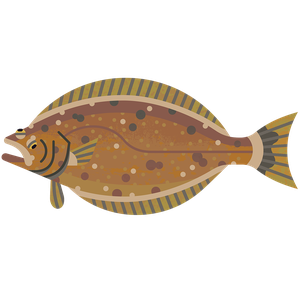
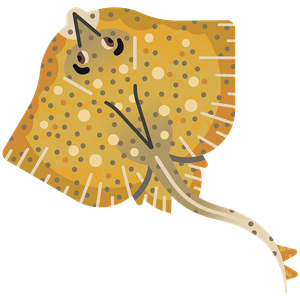
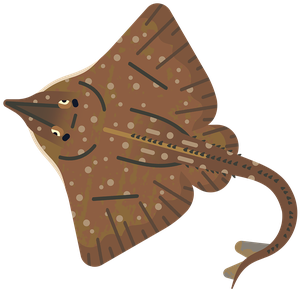
Plaice
Pleuronectes platessa
What to check for
Location
Celtic Sea South, southwest of Ireland
Technical location
Atlantic, Northeast, Celtic Sea (South), Southwest of Ireland (East), Southwest of Ireland (West)
Caught by
Bottom trawl (otter)
Rating summary
Updated: July 2021.This is a data limited stock and no reference points are available. The stock has been in a poor state since 2002, and fishing mortality has been above sustainable levels since 1993. There is no recovery plan to return the stock to sustainable levels and current management measures are not enough to recover the stock. Plaice are taken as a minor bycatch in a mixed fishery with sole. Otter trawlers interact with the seabed and can modify bottom topography and cause damage and removal of some biogenic features including vulnerable marine habitats and benthic communities. In the Eastern Channel, scars related to bottom trawling are difficult to identify due to predominant sandy sediments. Otter trawls can also encounter occasional bycatch of vulnerable species.
How we worked out this Rating
This is a data limited stock and no reference points are available. There is concern for the biomass and concern for the fishing pressure.Plaice in this area is on the south-west margins of the species distribution. A survey combined biomass index was used as an indicator of stock development. The biomass index from 2020-2019 is 516, a decrease from the index provided from 2016-2018. Therefore, there is concern for the biomass.A relative proxy for FMSY of 1 is used in the assessment and ICES notes that fishing pressure on the stock is above FMSY. While catches decreased by 50% from 2019 to 2020, ICES had advised a zero catch in 2020, and catch was still 40 tonnes. Therefore there is concern for the fishing pressure. Plaice has a medium resilience to fishing pressure.ICES advises that when the MSY approach is applied, catches in 2022 should be no more than 114 tonnes.
There is no management plan in place for this stock and management requires significant improvement. This stock is also data limited which limits the effectiveness of management.For the last 4 years, scientific catch advice for this stock has been for 0 tonnes and in 2020 and 2021, the Total Allowable Catch (TAC) has been set at 67 tonnes. However, in 2022, catch advice has increased to 114 tonnes due to a change in the method used to provide advice and a change in perception of the stock.Discards are significant, at 44% of the catch. Plaice are taken as a minor bycatch species in a mixed fishery. Restricting the landings by TAC is unlikely to reduce the catches, and effort restrictions and discard reduction would be more effective. The recently introduced square mesh panels will be unlikely to effect on catches of undersized plaice. An increase in mesh size could improve selection, but will also affect the catches of marketable fish.There are some survivability exemptions in place. According to the Western Waters Multiannual Plan (MAP), bycatch species should be managed under the precautionary approach if scientific information is not available. The target is a less-than 5% probability of the stock falling below its lower limit (Blim) - which this stock is already thought to be well below and has been for years. Despite that, there is no recovery plan for this stock.Technical measures in place for this fishery are:Minimum Conservation Reference Size (MCRS) of 27cmThe Celtic Sea Protection Zone (CSPZ) also has restrictions on fishing gearFor vessels fishing with demersal trawls and seines operating in the outer CSPZ within UK waters, the baseline mesh size is 100mm codend with a 100mm square mesh panel (not required within UK waters east of 5 degrees west).For vessels fishing with demersal trawls and seines in the outer EU CSPZ (outside UK waters), demersal trawlers and seines must operate using a 100mm codend within ICES divisions 7f-k and in the area west if longitude 5 degrees west in 7e.Both the EU and UK have fishery management measures in place, which can include catch limits, targets for population sizes and fishing mortality, and controls on what fishing gear can be used and where. In the EU, compliance with regulations has been variable, and there are ongoing challenges with implementing some of them. There was a target for fishing to be at Maximum Sustainable Yield by 2020, but this was not achieved. The Landing Obligation (LO), an EU law that the UK has kept after Brexit, requires all fish and shellfish to be landed, even if they are unwanted (over-quota or below minimum size). It aims to promote more selective fishing methods, reduce bycatch, and improve recording of everything that is caught, not just what is wanted. Compliance with the LO is generally poor and actual levels of discards are difficult to quantify using the current fisheries observer programme.In the UK, it is too early to tell how effective management is, as the Fisheries Act only came into force in January 2021. The Act requires the development of Fisheries Management Plans (FMPs) (replacing EU Multi-Annual Plans) but there are no details yet on how and when these will be developed. FMPs have the potential to be very important tools for managing UK fisheries, although data limitations may delay them for some stocks. MCS is keen to see FMPs for all commercially exploited stocks, especially where stocks are depleted, that include:Targets for fishing pressure and biomass, and additional management when those targets are not being metTimeframes for stock recoveryTechnologies such as Remote Electronic Monitoring (REM) to support data collection and improve transparency and accountabilityConsideration of wider environmental impacts of the fishery

Otter trawlers interact with the seabed and can modify bottom topography and cause damage and removal of some biogenic features including vulnerable marine habitats and benthic communities. There can also be occasional bycatch of vulnerable species.Plaice is a bycatch species in this fishery. In 2020, 75 tonnes were caught, of which 39 were landed (52%). Of these landings, 58% came from otter trawl fisheries, 33% from beam trawls and 9% from other gear types. 100% of discards came from otter trawl fisheries and < 0.01% from beam trawl fisheries.The assessed part of the fishery focusses mainly on division 7j, where Irish vessels operate close to shore on sandy grounds off the southwest of Ireland. Plaice landings are part of a mixed fishery, targeting sole, with plaice forming only a small component (<5%) of the overall landings per trip.The minimum conservation reference size for plaice in EU waters is 27cm, whereas the size at which 50% of females mature or first spawn is around 30-34cm.Demersal otter trawls have the potential to take relatively high quantities of bycatch (> 40% of catch weight). There are also reported catches of demersal elasmobranchs and endangered, protected and threatened (ETP) species (e.g. sharks and rays) in certain circumstances.Although otter trawls are considered to have a potential to cause significant habitat damage, damage to vulnerable and sensitive marine habitats is likely to be minimised given that the footprint of the fishery is within core areas, typically historically fished ground. In the Eastern English Channel, scars related to bottom trawling are difficult to identify due to predominantly sandy sediments.
References
EU, 2019. Regulation (EU) 2019/472 of the European Parliament and of the Council of 19 March 2019 establishing a multiannual plan for stocks fished in the Western Waters and adjacent waters, and for fisheries exploiting those stocks. Available at https://eur-lex.europa.eu/legal-content/EN/TXT/?qid=1554387217276&uri=CELEX:32019R0472 [Accessed on 19.07.2021].ICES. 2019. Report of the Working Group for the Celtic Seas Ecoregion. ICES Scientific Reports, 1:29. 1604 pp. Available at http://doi.org/10.17895/ices.pub.4982 [Accessed on 19.07.2021].ICES. 2021. Plaice (Pleuronectes platessa) in divisions 7.h-k (Celtic Sea South, southwest of Ireland). In Report of the ICES Advisory Committee, 2021. ICES Advice 2021, ple.27.7.h-k. https://doi.org/10.17895/ices.advice.7824. [Accessed on 16.07.2021].WWF, 2017. Remote Electronic Monitoring in UK Fisheries Management 2017. Available at https://www.wwf.org.uk/sites/default/files/2017-10/Remote%20Electronic%20Monitoring%20in%20UK%20Fisheries%20Management_WWF.pdf [Accessed on 14.07.2021].
Sustainable swaps
Learn more about how we calculate our sustainability ratings.
How our ratings work