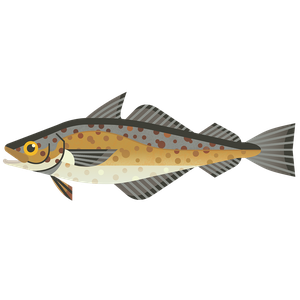
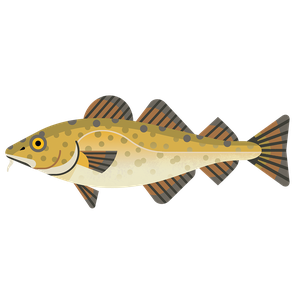
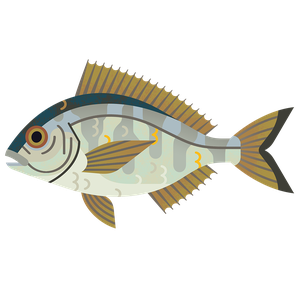
Pollack
Pollachius pollachius
What to check for
Location
North Sea, Skagerrak and Kattegat
Technical location
Atlantic, Northeast, North Sea, Skagerrak and Kattegat
Caught by
Bottom trawl (otter)
Rating summary
Pollack in the North Sea, Skagerrak and Kattegat is a very data limited stock. There is no information about biomass, but fishing pressure does not seem to be of concern. Pollack is mainly caught as bycatch, and so there is no targeted fishery that needs management measures. However, there are no catch limits or protections in place to ensure it is not overexploited. Most pollack are caught by otter trawl. There is a potential for damage to the seabed by trawling, and bycatch of unwanted species.Rating last updated August 2024.
Technical consultation summary
Pollack in the North Sea, Skagerrak and Kattegat is a very data limited stock. There is no information about biomass, but fishing pressure does not seem to be of concern. There is no information about the size of the pollack stock in this area, therefore there is concern for biomass due to a lack of information. There is no targeted fishery, and landings are stable, fishing pressure does not appear to be of concern. There are few appropriate management measures in place. The stock is mainly caught as bycatch, and so there is no targeted fishery that needs management measures. However, the stock is very data limited and there are no catch limits or protections in place to ensure it is not overexploited. Most pollack are caught by otter trawling. There has a potential for damage to the seabed by trawling, and bycatch of unwanted species.
How we worked out this Rating
Pollack in the North Sea, Skagerrak and Kattegat is a very data limited stock. There is no information about biomass, but fishing pressure does not seem to be of concern.Route 2 scoring has been applied to this rating owing to the lack of reference points for fishing pressure and biomass. Pollack is considered to have a medium resilience to fishing pressure.Stock assessments are carried out by the International Council for the Exploration of the Sea (ICES). The most recent assessment was published in 2024 using data from 2021 – 2023. Assessments are updated every three years; the next one is expected in 2027.There is no information about the size of the pollack stock in this area, therefore there is concern for biomass due to a lack of information.Pollack is not targeted by any major fisheries, but it is caught as bycatch and by recreational fishers. Recreational catches could be substantial, but there's no data on this. Known landings in the commercial fisheries have been stable at 1,500-3,000 tonnes since 1998. As there is no targeted fishery, and landings are stable, fishing pressure does not appear to be of concern.ICES advises that when the precautionary approach is applied, catches in the years 2025–2027 should be no more than 1,462 tonnes. This is based on the previous catch advice from 2022- 2024 (1,828t), with a 20% reduction. This reduction is applied for data limited stocks every three years. Information available for the Skagerrak and Kattegat suggests that this stock declined substantially from 1950 until around 2000. More recently, during routine surveys in areas 3 and 4, pollack catches have been irregular, with no clear pattern. The surveys do not cover the full geographic distribution of the species. However, if the stock increases, it is expected that present trawl surveys would be able to detect the trend.
Pollack in the North Sea, Skagerrak and Kattegat have few appropriate management measures in place. The stock is mainly caught as bycatch, and so there is no targeted fishery that needs management measures. However, the stock is very data limited and there are no catch limits or protections in place to ensure it is not overexploited.North Sea, Skagerrak and Kattegat pollack is not targeted by any fisheries. Instead, it is almost entirely caught as bycatch, and there are also some catches by recreational fishers. Discards were only reported by bottom trawl fleets and beam trawl fleets from Belgium, UK Scotland and Sweden.Preliminary landings for 2023 (2,072 tonnes) were 12 % above scientific advice (1,828 tonnes).The only management measure is a minimum landing size of 30cm for UK waters and EU member states. Female pollack are thought to mature at 35cm or more, so this does allow for juveniles to be caught. However, most juvenile pollack stay in coastal areas where they are less likely to be caught. The majority of fish caught in western Norwegian fjords had a size range of 60–80 cm, compared to 50–70 cm in the SkagerrakThere is no management plan in place, no assessments have been carried out for this pollack stock.There is no joint management between the EU, UK and Norway although it is caught by all three. Most catches happen in March and April, which could be associated with spawning aggregations. Overexploitation of pollack is a risk because there are no catch limits, there is no information about what catch level can be sustained by the population, and there is no knowledge about whether the stock is in a healthy state.The EU and UK both have fishery management measures, which can include catch limits, population targets, and gear restrictions. However, compliance in the EU and UK has been inconsistent, with ongoing challenges in implementing some regulations. The goal of reaching Maximum Sustainable Yield (MSY) by 2020 was missed, with less than half of UK TACs in 2024 following ICES advice. In 2024, the EU and UK reaffirmed their commitment to sustainable fisheries by aligning management with scientific advice to gradually approach MSY. However, no new target date has been set for achieving MSY across all fisheries. The Landing Obligation (LO), an EU law retained by the UK post-Brexit, requires all quota fish to be landed, even if unwanted (over-quota or below minimum size). It aims to encourage more selective fishing methods, reduce bycatch, and improve catch reporting. However, compliance is poor, and accurate discard levels are hard to quantify with current monitoring programmes. The UK is in the process of replacing the LO with country-specific Catching Policies. The Marine Conservation Society views Remote Electronic Monitoring (REM) with cameras is one of the most cost-effective tools for providing reliable fisheries data and aiding informed management decisions. Fully monitored fisheries enhance collaboration, data accuracy, stock recovery, and reduce impacts on marine wildlife and habitats. However, the full potential of REM may only be achieved when it tracks fishing location and documents catch and bycatch, particularly where vulnerable species and habitats are at risk. As of January 2024, the EU is introducing a Remote Electronic Monitoring (REM) mandate for EU vessels, including CCTV cameras on vessels 18m or more that pose a potential risk of non-compliance, within the next 4 years. Across the UK, different approaches to REM are being taken and legislation is expected to be in place across all 4 countries within the next few years.
Most pollack is caught by otter trawling. There is a potential for damage to the seabed by trawling, and bycatch of unwanted species.Otter trawlers interact with the seabed and can modify bottom topography and cause damage and removal of some biogenic features including vulnerable marine habitats and benthic communities. They can also bycatch vulnerable species. In 2023, 64% of pollack landings were by otter trawling, and 23% by gillnetting. There is a potential for damage to the seabed by trawling, and bycatch of unwanted species. Fishing effort in the region has halved since 2002, mainly in the trawl fisheries, which is reducing pressure on the seabed and on bycatch species.Demersal otter trawls have the potential to take relatively high quantities of bycatch In the Northeast Atlantic there are reported catches of demersal elasmobranchs and endangered, protected and threatened (ETP) species (e.g. sharks, rays and marine mammals). Bycatch data is limited in many UK and EU fisheries as they are generally not well monitored.Eight species of elasmobranchs that occur in the Greater North Sea ecoregion are listed on OSPAR’s list of threatened and declining species. Some of these are rare (e.g. basking shark, common skate, starry ray, and angel shark) and seldom caught in fisheries. Marine mammals and birds are also rarely recorded in otter trawls.Demersal trawls have contact with the seabed resulting in penetration and abrasion of habitat features. The impact of trawling on the seabed depends on the location and scale in which trawling occurs. For example, areas that are used to natural disturbance through tides and waves, are less sensitive to habitat impacts. Areas not used to mobile towed gears are typically more sensitive to trawling. Trawl gears are known to have some of the greatest impacts on Vulnerable Marine Ecosystems (VMEs).Fishing effort in the Greater North Sea Ecoregion has decreased by 11% between 2012-2019, which is reducing pressure on the seabed and on bycatch species. An estimated 66% of the ecoregion shallower than 800m was trawled in 2022. Most habitats are mud and sand, which are less vulnerable to trawling than vulnerable features such as reefs and seagrass.Sensitivity of seabed habitats is highest in the northeastern North Sea and Kattegat and lowest in the southern North Sea. The southern North Sea is less sensitive mainly because of the high natural disturbance.There are Marine Protected Areas (MPAs) in this area, some of which are designated to protect seabed features from damaging activities. This fishery overlaps with parts of these MPAs, but the proportion of the catch coming from these areas is expected to be relatively low in relation to the unit of assessment (i.e. less than 20% of the catch or effort), and so these impacts have not been assessed within the scale of this rating. Given the important role that MPAs have in recovering the health and function of our seas, the Marine Conservation Society encourages the supply chain to identify if their specific sources are being caught from within MPAs. If sources are suspected of coming from within designated and managed MPAs, the Marine Conservation Society advises businesses to establish if the fishing activity is operating legally inside a designated and managed MPA, and request evidence from the fishery or managing authority to demonstrate that the activity is not damaging to protected features or a threat to the conservation objectives of the site(s).To improve monitoring and reporting of fishing activity, the Marine Conservation Society would like to see remote electronic monitoring (REM) with cameras implemented, used and enforced. To reduce the impacts of fishing on the marine environment we would like to see a just transition to the complete removal of bottom towed gear from offshore Marine Protected Areas designated to protect the seabed. We also want to see reduction and mitigation of environmental impacts including emissions and blue carbon habitat damage.
References
Eigaard, O. R., Bastardie, F., Breen, M., Dinesen, G. E., Hintzen, N. T., Laffargue, P., Mortensen, L. O., Nielsen, J. R., Nilsson, H. C., O- Neill, F. G., Polet, H., Reid, D. G., Sala, A., Skold, M., Smith, C., Sorensen, T. K., Tully, O., Zengin, M. and Rijnsdorp, A. D., 2016. Estimating seabed pressure from demersal trawls, seines, and dredges based on gear design and dimensions. ICES Journal of Marine Science, 73:1, pp. i27- i43. https://doi.org/10.1093/icesjms/fsv099Froese R. and Pauly D. (Editors), 2024. Pollachius pollachius, Pollack. Available at: https://fishbase.mnhn.fr/summary/Pollachius-pollachius.html [Accessed on 19.07.2024].Hiddink, J., Jennings, S., Sciberras, M., Szostek, C.L., Hughes, K.M., Ellis, N., Rijnsdorp, A.D., McConnaughey, R.A., Mazor, T., Hilborn, R., Collie, J.S., Pitcher, C.R., Amoroso, R.O., Parma, A.M., Suuronen, P. and Kaiser, M.J. 2017. Global analysis of depletion and recovery of seabed biota after bottom trawling disturbance. PNAS. 114:31, pp. 8301-8306. https://doi.org/10.1073/pnas.1618858114.ICES, 2024a. Pollack (Pollachius pollachius) in Subarea 4 and Division 3.a (North Sea, Skagerrak and Kattegat). In Report of the ICES Advisory Committee, 2024. ICES Advice 2024, pol.27.3a4. Available at: https://doi.org/10.17895/ices.advice.25019474 [Accessed on 19.07.2024].ICES, 2024b. Greater North Sea ecoregion – Ecosystem overview. In Report of the ICES Advisory Committee, 2024. ICES Advice 2024, Section 7.1, Available at: https://doi.org/10.17895/ices.advice.25714239 [Accessed 19.07.2024].ICES, 2023. Working Group on the Assessment of Demersal Stocks in the North Sea and Skagerrak (WGNSSK). ICES Scientific Reports. 5:39. 1547 pp. Available at: https://doi.org/10.17895/ices.pub.22643143 [Accessed on 19.07.2024].ICES. 2020. Bycatch of protected and potentially vulnerable marine vertebrates – review of national reports under Council Regulation (EC) No. 812/2004 and other information. In Report of the ICES Advisory Committee, 2020. ICES Advice 2020, byc.eu, https://doi.org/10.17895/ices.advice.7474 [Accessed on 19.07.2024].ICES, 2021. Stock Annex: Pollack (Pollachius pollachius) in Subarea 4 and Division 3.a (North Sea, Skagerrak and Kattegat). Updated May 2021. Available at https://www.ices.dk/sites/pub/Publication%20Reports/Stock%20Annexes/2021/pol.27.3a4_SA.pdf [Accessed on 19.07.2024].Kennelly, S. J. & Broadhurst, M. K., 2021. A review of bycatch reduction in demersal fish trawls. Rev Fish Biol Fisheries 31, 289–318. https://doi.org/10.1007/s11160-021-09644-0.Kynoch, R., Fryer, R. & Neat, F., 2015. A simple technical measure to reduce bycatch and discard of skates and sharks in mixed-species bottom-trawl fisheries. ICES J Mar Sci,72(6):1861.Marshall, C.T. Macdonald, P. Torgerson, E. Asare, J.L. Turner, R. 2021. Design, development and deployment of a software platform for real-time reporting in the west of Scotland demersal fleet. A study commissioned by Fisheries Innovation Scotland (FIS). Available at http://www.fiscot.org/ [Accessed on 03.07.2024].Marty, L., Rochet, M.J., and Ernande, B., 2014. Temporal trends in age and size at maturation of four North Sea gadoid species: cod, haddock, whiting and Norway pout. Mar. Ecol. Prog. Ser. 496: pp 179-197. doi:10.3354/meps10580Silva, F., Ellis, J. & Catchpole, T., 2012. Species composition of skates (Rajidae) in commercial fisheries around the British Isles and their discarding patterns. J Fish Biol., 80:1678–1703.UK Government, 2018. Minimum Conservation Reference Sizes (MCRS) in UK waters, Updated 12 November 2018. Available at: https://www.gov.uk/government/publications/minimum-conservation-reference-sizes-mcrs/minimum-conservation-reference-sizes-mcrs-in-uk-waters [Accessed on 19.07.2024].van Denderen, P. Bolam, S., Hiddink, J.G., Jennings, S., Kenny, A., Rijnsdorp, A., and van Kooten, T., 2015. Similar effects of bottom trawling and natural disturbance on composition and function of benthic communities across habitats. Mar Ecol Prog Ser. 2015;541:31–43.

Sustainable swaps
Learn more about how we calculate our sustainability ratings.
How our ratings work