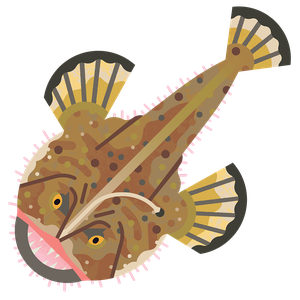
Pouting, or bib, is a very data limited species. There are no stock assessments, but recent studies indicate that the population may be declining. However, it is a low-value fish and is mainly caught as bycatch, so it would appear the fishing pressure is not of concern.Route 2 (data limited) scoring has been applied to this rating due to lack of reference points for biomass and fishing mortality. Pouting is considered to have a medium resilience to fishing.Pouting can be found throughout the coasts of the Northeast Atlantic, but stock structures are not well known. According to ICES catch data, 47% of pouting catches from 2006-2021 were from ICES area 7 (Celtic and Irish Seas and Bristol and English Channel). Almost all of them came from the English Channel (areas 7e and 7d). From 2006-2014 catches averaged around 5,350 tonnes, but were lower from 2015-2021, averaging around 3,700 tonnes. Between 2006 and 2021, around 30% of catches were from area 9 (Portuguese Waters), averaging 2,970 tonnes, and 20% from area 8 (Bay of Biscay), averaging 2,040 tonnes. The remaining 3% was from the North Sea, averaging 310 tonnes.A 2020 study attempted to estimate stock status of a number of data limited stocks from relative abundance (e.g. catch-per-unit-effort) and resilience (based on FishBase assessments). Based on data from 1983-2017, it was estimated that the ratio of North Sea pouting Biomass (B) to BMSY was 0.32, with estimates ranging between 0.18 and 0.58, indicating that the stock is very likely to be in a overfished state. Several studies on English Channel species indicate that pouting abundance in the English Channel has decreased since the 1990s. Abundance of the Portuguese population is also estimated to be decreasing. This indicates that there is concern for pouting abundance throughout its range.The level of fishing pressure is far more difficult to ascertain. For North Sea pouting, the ratio of Fishing Pressure (F) to FMSY has been estimated at 1.8, so this stock may be subject to overfishing, but there is a high level of uncertainty (the range of F:FMSY was 0.46 - 3.83). In the Basque demersal fishery (Bay of Biscay), pouting has been classed as a high-importance, high-risk fishery. However, in the Celtic Seas and English Channel, it is mainly caught as bycatch in the cod, haddock and saithe trawl fisheries, and there is no targeted fishery. It is therefore difficult to assess whether there is concern for fishing pressure.In the Basque fishery in the Bay of Biscay (ICES area 8), pouting is valued at 1.82 Euro/kg (approx. £1.63). In the UK, UK fleets landed on average of 700 tonnes per year between 2018 and 2022, valued at £135,000 overall, which makes the value approximately £0.26/kg. As a low-value, non-target fishery, and with landings decreasing, it seems likely that fishing pressure is not of concern. The lack of discard and recreational catch data add additional uncertainty. From 2002-2005, pouting was the 8th most discarded species in the beam trawl fleet in area 7. Discard survival rates of pouting are very low.