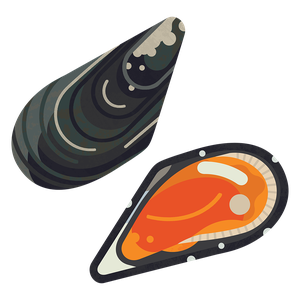
Queen scallop
Aequipecten opercularis
What to check for
Location
Wales
Technical location
Atlantic, Northeast, Irish Sea
Caught by
Dredge
Rating summary
There is very little information about queen scallops in Wales. Trends in the wider area suggest there could be concern for biomass and fishing pressure. There are few appropriate management measures in place. There is no harvest plan, catch limit, or significant effort control. Queen scallops in Wales are caught by dredging. This can have an impact on habitats, and has a bycatch of other species.
How we worked out this Rating
There is very little information about queen scallops in Wales. Trends in the wider area suggest there could be concern for biomass and fishing pressure. Route 2 (data limited) scoring has been applied to this rating owing to the lack of data. Queen scallops are considered to have low vulnerability to fishing (scoring 22 out of 100).There are a number of queen scallop fisheries in the Irish Sea. MMO data indicates that landings for the whole area (ICES Division 7a) have significantly declined from around 8,750 tonnes in 2016 to 2,770t in 2019. Landings for 2020 are even lower, at 1,770t, although Covid is likely to have affected the fishery. Within the Irish Sea, the main fishery is around the Isle of Man, responsible for around 1,000t of queen scallop landings in 2020. MMO data indicates that landings from Welsh waters averaged 60t between 2016 and 2020.There are no stock assessments of queen scallops in Welsh waters, and very little information to indicate the health of the population.Scallop surveys in Welsh waters have been carried out by Bangor University, but the main focus has been on king rather than queen scallops. The most recent available data for queen scallops is from 2013. It indicates that most queen scallops are found in north Wales in Liverpool Bay. However, there were only two years of data and therefore there was not enough information to indicate trends. There was no indication of whether the population size was healthy. In the absence of any information, we consider there to be concern for the biomass.Data for UK and Irish Sea fisheries in general indicates that widespread overfishing of queen scallops has taken place in recent years, leading to stock declines in multiple areas. While the Welsh fishery appears to be small compared to nearby fisheries, there is no data to indicate what a sustainable level of fishing pressure would look like for the Liverpool Bay stock. As there has been a pattern of overfishing elsewhere, and there is no data to demonstrate a sustainable approach in this area, there is concern for the fishing pressure.
There are few appropriate management measures in place for the queen scallop fishery. There is no harvest plan, catch limit, or significant effort control.Few specific management measures apply to fishing for queen scallops in Wales. There is no stock assessment, and no recently published data about stock trends that could indicate whether fishing is being appropriately managed.The main management measure applying to queen scallops is an EU minimum landing size of 40mm. In addition, the Western Waters Effort Regime limits how many days large boats (over 15m) can spend fishing for king or queen scallops in the Irish Sea. During 2017-2019, uptake of allowed effort was around 90%, suggesting that the effort regime was not limiting the fishery.There are a number of Marine Protected Areas in Welsh waters. However, the majority of queen scallop catches appear to be from an area of Liverpool Bay where there are no closures to protect stocks or habitats. As the fishery is not closely monitored, its full extent is somewhat uncertain. King scallop fishing in Wales is more regulated, with controls over where dredges can be used, a closed season, requirements for vessel tracking, and permits. However, all of these measures are specific only to fishing for king scallops.Queen scallop fishing also happens in the Irish Sea beyond the territorial waters of the Isle of Man, Northern Ireland and Wales. There are very few controls on this fishery. It is recommended that the Irish Sea queen scallop fishery be assessed and managed as a single biological stock.
Queen scallops in Wales are caught by dredging. This can have an impact on habitats, and has a bycatch of other species.The dredges used for queen scallops are 'skid dredges'. These are similar to those used for king scallops, usually known as Newhaven dredges, but with an important difference. Both comprise a heavy steel frame with a chainmail net. The Newhaven dredge has a toothed bar at the front that penetrates the seabed, flipping the scallop into the net. Skid dredges do not, and therefore are less damaging to seabed habitats. However, damage is still possible from the skids or skis that the dredge rests on, and which move along the sea floor.Data on the Welsh queen scallop fishery is limited. It appears to be focussed in Liverpool Bay, in North Wales. The seabed in this area is primarily sand and coarse sediment. A review of the impacts of fishing activities in Wales assigned a 'medium' risk to these habitats from queen scallop dredging. It deprioritised action on mitigating these risks because of the presence of legislation controlling scallop dredging in Wales. However, as the dredging legislation specifies that it is relevant only to fishing for Pecten maximus (king scallop), it is unclear how well queen scallop fishing is controlled.Studies of bycatch in dredge fisheries in Wales have noted higher levels of bycatch in skid dredges than Newhaven dredges. This is because the chainmail size in queen dredges is smaller and retains more. They have also noted higher bycatch in Liverpool Bay than elsewhere in Wales. Numerous species are recorded, including blonde ray, small-spotted catshark, whelks and the purple heart sea urchin. There is no data on the quantities caught. A study on king scallop dredging indicated that the most common bycatch species are spider crabs, common starfish, and brown crab. In a recent study, survival rates of dredged brown crabs were low (45% of crabs were dead/ severely damaged; 24% had missing limbs) and they require a lot of energy to repair themselves (which is vital for their growth and the moulting process). Most (around 75%) of the animals that king scallop dredges interact with remain on the seafloor and are not recorded in bycatch surveys. Therefore, in the absence of any additional data, this fishery has the potential to be contributing to declines in other species.
References
ABPmer, 2016. Assessing Welsh Fishing Activities - Phase 1, Principles and prioritisation report. ABPmer Report No R.2607. A report produced by ABPmer for Welsh Government, October 2016. Available at https://cdn.cyfoethnaturiol.cymru/media/684380/awfa-ppdoc-final-oct16.pdf.Delargy, A., Hold, N., Lambert, G.I., Murray L.G., Hinz H., Kaiser M.J., McCarthy, I., Hiddink J.G., 2019. Welsh waters scallop surveys and stock assessment. Bangor University, Fisheries and Conservation Report No. 75. pp 48. Available at http://sustainable-fisheries-wales.bangor.ac.uk/documents/Welsh%20waters%20scallop%20surveys%20and%20stock%20assessment.pdf [Accessed on 25.07.2022].Howarth, L. M. & Stewart, B. D. 2014. The dredge fishery for scallops in the United Kingdom (UK): effects on marine ecosystems and proposals for future management. Report to the Sustainable Inshore Fisheries Trust. Marine Ecosystem Management Report no. 5, University of York, 54 pp. Available at http://eprints.whiterose.ac.uk/79233/1/Howarth_and_Stewart_2014_Ecosystem_effects_management_of_UK_scallop_fisheries.pdf [Accessed on 14.06.2022].JNCC, 2022. MPA Mapper. https://jncc.gov.uk/mpa-mapper/ [Accessed on 26.07.2022].Lambert, G.I., Murray L.G., Kaiser M.J., Salomonsen H. and Cambie, G., 2013. Welsh waters scallop survey – Cardigan Bay to Liverpool Bay July-August 2013. Bangor University, Fisheries and Conservation Report No. 30. pp 44. Available at http://fisheries-conservation.bangor.ac.uk/wales/documents/30v2corr.pdf.Lambert, G.I., Murray L.G., Hinz H., and Kaiser M.J., 2014. Status of scallop populations in Welsh waters. Bangor University, Fisheries and Conservation Report No. 41. pp 61. Available at http://sustainable-fisheries-wales.bangor.ac.uk/documents/41corr.pdf [Accessed on 26.07.2022].MacNab, S. and Nimmo, F., 2022. Awel y Môr Offshore Wind Farm Commercial Fisheries Baseline Report. Report produced by Poseidon Aquatic Resources Management Ltd. Available at https://infrastructure.planninginspectorate.gov.uk/wp-content/ipc/uploads/projects/EN010112/EN010112-000249-6.4.8.1_AyM_ES_Volume4_Annex8.1_CommercialFisheriesBaseline_Final.pdf [Accessed on 26.07.2022].Ondes, F., Kaiser, M. and Murray, L. 2016. Quantification of the indirect effects of scallop dredge fisheries on a brown crab fishery. Marine Environmental Research, 119, pp.136-143. https://doi.org/10.1016/j.marenvres.2016.05.020.Palomares, M.L.D. and Pauly, D. Editors. 2022. SeaLifeBase: Pecten maximus, Great Atlantic scallop. Available at https://www.sealifebase.ca/summary/Aequipecten-opercularis.html [Accessed on 25.07.2022].Scottish Government, 2016. Consultation on New Controls in the Queen Scallop Fishery in ICES Divisions VIa and VIIa. Available at https://www.gov.scot/publications/consultation-new-controls-queen-scallop-fishery-ices-divisions-via-viia/ [Accessed on 25.07.2022].Szostek, C., Kaiser, M., Bell, E., Murray, L., & Lambert, G., 2017. Regional variation in bycatches associated with king scallop (Pecten maximus L.) dredge fisheries. Marine Environmental Research, 123, 1-13. https://doi.org/10.1016/j.marenvres.2016.11.006.UK Govt, 2022. Guidance: Manage your fishing effort: Western Waters crabs and scallops. Available at https://www.gov.uk/guidance/manage-your-fishing-effort-western-waters-crabs [Accessed on 08.07.2022].

Sustainable swaps
Learn more about how we calculate our sustainability ratings.
How our ratings work