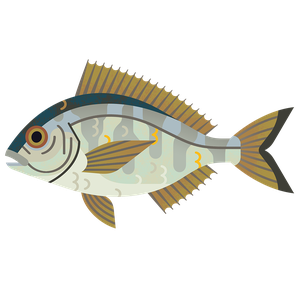
Red mullet
Mullus surmuletus
What to check for
Location
West of Scotland, Bay of Biscay, southern Celtic Seas, Atlantic Iberian Waters (Western Area)
Technical location
Atlantic, Northeast, Bay of Biscay, Bristol Channel, Celtic Sea (North), Celtic Sea (South), English Channel (West), Irish Sea, Porcupine Bank, Portuguese Waters (East), Rockall, West of Scotland, Southwest of Ireland (East), Southwest of Ireland (West), West of Ireland
Caught by
Bottom trawl (otter)
Rating summary
There is limited data on the striped red mullet population in these areas and fishing pressures are above advice limits. Management measures are lacking. Otter trawlers interact with the seabed and can modify bottom topography and cause damage.Rating last updated October 2023.
Technical consultation summary
There is limited data on the striped red mullet population in these areas and fishing pressures are above advice limits. Route 2 scoring has been applied to this rating owing to the lack of reference points for fishing pressure and biomass. Striped red mullet has a medium resilience to fishing pressure. Management measures are lacking, fish are fished without limit and above advised levels. Minimum legal-size limits are absent, or below size-of-maturity (I.e., France), offering inadequate protection to juveniles. It is unclear whether this stock should be one stock or three separate stocks. Otter trawlers interact with the seabed and can modify bottom topography and cause damage and removal of some biogenic features including vulnerable marine habitats and benthic communities.
How we worked out this Rating
There is limited data on the striped red mullet population (or stock) in this region and fishing pressures are above advised limits. Route 2 scoring has been applied to this rating owing to the lack of reference points for fishing pressure and biomass. Striped red mullet has a medium resilience to fishing pressure.This population (or stock) is data limited. The information available is insufficient to evaluate stock trends and exploitation. The only available data is landings data, which is not a good indicator of fishing mortality or biomass because it does not account for changes in fishing effort or catchability. In the absence of information there is concern for the population (or stock) biomass.Between 1975 and 2007 landings significantly increased, since a general decline in catches has been observed. Recent landings (1,973 tonnes in 2019, 1,445 tonnes in 2021 and 1,691 tonnes in 2022) have been above advised catch limits (1,600 tonnes in 2019, and 1,280 tonnes in 2021 and 2022) and the 5-year average (2018-2022). Moreover, for stocks without information on abundance or exploitation, ICES considers that a precautionary reduction of catches should be implemented unless there is supporting information clearly indicating that the current level of exploitation is acceptable for the stock. The precautionary buffer was last applied in 2020 and has been applied again in 2023. Consequently, there is concern for fishing pressure. ICES advises that when the precautionary approach is applied, landings should be no more than 1,024 tonnes in each of the years 2024, 2025, and 2026.
There are few management measures in place. The striped red mullet population is fished without limit, above advised levels and can be caught before having had the chance to reproduce.There is no known precautionary management plan in place for striped red mullet in these areas.Striped red mullet is not subject to Total Allowable Catch (TAC) and quotas. Recent catches have been significantly above advised limits. In 2019, 2021 and 2022, total catch exceeded advice by 23%, 13% and 32%, respectively.No Minimum Conservation Reference Size (MCRS) is in place for striped red mullet in UK waters. France applies a minimum size requirement of 15cm providing some, albeit limited, protection to immature fish. Striped red mullet reaches sexual maturity at an average of 16.1 cm. Fish caught below this length would likely not have had the chance to reproduce.In European waters, red mullet populations can be geographically divided into three zones:The Bay of Biscay (northern and southern)A mixing zone composed of the Celtic Sea and Western English Channel,A northern zone composed of the Eastern English Channel and the North Sea.This structuring should be taken into account when management measures are considered.Demersal fisheries in the area are mixed fisheries, with many stocks exploited together in various combinations in the different fisheries. In these cases, management advice must consider both the state of individual stocks and their simultaneous exploitation in demersal fisheries. Stocks in the poorest condition, particularly those which suffer from reduced reproductive capacity, become the overriding concern for the management of mixed fisheries, where these stocks are exploited either as a targeted species or as a bycatch.Discards are considered negligible.In the EU, compliance with regulations has been variable, and there are ongoing challenges with implementing some of them.In the UK, the Fisheries Act only came into force in January 2021. The Act requires the development of Fisheries Management Plans (FMPs) (replacing EU Multi-Annual Plans). FMPs have the potential to be very important tools for managing UK fisheries. They will set out the policies to secure the long-term sustainability of our fish stocks for current and future generations and can include (data allowing):Targets for fishing pressure and biomass, with effective management to meet them;Timeframes for stock recovery;Use of technologies such as Remote Electronic Monitoring (REM) to support data collection, improve transparency and accountability;Consideration of wider environmental impacts of the fishery.
Otter trawlers interact with the seabed and can modify bottom topography and cause damage and removal of some biogenic features including vulnerable marine habitats and benthic communities.The striped red mullet is a predominantly benthic fish found mostly on sandy muddy bottoms. Young fish are distributed in coastal areas, while adults have a more offshore distribution.The striped red mullet is one species among a set of demersal species targeted by the French fleet, and is mainly caught by bottom trawlers with a mesh size of 70-99 mm. Discarding is known to take place but discards cannot be fully quantified and are estimated to be non-negligible for this stock. This area is fished by trawlers of various types and this species is a bycatch in all of these fisheries.Demersal trawls penetrate the seabed, resulting in the abrasion of habitat features. The impact of trawling on the seabed depends on where trawling happens, and on what scale. For example, habitats that are used to natural disturbance through tides and waves are less sensitive to impacts. Areas not used to mobile towed gears are typically more sensitive.Demersal otter trawls have the potential to take relatively high quantities of bycatch. In the Northeast Atlantic there are reported catches of demersal elasmobranchs and endangered, protected and threatened (ETP) species (e.g., sharks, rays and marine mammals). Bycatch data is limited in many UK and EU fisheries as they are generally not well monitored.The main mitigation measures are Marine Protected Areas, some of which are designated for benthic features. If those MPAs were found to be subjected to bottom trawling, MCS would consider it a default red rating unless there is evidence (e.g., environmental impact assessment) indicating the activity does not damage the integrity of the site.UK regulations to reduce the impacts of fishing on marine habitats and wider species are under development, in the meantime most EU regulation have been adopted. Under EU legislation, bycatch species should be managed within scientifically defined or, where data isn’t available, suitability precautionary sustainable exploration limits. If stocks fall below a certain threshold, measures can be brought in such as gear limitations (e.g., mesh size or depth of use), time and/or areas closures, and Minimum Conservation Reference Sizes (MCRS).
References
Angling Trust (2023). Minimum Conservation Reference Sizes. Available at https://anglingtrust.net/minimum-conservation-reference-sizes-mcrss/ [Accessed 24.07.2023]Cornwall IFCA (2023). Cornwall IFCA byelaws, other regulations and codes of practise: Specified fish sizes (as amended). Available at https://www.cornwall-ifca.gov.uk/Byelaws_Regulations [Accessed 24.07.23]Eigaard OR, Bastardie F, Breen M, Dinesen GE, Hintzen NT, Laffargue P, et al. 2016. Estimating seabed pressure from demersal trawls, seines, and dredges based on gear design and dimensions. ICES J Mar Sci, 73(suppl_1):i27–43.Froese R. and Pauly D. (Editors), 2023. Mullus surmuletus, Red mullet. Available at: https://www.fishbase.se/Summary/SpeciesSummary.php?ID=1327&AT=red+mullet [Accessed 24.07.2023]Hiddink JG, Jennings S, Sciberras M, Szostek CL, Hughes KM, Ellis N, et al. 2017. Global analysis of depletion and Recovery of seabed biota after bottom trawling disturbance. Proc Natl Acad Sci, 114(31):8301–6.ICES. 2022a. Greater North Sea ecoregion – fisheries overview. ICES Advice: Fisheries Overviews. Report. https://doi.org/10.17895/ices.advice.21641360.v1 [Accessed 03.07.2023]ICES. 2022b. Greater North Sea ecoregion – Ecosystem Overview. ICES Advice: Ecosystem Overviews. Report. https://doi.org/10.17895/ices.advice.21731912.v1 [Accessed 03.07.2023]ICES. 2023c. Striped red mullet (Mullus surmuletus) in Subarea 4 and divisions 7.d and 3.a (North Sea, eastern English Channel, Skagerrak and Kattegat). In Report of the ICES Advisory Committee, 2023. ICES Advice 2023, mur.27.3a47d. https://doi.org/10.17895/ices.advice.21840957 [Accessed 20.07.2023]ICES. 2023d. Stock Annex: Striped red mullet (Mullus surmuletus) in Subarea 4 and divisions 7.d and 3.a (North Sea, eastern English Channel, Skagerrak and Kattegat). ICES Stock Annexes. 29 pp. https://doi.org/10.17895/ices.pub.23578803 [Accessed 20.07.2023]ICES. 2023e. Working Group on Widely Distributed Stocks (WGWIDE). ICES Scientific Reports. 5:82. 980 pp. https://doi.org/10.17895/ices.pub.24025482 [Accessed 02.10.2023]Kennelly, S. J. & Broadhurst, M. K., 2021. A review of bycatch reduction in demersal fish trawls. Rev Fish Biol Fisheries 31, 289–318. https://doi.org/10.1007/s11160-021-09644-0Kynoch, R., Fryer, R. & Neat, F., 2015. A simple technical measure to reduce bycatch and discard of skates and sharks in mixed-species bottom-trawl fisheries. ICES J Mar Sci,72(6):1861. https://doi.org/10.1093/icesjms/fsv037Leaper, R. 2021. An evaluation of cetacean bycatch in UK fisheries: problems and solutions. Available at https://uk.whales.org/wp-content/uploads/sites/6/2021/02/cetacean-bycatch-uk-fisheries-problems-solutions.pdf [Accessed 17.07.2023]MCS. 2023. MPA Reality Check. Available at https://mpa-reality-check.org/ [Accessed 03.07.2023]Monterey Bay Aquarium Seafood Watch. 2023. Red mullet. Available at https://www.seafoodwatch.org/globalassets/sfw-data-blocks/reports/M/seafood-watch-red-mullet-uk-27937.pdf [Accessed 24.07.2023]North Western IFCA (2023). Minimum sizes. Available at https://www.nw-ifca.gov.uk/minimum-sizes/ [Accessed 24.07.23]Seafish, 2023. Demersal Trawl - General. Available at: https://www.seafish.org/responsible-sourcing/fishing-gear-database/gear/demersal-trawl-general/ [Accessed 19.07.2023]Silva, F., Ellis, J. & Catchpole, T., 2012. Species composition of skates (Rajidae) in commercial fisheries around the British Isles and their discarding patterns. J Fish Biol., 80:1678–1703. https://doi.org/10.1111/j.1095-8649.2012.03247.xSouthern IFCA (2023). Minimum sizes. Available at https://www.southern-ifca.gov.uk/da/164147 [Accessed 24.07.23]van Denderen PD, Bolam SG, Hiddink JG, Jennings S, Kenny A, Rijnsdorp AD, et al. 2015. Similar effects of bottom trawling and natural disturbance on composition and function of benthic communities across habitats. Mar Ecol Prog Ser, 541:31–43.

Sustainable swaps
Learn more about how we calculate our sustainability ratings.
How our ratings work