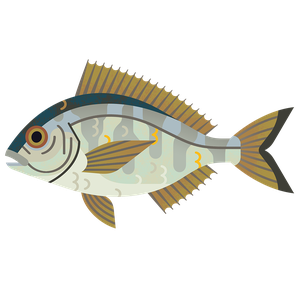
Red mullet
Mullus surmuletus
What to check for
Location
West of Scotland, Bay of Biscay, southern Celtic Seas, Atlantic Iberian Waters (Western Area)
Technical location
Atlantic, Northeast, Bay of Biscay, Bristol Channel, Celtic Sea (North), Celtic Sea (South), English Channel (West), Irish Sea, Porcupine Bank, Portuguese Waters (East), Rockall, West of Scotland, Southwest of Ireland (East), Southwest of Ireland (West), West of Ireland
Caught by
Bottom trawl (otter)
Rating summary
For more information about this rating please visit: https://www.cornwallgoodseafoodguide.org.uk/fish-guide/red-mullet.php
Technical consultation summary
Lack of data - ICES advise TAC should be reduced by 20% as a precautionary approach. Stock data is very poor and while landings are on a downward trend, they have exceeded ICES advice in recent years. NQS species. Management within Cornwall IFCA district is a MLS 15cm and voluntary code of conduct for netting is in place. Red mullet make up a small, but high value part of the Cornish fishing industry's landings. Red mullet stocks are not well studied in our area. Landings data show a fluctuating quantity of red mullet landed to Cornish ports, decreasing but occasionally exceeding TAC advice. The stocks are not protected by quotas but in Cornwall are protected by a minimum landing size of 15cm. Red mullet are caught using specialised red mullet nets in coastal waters and are also caught in Cornish trawl fisheries. Management in Cornish waters is through a voluntary code and mls.
How we worked out this Rating
There is limited data on the striped red mullet population (or stock) in this region and fishing pressures are above advised limits. Route 2 scoring has been applied to this rating owing to the lack of reference points for fishing pressure and biomass. Striped red mullet has a medium resilience to fishing pressure.This population (or stock) is data limited. The information available is insufficient to evaluate stock trends and exploitation. The only available data is landings data, which is not a good indicator of fishing mortality or biomass because it does not account for changes in fishing effort or catchability. In the absence of information there is concern for the population (or stock) biomass.Between 1975 and 2007 landings significantly increased, since a general decline in catches has been observed. Recent landings (1,973 tonnes in 2019, 1,445 tonnes in 2021 and 1,691 tonnes in 2022) have been above advised catch limits (1,600 tonnes in 2019, and 1,280 tonnes in 2021 and 2022) and the 5-year average (2018-2022). Moreover, for stocks without information on abundance or exploitation, ICES considers that a precautionary reduction of catches should be implemented unless there is supporting information clearly indicating that the current level of exploitation is acceptable for the stock. The precautionary buffer was last applied in 2020 and has been applied again in 2023. Consequently, there is concern for fishing pressure. ICES advises that when the precautionary approach is applied, landings should be no more than 1,024 tonnes in each of the years 2024, 2025, and 2026.
For more information about this rating please visit: https://www.cornwallgoodseafoodguide.org.uk/fish-guide/red-mullet.php
References
For more information about this rating please visit: https://www.cornwallgoodseafoodguide.org.uk/fish-guide/red-mullet.php
Sustainable swaps
Learn more about how we calculate our sustainability ratings.
How our ratings work