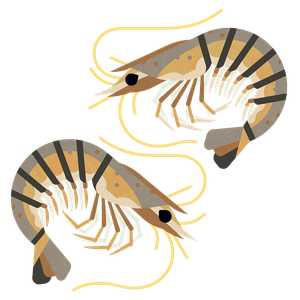
Scampi or langoustine
Nephrops norvegicus
What to check for
Location
Skagerrak and Kattegat (FU 3 & 4)
Technical location
Atlantic, Northeast, Skagerrak and Kattegat
Caught by
Pot, trap or creel
Rating summary
In the Skagerrak and Kattegat, scampi, often referred to as Nephrops or Norway lobster, is data limited as there is no threshold to indicate a sustainable stock size. There does not appear to be concern for the biomass, and fishing pressure is below the target level. Some management measures are in place, and catches are within recommended limits. Creeling or potting is a low impact method of fishing, with low levels of bycatch and low impact on the seabed.Rating last updated: January 2023
Technical consultation summary
In the Skagerrak and Kattegat, scampi, often referred to as Nephrops or Norway lobster, is data limited. There does not appear to be concern for the biomass as although the abundance has declined, landings per unit effort have been increasing and are at a long-term high level. ICES has also concluded that there are no signs of overexploitation in this stock. The total catch in 2022 was 7,110 tonnes, which is equivalent to a harvest rate of 4.7% of the population. This is below FMSY (7.9%) and therefore, there is no concern for fishing pressure. Some management measures are in place, and catches are within recommended limits. Creeling or potting is a low impact method of fishing, with low levels of bycatch and low impact on the seabed.
How we worked out this Rating
In the Skagerrak and Kattegat, scampi, often referred to as Nephrops or Norway lobster, is data limited. There does not appear to be concern for the biomass, and fishing pressure is below the target level.Route 2 scoring has been applied to this rating owing to the uncertainty of the data and the lack of reference points for biomass. Norway lobster is considered to have a medium resilience to fishing pressure.Stock abundance in 2022 is estimated to be 3,138 million individuals. Abundance has steadily declined from a peak of 5,152 million in 2017. There is no threshold or reference to indicate what a sustainable stock size would be. However, landings per unit of effort have been increasing and are at a long-term high level. ICES has concluded that there are no signs of over-exploitation in this stock. Therefore, there is no concern for the biomass.The total catch in 2022 was 7,110 tonnes. This is equivalent to a harvest rate of 4.7% of the population (by number). This is below the level associated with Maximum Sustainable Yield (FMSY, 7.9%), indicating that the stock is not subject to overfishing. Therefore, there is no concern for fishing pressure.ICES advises that when the Maximum Sustainable Yield (MSY) approach is applied, and assuming that discard rates and fishery selection patterns do not change from the average of the years 2020-2022, catches in 2024 should be no more than 11,863 tonnes. This is a 1.7% decrease from the previous year's advice.A 2011 study on Norway lobster in the Clyde found a high prevalence of plastics and suggested that this could have implications for the health of the stock - this may have relevance for other Norway lobster stocks. Some of the plastics were sourced to fishing waste. Studies have shown that the effects of climate change - warmer waters, reduced oxygen levels, higher ocean acidity, and higher levels of heavy metals - can negatively impact Norway lobsters' larval development and make adults more susceptible to disease. Lower oxygen levels can also cause Norway lobster to leave their burrows, making them easier to catch.
Some management measures are in place for Norway lobster in the Skagerrak and Kattegat, and catches are within recommended limits. However, discarding of unwanted catch is high and needs to be reduced.Norway lobster stock assessments are conducted by the International Council for the Exploration of the Sea (ICES). Stock assessments are produced for 33 areas across the Northeast Atlantic, called Functional Units (FUs). However, management is applied to 18 areas, called management units. In general, management units broadly overlap with the functional units, but not very effectively. However, in this area, the stock unit and management unit match.This stock is mainly fished by Denmark, Sweden and Norway, and managed through the EU's North Sea Multi Annual management Plan (MAP). This MAP covers eleven FUs: 3-10, and 32-34. It provides guidance on setting catch limits, and FU-specific management measures can be introduced if individual stocks are found to be below sustainable levels.Catch limits (Total allowable Catches, TACs) are specific to this Norway lobster stock. They have been in line with or below the advice every year since 2012. Actual catches (including discards) have stayed within those limits. This is contrast to other areas, where catch limits are set for multiple stocks combined, allowing overexploitation in some areas. The TAC in 2022 and 2023 was for 8,501 tonnes.In addition to catch limits, Denmark and Sweden incentivise the use of more selective fishing gear to reduce bycatch of unwanted species and undersized Norway lobster. In Sweden, 30% of the quota is allocated to creels, 50% to grid trawls and the remaining 20% to other trawls. Swedish fleets must use a species-selective grid, with a certain mesh size for part of the net. Danish fleets must use either the grid or a SELTRA trawl which has a larger-meshed net and an escape panel.There is Minimum Conservation Reference Size of 25mm in the North Sea, and 32mm in the Skagerrak and Kattegat. Below this size, Norway lobster must be landed but can't be sold for human consumption, and so have a lower value. Under the EU Landings Obligation (LO) and Norwegian law, it is illegal to discard unwanted (e.g. undersized or over-quota) Norway lobster at sea. However, there are exemptions in this area, because this species survives well after being discarded (25-50% survival rate), even from trawlers. Discarding is still allowed in all creel fisheries and throughout the Skagerrak. Discard rates for this stock have been high, at around 30% by number, and scientists recommend further work to reduce it.
Creeling or potting is a low impact method of fishing, with low levels of bycatch and low impact on the seabed.Creeling only accounts for a small proportion of Norway lobster catches in this area, at around 5%. The remainder is caught by trawling. Creeling is mainly carried out by Sweden, and mainly in the Skagerrak.Bycatch in creel fisheries is generally low, and survival rates of any species bycaught are far higher than from trawling. Bycatch species can include whelks, crabs and lobster. The discarded catch is small (around 6% of total catch). Some cod is bycaught in Swedish creel fisheries, but bycatch levels are about a tenth of that in Norway lobster trawls and the survival rate is between 75% and 100% (compared to 0% in trawl fisheries).Creeling in the Swedish fishery generally happens near the coast on mud or sandy mud. The impact of creels on the seabed is likely to be low, although they can sometimes impact sessile species. The impact on sea pens is considered minimal.Creel fisheries are exempt from the discard bans, as Norway lobster are likely to survive after being discarded from these fisheries. Creeling tends to catch larger Norway lobster than trawling, and below-minimum-size individuals are likely to survive if caught and released. This can result in lower fishing pressure than trawling. However, creeling may catch more females than males, and in particular could catch berried (egg-bearing) females, which could have an impact on reproduction. More research is needed to fully understand the level of risk. At the current low harvest rates, it is not expected to be a significant concern.
References
BENTHIS. 2015. Deliverable 2.3: Benthic impact of fisheries in European waters: the distribution and intensity of bottom trawling. Available at: http://archimer.ifremer.fr/doc/00310/42138/54476.pdf [Accessed on 27.11.2023].CruCSChange, 2015. The crustacean chemosensory system: Consequences of climate and environmental change. EU Grant agreement ID: 331296. Available at https://cordis.europa.eu/article/id/182940-impact-of-environmental-change-on-norway-lobster [Accessed on 27.11.2023].EU, 2018. Regulation 2018/973 establishing a multiannual plan for demersal stocks in the North Sea and the fisheries exploiting those stocks. Available at https://eur-lex.europa.eu/legal-content/en/TXT/?uri=CELEX:32018R0973 [Accessed on 27.11.2023].Hinz, H., Prieto, V., and Kaiser, M. J., 2009. Trawl disturbance on benthic communities: chronic effects and experimental predictions. Ecological Applications: A Publication of the Ecological Society of America, 19(3), 761-73. https://doi.org/10.1890/08-0351.1Hornborg,S., Jonsson, P., Skad, M., Ulmestrand, M., Valentinsson, D., Eigaard, O.R., Feekings, J., Nielsen, J.R., Bastardie, F. Lavgren, J., 2017. New policies may call for new approaches: the case of the Swedish Norway lobster (Nephrops norvegicus) fisheries in the Kattegat and Skagerrak, ICES Journal of Marine Science, 74 (1) pp: 134-145. https://doi.org/10.1093/icesjms/fsw153.ICES. 2023. EU standing request on catch scenarios for zero-TAC stocks: cod (Gadus morhua) in Subdivision 21. Replacing technical service provided in November 2023. In Report of the ICES Advisory Committee, 2023. ICES Advice 2023, sr.2023.09e. Available at https://doi.org/10.17895/ices.advice.24720483 [Accessed on 27.11.2023].ICES. 2023. Norway lobster (Nephrops norvegicus) in Division 3.a, Functional units 3 and 4 (Skagerrak and Kattegat). In Report of the ICES Advisory Committee, 2023. ICES Advice 2023, nep.fu.3-4. https://doi.org/10.17895/ices.advice.2197518. [Accessed on 27.11.2023].ICES, 2022. Working Group on the Assessment of Demersal Stocks in the North Sea and Skagerrak (WGNSSK). ICES Scientific Reports. 3:66. 1281 pp. Available at http://doi.org/10.17895/ices.pub.19786285 [Accessed on 27.11.2023].Jones, H., Addison, J., Sieben, C., Blyth-Skyrne, R., Borges, L. and Honneland, G., 2022. Marine Stewardship Council (MSC) 2nd Surveillance Audit Report: Background Report: Joint demersal fisheries in the North Sea and adjacent waters. Prepared by Control Union (UK) Limited On behalf of Danmarks Fisheriforening Producent Organisation (DFPO), Sveriges Fiskares Producent Organisation (SFPO), Erzeugergemeinschaft-nordsee (EZG) and Coöperatieve Visserij Organisatie (CVO). 91pp. Available at https://fisheries.msc.org/en/fisheries/joint-demersal-fisheries-in-the-north-sea-and-adjacent-waters/@@assessments [Accessed on 27.11.2023].Matear, L., Vina-Herbon, C., Woodcock, K.A., Duncombe-Smith, S.W., Smith, A.P., Schmitt, P., Kreutle, A., Marra, S., Curtis, E.J., and Baigent, H.N. 2023. Extent of Physical Disturbance to Benthic Habitats: Fisheries. In: OSPAR, 2023: The 2023 Quality Status Report for the Northeast Atlantic. OSPAR Commission, London. Available at https://oap.ospar.org/en/ospar-assessments/quality-status-reports/qsr-2023/indicator-assessments/phys-dist-habs-fisheries/ [Accessed on 27.11.2023].Murray and Cowie, 2011. Plastic contamination in the decapod crustacean Nephrops norvegicus (Linnaeus, 1758). Marine Pollution Bulletin, 62: 6, pp.1207-1217. https://doi.org/10.1016/j.marpolbul.2011.03.032.OSPAR. 2023. Sea Pen & Burrowing Megafauna. Available at https://www.ospar.org/work-areas/bdc/species-habitats/list-of-threatened-declining-species-habitats/habitats/sea-pen-burrowing-megafauna [Accessed on 27.11.2023].Palomares, M.L.D. and Pauly, D. (Editors), 2023. SeaLifeBase. Nephrops norvegicus: Norway lobster. Available at https://www.sealifebase.ca/summary/Nephrops-norvegicus.html [Accessed on 27.11.2023].Wood, H., Eriksson, S., Nordborg, M., and Styf, H., 2015. The effect of environmental stressors on the early development of the Norway lobster Nephrops norvegicus (L.). Journal of Experimental Marine Biology and Ecology. 473. pp. 35-42. http://dx.doi.org/10.1016%2Fj.jembe.2015.08.009

Sustainable swaps
Learn more about how we calculate our sustainability ratings.
How our ratings work