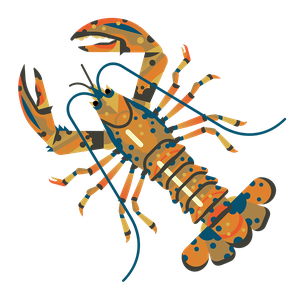
Scampi or langoustine
Nephrops norvegicus
What to check for
Location
Firth of Clyde and Sound of Jura (FU 13)
Technical location
Atlantic, Northeast, West of Scotland
Caught by
Pot, trap or creel
Rating summary
In the Firth of Clyde and the Sound of Jura, Norway lobster is not overfished or subject to overfishing. Some management measures are in place. Current catches exceed recommended limits, and catch limits don't match the stock area. From 2022, a pot limit per vessel size is being trialled to help improve catch per unit effort. Entanglement rates in creel fisheries on the west coast are possibly contributing to the decline or preventing the recovery of minke whales.Rating last updated November 2025.
Technical consultation summary
In the Firth of Clyde and the Sound of Jura, Norway lobster is not overfished or subject to overfishing. Within this Functional Unit, the two subareas have different characteristics and different reference points. However, catch data cannot be separated and so only a combined harvest rate is provided. In both the Firth of Clyde and the Sound of Jura, the stock has decreased since the peak in 2018 but is still well above MSY BTrigger and therefore, not considered in an overfished state. The total catch for both areas combined in 2024 was 4,596 tonnes, representing a 12.5% harvest rate of the overall population (by number). This is below the FMSY level for the Firth of Clyde (15.1%), but in the Sound of Jura, the harvest rate is above FMSY (12%), though still below 1.1 x FMSY (13.2%). These figures indicate that the stock is not currently subject to overfishing. Some management measures are in place. Most recent catches have exceeded recommended limits, and catch limits don't match the stock area. The total catches for Clyde and Jura exceeded advised limits in 2023 (4.4%) and 2024 (1.5%). A pot limit per vessel size is being trialled to help improve catch per unit effort. Entanglement rates in creel fisheries on the west coast are possibly contributing to the decline or preventing the recovery of minke whales. In 2022, a study interviewed fishers about whale entanglements in Scotland. Of 59 Nephrops fishers interviewed, 27 reported minke whale entanglement, and 5 reported humpback whale entanglement. The study also found that there was a positive correlation between the average amount of gear set by a vessel and the number of minke whale entanglements.
How we worked out this Rating
In the the Firth of Clyde and the Sound of Jura, scampi, often referred to as Nephrops or Norway lobster, is not overfished or subject to overfishing.Stock assessments are carried out annually by the International Council for the Exploration of the Sea (ICES). The most recent assessment was published in 2025 using data up to 2025. The next assessment is expected in 2026.The stock assessment defines reference points for fishing pressure (F) and biomass (B). For fishing pressure, there is a target to keep F at or below Maximum Sustainable Yield (MSY). For biomass, there is no target. However, there is a trigger point (MSY BTrigger). Below this level, F should be reduced to allow the stock to increase. Because BMSY is not defined, the Good Fish Guide (GFG) applies its own definition of 1.4 x MSY BTrigger.Within this Functional Unit, the two subareas have different characteristics and different reference points. However, catch data cannot be separated and so only a combined harvest rate is provided.In the Firth of Clyde, stock abundance in 2025 is estimated to be 1,861 million individuals. There has been a decrease since the peak of 2,193 million in 2018, but have been increasing in recent years. The stock remains well above target levels (MSY BTrigger, 580 million) and the GFG BMSY proxy (812 million).In the Sound of Jura, stock abundance in 2025 is estimated to be 424 million individuals. This stock has also decreased since a peak of 422 million in 2016, have been increasing in recent years. This stock also remains well above target levels (MSY BTrigger, 160 million) and the GFG BMSY proxy (224 million). Therefore, the stock is not in an overfished state.In 2024, the combined catch from both areas totaled 4,596 tonnes, representing a 12.5% harvest rate of the overall population (by number). This is below the FMSY level for the Firth of Clyde (15.1%), but in the Sound of Jura, the harvest rate is above FMSY (12%), though still below 1.1 x FMSY (13.2%). These figures indicate that the stock is not currently subject to overfishing.ICES advises that when the MSY approach is applied, catches in 2026 should be no more than 6,080 tonnes (5,148 tonnes for the Firth of Clyde and 932 tonnes for the Sound of Jura), assuming discard rates and fishery patterns don't change from recent years. The combined advice for 2026 is 22% higher for the Clyde and 32% higher for the Sound Jura compared to in 2025. This is due to the higher estimated stock abundance and increased mean weights in both the Firth of Clyde and Sound of Jura.A 2011 study on Norway lobster in the Clyde found a high prevalence of plastics and suggested that this could have implications for the health of the stock - this may have relevance for other Norway lobster stocks. Some of the plastics were sourced to fishing waste. Studies have shown that the effects of climate change - warmer waters, reduced oxygen levels, higher ocean acidity, and higher levels of heavy metals - can negatively impact Norway lobsters' larval development and make adults more susceptible to disease. Lower oxygen levels can also cause Norway lobster to leave their burrows, making them easier to catch.
Some management measures are in place for Norway lobster in the Firth of Clyde and Sound of Jura. Current catches exceed recommended limits, and catch limits don't match the stock area.Norway lobster stock assessments are conducted by the International Council for the Exploration of the Sea (ICES). Stock assessments are produced for 33 areas across the Northeast Atlantic, called Functional Units (FUs). However, management is applied to 18 areas, called management units. These management units broadly overlap with the functional units, but not very effectively. Vessels are free to move between grounds, allowing relatively uncontrolled fishing on some stocks, and risking overfishing. Scientists have repeatedly advised over the years that management should be implemented at the functional unit level, to better protect Norway lobster. This would result in fishing controls that respond to changes within individual stocks.In this particular FU, the scientific advice is that additional measures should be implemented to ensure that landings taken in each subarea (the Firth of Clyde and the Sound of Jura) are in line with the advice. These recommendations are not being followed.This stock is fished by the UK, primarily by Scottish fleets. It is covered by the EU's Western Waters Multi Annual management Plan (MAP), but the UK is not signed up to the MAP. There is no UK management plan for it.Catch limits (Total Allowable Catches, TACs) are in place, but these are not specific to this Norway lobster stock. One TAC covers the whole of the West of Scotland (subarea 6), encompassing 3 different stocks. This does not protect stocks from overfishing. In recent years, catches in Subarea 6 have been less than the TAC, as there has been a general decline in trawling fishing effort for Norway lobster. The total catches for Clyde and Jura exceeded advised limits in 2023 (4.4%) and 2024 (1.5%). Previous to these years catches averaged 87% of the advice from 2018 to 2022. However, currently catches are not following scientific advice.In addition to catch limits, there are requirements to use selective gear (e.g. square-meshed panels) to allow small Norway lobster and fish to escape the nets, with the aim of reducing bycatch. Scotland has established a network of regional Inshore Fisheries Groups (rIFGs). These non-statutory bodies aim to improve the management of Scotland's inshore fisheries out to six nautical miles, and to give commercial inshore fishermen a strong voice in wider marine management developments. In 2022, the first rIFG management measure was implemented in the Firth of Clyde to help improve catch per unit effort. Restrictions have been introduced on the total number of creels or pots each vessel can work, depending on the size of the vessel. The aim is that this will allow for greater sustainability for the shellfish stocks as well as for the fishers and the coastal communities that rely on the fishing industry. For crab and lobster, a maximum of 650 creels per boat are allowed, and for Nephrops the limits are as follows:Under 8 metre vessels - 700 creelsBetween 8 and 10 metre vessels - 1,100 creelsBetween 10 and 12 metre vessels - 1,400 creelsVessels over 12 metres in length - 1,600 creelsThere is a Minimum Conservation Reference Size of 25mm in the Celtic Seas. Below this size, Norway lobster must be landed but can't be sold for human consumption, and so have a lower value. Under the EU Landings Obligation (LO) and UK law, it is illegal to discard unwanted (e.g. undersized or over-quota) Norway lobster at sea. However, there are exemptions in this area, because this species survives well after being discarded, even from trawlers. Discarding is still allowed in all creel fisheries and up to 5% can be discarded from trawlers. Compliance with the LO is poor throughout European fisheries. In this fishery, discard rates have been high, averaging 27% by number since 1999. They declined to just 2.5% in 2018 but increased back to 12.5% in 2024. The average from 2020-2024 is 7%, which is relatively low but still above the 5% legally allowed.The Project UK FIP includes Nephrops caught by trawl or creel around the UK. It began in 2019 and ended in April 2024.The FIP was successful in tackling some issues, including providing research into habitat impacts and developing advice for potential approaches to a harvest strategy. These outcomes are not inconsiderable. However, there has been very little change to the footprint of the Nephrops fishery, and requirements are not being met for outcomes for endangered, threatened and protected (ETP) species, despite research by the FIP indicating that trawling poses a significant risk to them. The advice on harvest strategy has also not resulted in any changes to management.The EU and UK both have fishery management measures, which can include catch limits, population targets, and gear restrictions. However, compliance in the EU and UK has been inconsistent, with ongoing challenges in implementing some regulations. The goal of reaching Maximum Sustainable Yield (MSY) by 2020 was missed, with less than half of UK TACs in 2024 following ICES advice. In 2024, the EU and UK reaffirmed their commitment to sustainable fisheries by aligning management with scientific advice to gradually approach MSY. However, no new target date has been set for achieving MSY across all fisheries. The Landing Obligation (LO), an EU law retained by the UK post-Brexit, requires all quota fish to be landed, even if unwanted (over-quota or below minimum size). It aims to encourage more selective fishing methods, reduce bycatch, and improve catch reporting. However, compliance is poor, and accurate discard levels are hard to quantify with current monitoring programmes. The UK is in the process of replacing the LO with country-specific Catching Policies.The Marine Conservation Society views Remote Electronic Monitoring (REM) with cameras is one of the most cost-effective tools for providing reliable fisheries data and aiding informed management decisions. Fully monitored fisheries enhance collaboration, data accuracy, stock recovery, and reduce impacts on marine wildlife and habitats. However, the full potential of REM may only be achieved when it tracks fishing location and documents catch and bycatch, particularly where vulnerable species and habitats are at risk. As of January 2024, the EU is introducing a Remote Electronic Monitoring (REM) mandate for EU vessels, including CCTV cameras on vessels 18m or more that pose a potential risk of non-compliance, within the next 4 years. Across the UK, different approaches to REM are being taken and legislation is expected to be in place across all 4 countries within the next few years.The Fisheries Act (2020) requires the development of Fisheries Management Plans (FMPs) (replacing EU Multi-Annual Plans) in the UK. 43 FMPs have been proposed and are at various stages of development and implementation, these should all be published by the end of 2028. FMPs have the potential to be very important tools for managing UK fisheries, although data limitations may delay them for some stocks. It is also essential the UK governments define and adopt a standardised approach or model across the four nations to a universally defined FMP design, to ensure the consistence, quality and coherence of all the proposal FMPs.The Marine Conservation Society is keen to see publicly available Fishery Management Plans for all commercially exploited stocks, especially where stocks are depleted, that include:An overview of the fishery including current stock status, spatial coverage, current fishing methods and impactsTargets for fishing pressure and biomass, and additional management when those targets are not being met, based on the best scientific evidenceTimeframes for stock recoveryImproved data collection, transparency, and accountability, supported by technologies such as Remote Electronic Monitoring (REM)Consideration of wider environmental impacts of the fishery, including habitat impacts and minimising bycatchStakeholder engagementA West of Scotland Nephrops FMP has been proposed, coordinated by the Scottish Government that incorporates this stock. At the time of writing, it is too soon to know whether proposed management measures will be effective in managing the stock. For more information about this FMP and expected progress and timelines, see [https://www.gov.uk/government/collections/fisheries-management-plans#published-fmps].
Some Norway lobster in this area are caught by creels. Entanglement rates in creel fisheries on the west coast are possibly contributing to the decline or preventing the recovery of minke whales.Around 5.5% of Nephrops landings in the Firth of Clyde and Sound of Jura are by creels, while the majority (94.5%) are by trawl.Creeling is a relatively passive method of fishing, using baited pots placed on the seabed to attract Norway lobster. However, there is potential for entanglement of endangered, threatened or protected species from the ropes attached to the pots. A report in 2010 estimated that around 7.5km of creel lines would be in Scottish waters throughout most of the year. These creels are targeting crab, lobster, and Norway lobster. Whales become entangled in groundline because the rope used is buoyant and floats in loops between pots, rather than lying on the seabed.The main species at risk are minke and humpback whales and basking sharks. Recent data suggest that 2.3% of the local minke population may be killed through entanglement each year, which is risking local depletion. Humpback whales are present in low abundances in Scottish waters, but entanglement rates are relatively high, and increasing. For both species, there is a risk of local depletion as a result. In 2022, a new study interviewed fishers about whale entanglements in Scotland. Of 59 Nephrops fishers interviewed, 27 reported minke whale entangelement, and 5 reported humpback whale entanglement. The study also found that there was a positive correlation between the average amount of gear set by a vessel and the number of minke whale entanglements.Minke whales entanglements are likely to be acutely fatal, with 84% of entangled minke whales found by creel fishers being already dead. In the area covering the west coast of Scotland, inside of the Outer Hebrides, it is estimated that there are 16 fatal entanglements per year. Potential biological removal (PBR) is used to assess the conservation implications of bycatch. In this area, the PBR for minke whales would be 4.6 individuals per year, this is less than a third of the estimated annual number of fatal entangelements. This suggests a risk of localised depletion for minke whales.Work is underway with fishers to investigate ways to reduce these risks, but no widescale mitigation measures have so far been introduced. Marine mammal bycatch reporting requirements were only introduced in the UK in November 2021, so monitoring to date has been poor. Scottish creel fishers have shown a willingness to engage in entanglement mitigation, with suggestions such as the introduction of sinking groundline to the sector, and these options should be urgently pursued.Unwanted catch within the pots, e.g. egg-bearing Norway lobsters or other species, is released alive and is very likely to survive. This generally includes whelks, hermit crabs, brown crabs, velvet crabs, and lobsters. Bycatch of these species is not a concern in this fishery.The impact of creels on the seabed is likely to be low. They are normally set on a mud surface but can sometimes impact sessile species, although the impact of creels on sea pens is considered minimal. Research that has taken place suggests that while some damage does occur, it is unlikely to be significant unless potting intensity is high (defined as approximately 30 pots per 500 square metres). Most damage occurs where traps are set in rocky habitats that are home to corals, sponges, sea whips and other large emergent species. These habitats and species provide nursery areas, refuges from predators and habitat for the settlement of invertebrate spat. To mitigate their impact, under the National Marine Planning process, habitats are being mapped in Scottish waters. Burrowed mud habitat is mapped as a priority marine feature, as per OSPAR Convention legislation.There are some fishing restrictions in the Firth of Clyde. There is a weekend ban on mobile gear, and vessels over 21m are also banned in the Inshore area. Creeling activity now takes place quite widely in the northern parts of the Firth of Clyde, operating on some of the same grounds but often taking place during the weekend trawling ban.There are also three Marine Protected Areas (MPAs) with management measures in the Firth of Clyde and the Sound of Jura.In the South Arran Nature Conservation (NC) MPA, which extends onto the main patch of Nephrops habitat, there is a complete ban on demersal vessels greater than 120t. Partial closures (i.e. zoned management) for smaller trawlers and creelers are also in place. This removed a large sea area for Nephrops trawlers to operate over and has reportedly increased trawling effort outside of the prohibited area, and allowed creelers to move into the areas were trawling was banned. There have been recent reports of increases in creel numbers in this area and this has resulted in gear conflict within the creel sector.In Loch Sween, north of the main habitat area in the Sound of Jura subarea, demersal trawling is banned, with some exceptions for trawlers smaller than 75t.For the Upper Loch Fyne and Loch Goil NCMPA, just north of the main habitat area in the Firth of Clyde subarea, demersal trawling by vessels greater than 75t is banned and the activity of vessels below this is zoned. Creeling activity is also zoned. This is reported to have had little impact on the fishery.A small portion of Norway lobster catch comes from areas overlapping MPAs.Given the important role that Marine Protected Areas (including NCMPAs and SACs) have in recovering the health and function of our seas, Marine Conservation Society encourages the supply chain to identify if their specific sources are being caught from within MPAs. If sources are suspected of coming from within designated and managed MPAs, Marine Conservation Society advises businesses to establish if the fishing activity is operating legally inside a designated and managed MPA, and to request evidence from the fishery or managing authority to demonstrate that the activity is not damaging to protected features or a threat to the conservation objectives of the site(s).
References
CruCSChange, 2015. The crustacean chemosensory system: Consequences of climate and environmental change. EU Grant agreement ID: 331296. Available at https://cordis.europa.eu/article/id/182940-impact-of-environmental-change-on-norway-lobster [Accessed on 28.11.2025].ICES, 2022. Working Group for the Celtic Seas Ecoregion(WGCSE).ICES Scientific Reports. 4:45. 1413pp. Available at http://doi.org/10.17895/ices.pub.19863796 [Accessed on 25.01.2023].ICES, 2024. Celtic Seas Ecoregion – Ecosystem overview. In Report of the ICES Advisory Committee, 2024. ICES Advice 2024, Section 7.1, Available at: https://doi.org/10.17895/ices.advice.25713033 [Accessed on 28.11.2025].ICES, 2025. Celtic Sea mixed fisheries considerations. In Report of the ICES Advisory Committee, 2025. ICES Advice 2025. Available at: https://doi.org/10.17895/ices.advice.30374749 [Accessed on 28.11.2025].ICES, 2025. Norway lobster (Nephrops norvegicus) in Division 6.a, Functional Unit 13 (West of Scotland, the Firth of Clyde and Sound of Jura). In Report of the ICES Advisory Committee, 2025. ICES Advice 2025, nep.fu.13. Available at: https://doi.org/10.17895/ices.advice.27202713 [Accessed on 28.11.2025].Leaper, R., 2021. An evaluation of cetacean bycatch in UK fisheries: problems and solutions. A report to WDC and HIS. Available at https://uk.whales.org/wp-content/uploads/sites/6/2021/02/cetacean-bycatch-uk-fisheries-problems-solutions.pdf [Accessed on 28.11.2025].Leaper, R., MacLennan, E. et al., 2022. Estimates of humpback and minke whale entanglements in the Scottish static pot (creel) fishery. Endangered Species Research. 49(217-232). doi:https://doi.org/10.3354/esr01214 Available at https://www.int-res.com/articles/esr2022/49/n049p217.pdfMacLennan, E., Hartny-Mills, L., Read, F.L., Dolman, S.J., Philp, A., Dearing, K.E., Jarvis, D. and Brownlow, A.C., 2021. Scottish Entanglement Alliance (SEA) - understanding the scale and impacts of marine animal entanglement in the Scottish creel fishery. NatureScot Research Report 1268. Available at https://www.nature.scot/doc/naturescot-research-report-1268-scottish-entanglement-alliance-sea-understanding-scale-and-impacts [Accessed on 28.11.2025].Moffat, C., Baxter, J., Berx, B., Bosley, K., Boulcott, P., Cox, M., Cruickshank, L., Gillham, K., Haynes, V., Roberts, A., Vaughan, D., & Webster, L. (Eds.), 2020. Scotland's Marine Assessment 2020. Scottish Government. Available at https://marine.gov.scot/sma/ [Accessed on 28.11.2025].Murray and Cowie, 2011. Plastic contamination in the decapod crustacean Nephrops norvegicus (Linnaeus, 1758). Marine Pollution Bulletin, 62: 6, pp.1207-1217. https://doi.org/10.1016/j.marpolbul.2011.03.032.Northridge, S., Cargill, A., Coram, A., Mandleberg, L., Calderan S. and Reid, B., 2010. Entanglement of minke whales in Scottish waters; an investigation into occurrence, causes and mitigation. Contract Report CR/2007/49 to Scottish Government by the Sea Mammal Research Unit. Available at http://www.smru.st-andrews.ac.uk/files/2016/08/Entaglement-of-minke-whales-in-Scottish-waters-an-investigation-into-occurrence-causes-and-mitigation.pdf [Accessed on 28.11.2025].Ryan, C., Leaper, R., Evans, P.G.H., Dyke, K., Robinson, K.P., Haskins, G.N., Calderan, S., van Geel, N., Harries, O., Froud, K., Brownlow, A. and Jack, A., 2016. Entanglement: an emerging threat to humpback whales in Scottish waters. Report to the Scientific Committee of the International Whaling Commission, SC/66b/HIM/01, 1-12. Avialable at https://www.seawatchfoundation.org.uk/wp-content/uploads/2016/12/Ryan_et-al_IWC.pdf[Accessed on 28.11.2025].Palomares, M.L.D. and Pauly, D. (Editors), 2025. SeaLifeBase. Nephrops norvegicus: Norway lobster. Available at https://www.sealifebase.ca/summary/Nephrops-norvegicus.html [Accessed on 26.11.2025].SEA, 2018. Scottish Entanglement Alliance (SEA): Is marine animal entanglement in Scottish waters really a problem? Available at https://www.scottishentanglement.org/is-marine-animal-entanglement-in-scottish-waters-really-a-problem/ [Accessed on 26.11.2025].Scottish Marine Animal Stranding Scheme. Map of Strandings. Available at https://strandings.org/map/ [Accessed on 26.11.2025].Seafish, 2025. UK Nephrops Fisheries Improvement Action Plan. Available at: https://www.seafish.org/document/?id=36083 [Accessed on 26.11.2025].UK Government, 2024. Technical Conservation and Landing Obligation rules and regulations from 2022 onwards. Last up dated 13 December 2024. Available at: https://www.gov.uk/government/publications/technical-conservation-and-landing-obligation-rules-and-regulations-2022 [Accessed on 26.11.2025].Williams, C. and Carpenter, G., 2016. NEF working paper: The Scottish Nephrops fishery: Applying social, economic, and environmental criteria. Available at https://griffincarpenter.org/briefings/the-scottish-nephrops-fishery-applying-social-economic-and-environmental-criteria/ [Accessed on 26.11.2025].Wood, H., Eriksson, S., Nordborg, M., and Styf, H., 2015. The effect of environmental stressors on the early development of the Norway lobster Nephrops norvegicus (L.). Journal of Experimental Marine Biology and Ecology. 473. pp. 35-42. http://dx.doi.org/10.1016%2Fj.jembe.2015.08.009.

Sustainable swaps
Learn more about how we calculate our sustainability ratings.
How our ratings work