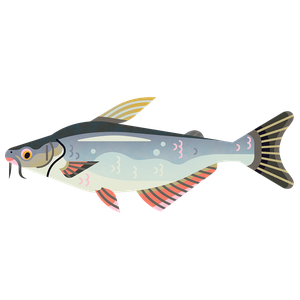
Seabass
Dicentrarchus labrax
What to check for
Location
Bay of Biscay (South), Atlantic Iberian waters
Technical location
Atlantic, Northeast, Bay of Biscay (South), Portuguese Waters (East)
Caught by
Net (gill or fixed)
Rating summary
Updated: July 2020
Sea bass in southern Bay of Biscay and Atlantic Iberian waters is a data limited stock, and stock identity remains poorly understood. The state of the stock and fishery relative to reference points is unknown and information on abundance and catches is unavailable. There is no concern for the stock biomass but concern for fishing pressure, as catches have been significantly above advised limits. The combination of slow growth, late maturity, spawning aggregation and strong site fidelity, increase the vulnerability of sea bass to overexploitation and localized depletion. The EU multiannual plan for stocks in the Western Waters and adjacent waters applies to this stock, however, as a data-limited stock ICES precautionary approach is applied. Sea bass are not subject to EU TACs (Total Allowable Catch) or quotas, and are caught both commercially and recreationally, at similar levels. Sea bass are caught using a variety of fishing gears (e.g. gillnet, hook and line, trawl and seine), some of which, can have high levels of bycatch of non-target species, and habitat impacts upon the seabed, by abrasion and smothering in this ecoregion. Pelagic trawling in the Bay of Biscay is associated with concerning levels of dolphin bycatch and mortality, particularly of common dolphin. Harbour porpoises are being caught as bycatch off Iberia in set-nets to the extent that the local population of the species may become extinct.
How we worked out this Rating
IN DRAFTCHECKING RE RELEVANCE TO UK MARKET AND FISHERIES.For seabass in southern Bay of Biscay and Iberian waters there is concern for biomass and concern for fishing pressure.This is a data limited stock and does not have reference points, trends are used instead to determine the stocks state. European seabass has a medium resilience to fishing pressure.
There are management measures in place, but they are not precautionary. The stock is poorly managed and requires considerable improvement or specific management measures implemented.
The EU multiannual plan for stocks in the Western Waters and adjacent waters applies to this stock. The MAP stipulates that when the FMSY ranges are not available, fishing opportunities should be based on the best available scientific advice. Consequently, as a data-limited stock, ICES precautionary approach is applied.
ICES cannot quantify total catches as recreational catches cannot be quantified. There is anecdotal information that underreporting is occurring in small artisanal fleets. This presents a number of challenges for management. Relatively little historical data are available on recreational fisheries although several European countries are now carrying out surveys to meet the requirements of the EU Data Collection Framework and for other purposes.
Sea bass are not subject to EU TACs (Total Allowable Catch) and quotas. Landings have been above advice, throughout the period advice has been provided (except in 2013, at 17% of advice). Between 2014 and 2018, on average landings have exceeded advice 152%, which ranged between 137% and 159%.
Under EU regulation, the Minimum Landings Size (MLS) of sea bass in the Northeast Atlantic, is 36 cm total length (EC regulation 850/98). However, in the Bay of Biscay the size at which 50% of females mature is just over 42 cm (ranging between 41.31 cm and 43.08 cm). Therefore, seabass are being caught before they have had chance to reproduce.
Discarding is assumed to be negligible. Portugal: Sea bass discards are recorded by the DCF on-board sampling program, no discards are observed. Spain: No sea bass discards were observed, 2003-2019.
In addition, a variety of national restrictions on commercial fishing for each metier also apply to sea bass. The measures affecting recreational fisheries in Portugal include gear restrictions, a minimum landing size equal to the commercial fishery MLS (36 cm), the total catch of fish and cephalopods by each fisher must be less than 10 kg per day, and prohibition on the sale of catch.
The UK is due to leave the EU on 31st December 2020, and new UK Fisheries legislation is being developed during 2020. MCS will update ratings with new management information when new legislation comes into force.
In the European Union (EU), EU fishing vessels can fish up to 12 nautical miles of any Member State coast, and closer by agreement. There is overarching fisheries legislation for all Member States, but implementation varies between fisheries, Member States and sea basins.
The EU Common Fisheries Policy (CFP) is the primary overarching policy. Its key environmental objectives are to restore and maintain harvested species at healthy levels (above BMSY), and apply the precautionary and ecosystem-based approaches to fisheries management. To achieve the MSY objective, the MSY exploitation rate is supposed to be achieved by 2020, but this seems unlikely to happen.
The CFP also introduced a Landing Obligation (LO) which bans the discarding at sea of species which are subject to catch limits. Some exemptions apply to species with high post-capture survival, and where avoiding unwanted catches is very difficult. These exemptions are outlined in regional discard plans. Despite quota 'uplift' being granted to fleets under the LO, available evidence suggests there has been widespread non-compliance with the policy, and illegal and unreported discarding is likely occurring.
Multi-Annual Plans (MAPs) are a tool for implementing the CFP regionally, with one in place or being developed for each sea basin. They specify fishing mortality targets and ranges for the main targeted species, as well as lower biomass reference points. If populations drop below these points it should trigger a management response. The MAPs also empower Member States to jointly apply measures such as closures, gear or capacity limits, and bycatch limits. There is concern however that the MAPs do not provide adequate safeguards to maintain all stocks at healthy levels.
The EU Technical Measures regulation addresses how, where and when fishing can take place in order to limit unwanted catches and ecosystem impacts. There are common measures that apply to all EU sea basins, and regional measures that vary between sea basins. Measures include Minimum Conservation Reference Sizes (MCRS, previously Minimum Landing Sizes, MLS), gear specifications, mesh sizes, closed areas, and bycatch limits.
The Control Regulation, which is being revised in 2019, addresses application of and compliance with the above, e.g. keeping catches within limits, recording and sharing data, and satellite tracking of vessels over 12 metres (VMS).
Sea bass are caught by a variety of methods (e.g. gillnet, trammel net, longline or hand-line, trawl, and purse seine) in the southern Bay of Biscay and Atlantic Iberian waters.
Sea bass (Dicentrarchus labrax), are caught by commercial and recreational fishers. Seabass fisheries in this area are mainly artisanal, and recreational catch is thought to be as significant as commercial catch, but cannot be quantified. Most commercial sea bass catches are taken in targeted fisheries, although some are caught as bycatch in other fisheries. Spanish and Portuguese vessels represent almost all of the total annual commercial landings in the area. Landings from Portugal are only from the 9a area, while the Spanish landings are distributed equally between the two zones 8c and 9a (186 tonnes and 187 tonnes in 2019, respectively). Artisanal fisheries are mainly observed in this area. Inshore, small day boats operate with relatively little activity in late winter/early spring. Most landings come from the polyvalent mixed fishery (80-99%) using mostly gill nets, trammel nets and longline or hand-line. The landings by purse seiners and trawlers represent a small amount.
The fixed or static net fishery for sea bass has little to no habitat impacts, with very low levels of disturbance to the seabed. Gillnets and fixed nets can be very selective, but incidental catch (bycatch) of non-target species can occur. Gillnets cannot be specifically targeted to give clean catches of sea bass and a wide range of other non-target species can become enmeshed, particularly in demersal set gillnets. Gillnets can bycatch species such as sharks, cetaceans and other marine mammals. Observation of marine mammal bycatch has occurred in certain fisheries off France and in a few off Galicia. Endangered, harbour porpoises (Phocoena phocoena) are being caught as bycatch off Iberia, in set-nets to the extent that the local population of the species may become extinct. It is estimated that in the Celtic Seas (including the eastern Bay of Biscay) in 2017 between 536 “1409 harbour porpoises were killed by net fisheries (trammel net; set gillnet; driftnet) (>2% of the population abundance) which exceeds both ASCOBANS thresholds. Set net fisheries, particularly those for sea bass, have caught common dolphins (Delphinus delphis) and striped dolphins (Stenella coeruleoalba) an IUCN listed Threatened species. Seabird bycatch seems likely to be part of the reason for the loss of the Iberian form of the common guillemot (Uria aalge) and some other seabird species.
No anthropogenic mortality (or bycatch) limits have been defined for the common dolphin in the Northeast Atlantic. Based on the number of strandings, it was estimated that in 2019 up to 11,000 common dolphins were killed in the Bay of Biscay by fishing, the highest ever recorded level: this level of mortality would likely contribute to a decline in the common dolphin population there. France is carrying out research and developing plans (including acoustic repellents, avoidance tactics, better data collection and quantified mortality reduction targets) to reduce dolphin mortality from bycatch. Some measures are already required under EU legislation, but these have not yet resulted in a reduction in bycatch. In May 2020, ICES concluded that proposed measures by NGOs for the common dolphin (Delphinus delphis) in the Bay of Biscay are appropriate to reduce the bycatch. However, several spatio-temporal and technical amendments are recommended. ICES advises, for the common dolphin in the Bay of Biscay, temporal closures of all metiers (fisheries) of concern to mitigate bycatch. Application of this advice is yet to be displayed.
Sea bass is a widely distributed species in northeast Atlantic shelf waters with a range from southern Norway, through the North Sea, the Irish Sea, the Bay of Biscay, the Mediterranean and the Black Sea to North-west Africa. The species is at the northern limits of its range around the British Isles and southern Scandinavia. Expansions of sea bass populations is thought to coincide with periods of ocean warming. Therefore, temporal changes may alter the distribution of sea bass stocks over time.
References
Dars, C., Dabin, W., Demaret, F., Doremus, G., Meheust, E., Mendez-Fernandez, P., Peltier, H., Spitz, J. and Van Canneyt, O. (2017). Les echouages de mammiferes marins sur le littoral francais en 2017. Reseau National Echouages (RNE), Rapport annuel. Available at http://www.observatoire-pelagis.cnrs.fr/IMG/pdf/rapportechouages2017.pdf [Accessed on 23.07.2020]
Drogou, M. (2013). Stock Annex: Seabass (Dicentrarchus labrax) in divisions 8.c and 9.a (southern Bay of Biscay and Atlantic Iberian waters). Available at http://www.ices.dk/sites/pub/Publication%20Reports/Stock%20Annexes/2016/bss-8c9a_SA.pdf [Accessed 22.07.2020]
ICES (2018). Bycatch of small cetaceans and other marine animals - “ review of national reports under Council Regulation (EC) No. 812/2004 and other information. Available at https://www.ices.dk/sites/pub/Publication%20Reports/Advice/2018/2018/byc.eu.pdf [Accessed 29.07.2020]
EU (2019). Regulation (EU) 2019/472 of the European Parliament and of the Council of 19 March 2019 establishing a multiannual plan for stocks fished in the Western Waters and adjacent waters, and for fisheries exploiting those stocks, amending Regulations (EU) 2016/1139 and (EU) 2018/973, and repealing Council Regulations (EC) No 811/2004, (EC) No 2166/2005, (EC) No 388/2006, (EC) No 509/2007 and (EC) No 1300/2008. Official Journal of the European Union, L 83. 17 pp. Available at http://data.europa.eu/eli/reg/2019/472/oj [Accessed 22.07.2020]
Froese, R. and Luna, S. (2020). European seabass, Dicentrarchus labrax. Available at https://www.fishbase.se/summary/dicentrarchus-labrax.html [Accessed 24.07.2020]
ICES (2019). Bay of Biscay and the Iberian Coast ecoregion - “ Ecosystem overview. Available at http://ices.dk/sites/pub/Publication%20Reports/Advice/2019/2019/EcosystemOverview_BayofBiscayandIberianWaters_2019.pdf [Accessed 23.07.2020]
ICES (2019). Seabass (Dicentrarchus labrax) in divisions 8.c and 9.a (southern Bay of Biscay and Atlantic Iberian waters). In Report of the ICES Advisory Committee, 2019. ICES Advice 2019, bss.27.8c9a, https://doi.org/10.17895/ices.advice.4758. Available at http://ices.dk/sites/pub/Publication%20Reports/Advice/2019/2019/bss.27.8c9a.pdf [Accessed 22.07.2020]
ICES (2019). Working Group on Bycatch of Protected Species (WGBYC). ICES Scientific Reports. 1:51. 163 pp. http://doi.org/10.17895/ices.pub.5563. Available at https://www.ices.dk/sites/pub/Publication%20Reports/Expert%20Group%20Report/HAPISG/2019/ICES%20WGBYC%20Report%202019.pdf [Accessed 18.09.2020]
ICES (2020). EU request on emergency measures to prevent bycatch of common dolphin (Delphinus delphis) and Baltic Proper harbour porpoise (Phocoena phocoena) in the Northeast Atlantic. Available at http://ices.dk/sites/pub/Publication%20Reports/Advice/2020/Special_Requests/eu.2020.04.pdf [Accessed 22.07.2020]
ICES (2020). Working Group for the Bay of Biscay and the Iberian Waters Ecoregion (WGBIE). ICES Scientific Reports. 2:49. http://doi.org/10.17895/ices.pub.6033. Available at http://www.ices.dk/sites/pub/Publication%20Reports/Expert%20Group%20Report/Fisheries%20Resources%20Steering%20Group/2020/WGBIE_2020.pdf [Accessed 22.07.2020]
Peltier, H., Authier, M., Deaville, R., Dabin, W., Jepson, P. D., van Canneyt, O., Daniel, P. and Ridoux, V. (2016). Small cetacean bycatch as estimated from stranding schemes: The common dolphin case in the northeast Atlantic. Environmental Science and Policy, 63: 7-18. doi: 10.1016/j.envsci.2016.05.004. Available at https://www.sciencedirect.com/science/article/abs/pii/S1462901116301514 [Accessed 23.07.2020]
Peltier H., Authier M., Caurant F., Dabin W., Dars C., Demaret F., Meheust E., Ridoux V., Van Canneyt, O. and Spitz, J. (2019). Etat des connaissances sur les captures accidentelles de dauphins communs dans le golfe de Gascogne - “ Synth ¨se 2019. Rapport scientifique dans le cadre de la convention avec le MTES. Observatoire PELAGIS - “ UMS 3462, La Rochelle Universit © / CNRS, 23 pages. Available at https://www.observatoire-pelagis.cnrs.fr/IMG/pdf/Rapports/ByCatch_Rapport_CAPECET_DEB_2019.pdf [Accessed 18.09.2020]

Sustainable swaps
Learn more about how we calculate our sustainability ratings.
How our ratings work