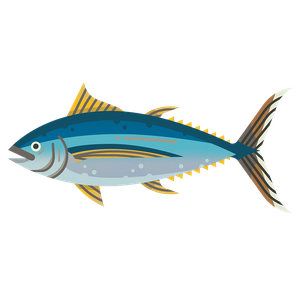
Skipjack tuna
What to check for
Location
Western and Central Pacific
Technical location
Pacific, Eastern Central, Pacific, Northwest, Pacific, Western Central, All areas, All areas, All areas
Caught by
Hook & line (pole & line)
Certification
 Marine Stewardship Council (MSC)
Rating summary
Skipjack tuna in the western and central Pacific Ocean is abundant and not subject to overfishing. Some appropriate management measures are in place to control fishing activity. Some skipjack tuna catches in the west Pacific Ocean are by pole & line. This is a generally low-impact method. MSC-certified fleets are taking extra measures to limit skipjack catches and monitor the fishery.Rating last updated January 2023.
Technical consultation summary
Skipjack tuna in the western and central Pacific Ocean is not overfished or subject to overfishing. A new stock assessment was carried out in 2022 using data up to 2021. Spawning Biomass was 51% of unfished levels in 2021. This is an improvement on the 2018 estimate of 44% and above the Target Reference Point of 40%. Fishing Mortality has increased since the 1970s, peaking in 2018 at 45% of MSY. It has since declined slightly to 32%. Some appropriate management measures are in place to control fishing activity. A Harvest Control Rule (HCR) came into force in 2023, with rules and targets for setting catch and effort limits. Limits have not yet been published for 2023, so it is too early to tell what impact this will have on the fishery. The majority of western and central Pacific skipjack tuna catches are certified by the Marine Stewardship Council. Certified fisheries must meet additional auditing and traceability requirements that result in improved monitoring. Some skipjack tuna catches in the west Pacific Ocean are by pole & line. This is a generally low-impact method.