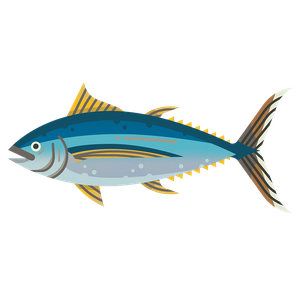
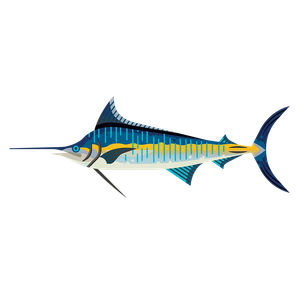
Skipjack tuna
What to check for
Location
Indian Ocean
Technical location
Indian Ocean, Eastern, Indian Ocean, Western, All areas, All areas
Caught by
Net (purse seine on aggregating devices or free-schooling fish)
Certification
 Marine Stewardship Council (MSC)
Rating summary
Skipjack tuna in the Indian Ocean is not overfished and not subject to overfishing. Some appropriate management measures are in place for MSC certified Indian Ocean skipjack tuna. Certified fisheries are required to meet strict monitoring and reporting requirements that result in better management, although some improvements are still needed. These tuna from the Indian Ocean is caught by purse seining. This method is associated with bycatch of species such as sharks, rays, and turtles, but certified fleets are taking steps to tackle this.Commercial buyers should establish what measures the flag state and fleet relating to their source is taking to reduce impacts to and improve reporting of interactions with vulnerable species. Large buyers should consider supporting such improvements. MCS also advocates specifying the need for vessels, in particular purse seiners, to register on the ISSF Proactive Vessel Register.Rating last updated January 2024.
Technical consultation summary
Skipjack tuna in the Indian Ocean is not overfished and not subject to overfishing. This stock is managed and assessed by the Indian Ocean Tuna Commission (IOTC). The last stock assessment was carried out in 2023, using data up to 2022. The next stock assessment is expected in 2026. In 2022, biomass was 53% of unfished levels and 230% of SBMSY. Therefore, the stock is not in an overfished state. The target for fishing mortality is the level consistent with keeping biomass at the target level (F40%SSB). In 2022, F was 55% of the target level and 48% of FMSY. Therefore, the stock is not subject to overfishing. Few appropriate management measures are in place for Indian Ocean skipjack tuna. However, certified fisheries are required to meet strict monitoring and reporting requirements that result in better management, although some improvements are still needed. There are currently four MSC certifications that apply to Indian Ocean skipjack tuna (CFTO, Echebastar, AGAC, and Maldives pole & line), amounting to around 50% of the total catch. These fleets are taking a number of actions in addition to IOTC requirements, including working towards 100% observer coverage, supporting scientific research, and management plans. Information on management of the wider fishery is below. Recent catches have been well above catch limits, and monitoring and enforcement needs to be improved. The main management measure is a Harvest Control Rule (HCR), which has been in place since 2017. It has a target of maintaining the stock at or above 40% of unfished levels. Catch limits are calculated using the HCR and data from stock assessments, carried out every 3 years. However, management is very poorly monitored and enforced. The catch limit for 2021-2023 was 513,572 t. Catches substantially exceeded it, averaging 597,588t for those three years. The new limit for 2024-2026 is 628,605t. This is higher than the previous limit because the stock has remained productive thanks to favourable environmental conditions. However, those conditions are predicted to become less favourable. Catch in 2022 was 666,408t - the highest on record and well above the new catch limit. As of January 2024, countries are encouraged to stop fishing for tropical tunas for a 31-day period (dates TBC), or implement voluntary catch reductions for yellowfin. These measures are not mandatory and therefore do not influence management scoring for this rating. Monitoring and compliance with management measures in the IOTC region is generally poor. Some countries repeatedly fail to report catch data to the commission. Mandatory observer coverage is very low, at just 5% for all vessels over 24m or under 24m and fishing outside of their Exclusive Economic Zone (EEZ). A number of countries fail to meet the 5% threshold. In general, 20% is scientifically recommended to ensure adequate monitoring of catch and bycatch. Some skipjack tuna from the Indian Ocean is caught by purse seining. This method is associated with bycatch of species such as sharks, rays, and turtles. Bycatch is higher when FADs are used. In the Indian Ocean, bycatch per ton of tuna averages 0.8% on free school sets and 3% on FADs. Some mitigation measures are in place. Around 30% of purse-seine-caught skipjack is from MSC-certified fleets. These fleets are taking extra measures, including increased monitoring of bycatch through additional observer coverage and electronic monitoring. Observer coverage through human and electronic monitoring in the certified fleets is 60-90%. There are also codes of good practice for some fisheries aimed at altering fishing gear to reduce bycatch and entanglement, and training skippers and crew to safely release captured animals such as sharks. This can help to address, to some extent, the issues with the uncertified fishery.