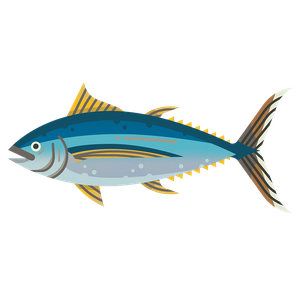
Skipjack tuna
Euthynnus pelamis, Katsuwonus pelamis
What to check for
Location
Western and Central Pacific
Technical location
Pacific, Eastern Central, Pacific, Northwest, Pacific, Western Central, All areas, All areas, All areas
Caught by
Net (gill or fixed)
Rating summary
Some skipjack catches from the west Pacific Ocean are by gillnetting. This receives a default red rating owing to the very high levels of cetacean and turtle bycatch.Rating last updated January 2023
Technical consultation summary
Skipjack tuna in the western and central Pacific Ocean is not overfished or subject to overfishing. A new stock assessment was carried out in 2022 using data up to 2021. Spawning Biomass was 51% of unfished levels in 2021. This is an improvement on the 2018 estimate of 44% and above the Target Reference Point of 40%. Fishing Mortality has increased since the 1970s, peaking in 2018 at 45% of MSY. It has since declined slightly to 32%. Some appropriate management measures are in place to control fishing activity. A Harvest Control Rule (HCR) came into force in 2023, with rules and targets for setting catch and effort limits. Limits have not yet been published for 2023, so it is too early to tell what impact this will have on the fishery. To date, management of the tropical tuna fisheries (skipjack, yellowfin and bigeye) has primarily been by controlling the purse seine fishery. This has not prevented catches from increasing from 1.36 million tonnes in 2004 to average 1.75 million tonnes in 2017-2021. The stock assessment indicates that fishing mortality is continuously increasing. Management has not, therefore, controlled fishing pressure on the stock. Some skipjack catches from the west Pacific Ocean are by gillnetting. This receives a default red rating owing to the very high levels of cetacean and turtle bycatch.
How we worked out this Rating
Skipjack tuna in the western and central Pacific Ocean is not overfished or subject to overfishing.The western and central Pacific Ocean (WCPO) skipjack tuna stock is the largest tuna fishery in the world, accounting for approximately 37% of worldwide tuna landings. Catches of this stock increased steadily from 1970 onwards, reaching a record of over 2 million tonnes in 2019.The WCPO skipjack tuna fishery is managed and assessed by the Western and Central Pacific Fisheries Commission (WCPFC). The last stock assessment was carried out in 2022 using data up to 2021. The next stock assessment is expected in 2025.Spawning Biomass (SB) has declined from about 90% of unfished levels in 1970 to 51% in 2021. This is an improvement on the 2018 estimate of 44%. It is above the Target Reference Point of 40%, and well above the Limit Reference Point of 20%. Therefore, the stock is not in an overfished state.Fishing Mortality (F) has increased since the 1970s, peaking in 2018 at 45% of levels associated with Maximum Sustainable Yield (MSY). It has since declined slightly to 32%. As F is below MSY, the stock is not subject to overfishing.Trends in spawning biomass vary by region, and there is a higher depletion rate in equatorial areas. However, projections indicate that if the 2018-2021 average catch and effort levels are maintained, there is zero probability of the stock breaching its limit reference point.
Some appropriate management measures are in place to control fishing activity. However, catches have increased to record levels. Regulations have been insufficient to prevent them from increasing further and exceeding sustainable limits.Tuna and swordfish are highly migratory species, found on the high seas and in numerous countries' waters. This makes harmonised and effective management challenging. Regional Fisheries Management Organisations (RFMOs) are responsible for monitoring and managing these stocks on behalf of the countries that access them. However, the degree to which management is implemented, monitored and enforced by each country varies significantly. It is important that commercial buyers choose tuna that has been caught by vessels that are well regulated by their flag state.This stock is managed and assessed by the Western and Central Pacific Fisheries Commission (WCPFC). Some stocks overlap with the Inter-American Tropical Tuna Commission (IATTC). The IATTC and WCPFC endeavour to work together to promote compatibility between their respective conservation and management measures across the Pacific, but this is not always achieved. A significant proportion of West Pacific skipjack and yellowfin tuna is caught within the waters of the Parties to the Nauru Agreement (PNA). These South Pacific island nations have incorporated additional management measures, and pushed for improvements in the wider management of these stocks.The Western and Central Pacific Ocean (WCPO) skipjack stock supports the largest tuna fishery in the world, accounting for approximately one third of worldwide tuna landings. It is not overfished or subject to overfishing, although fishing mortality is continuously increasing. The main management measure is now a Harvest Control Rule (HCR), which came into force in 2023.The HCR sets out targets to keep the stock at certain levels, and rules for deciding limits on catch and fishing effort. It aims to keep the stock size between 40% and 56% of unfished levels. The stock should also be above the point of reproductive impairment - 20% of unfished levels - with at least 80% probability. If the stock falls below 40%, fishing mortality must be reduced. Above 56%, it can be increased. Catch and effort limits will be set for 3 year periods. Changes are limited to up to 10% from one period to the next, to keep the fishery stable. Limits have not yet been published for 2023, so it is too early to tell what impact this will have on the fishery.To date, management of the tropical tuna fisheries (skipjack, yellowfin and bigeye) has primarily been by controlling the purse seine fishery. This method is responsible for around 80% of skipjack catches. The focus is on the main fishing grounds, between 20 degrees North and South, which is where fishing has the highest impact on the skipjack stock. In this area:Each country is allowed to fish for a set number of days. Fishing effort (in days) should not be displaced to other areas.Purse seiners must retain and land all bigeye, skipjack, and yellowfin tuna. This is intended to incentivise reductions in bycatch of juvenile fish.Fish Aggregating Devices (FADs) - floating objects which purse seiners use to attract tuna and increase catches - are banned from July-September. There is an additional 2-month closure in parts of the southwest Pacific islands.Vessel Monitoring System (VMS) polling, which tracks vessels using satellites, increases to every 30 minutes during the FAD closure.Observers, to verify catch and bycatch, must be on 100% of large purse seiners.In addition:Purse seine vessels are limited to 350 drifting FADs each.Each country has set its own catch or effort limits for purse seining within their own waters.Skipjack catches by other fishing gears are frozen to 2004 levels.This has not prevented catches from increasing. The catch in 2004 was 1.36 million tonnes. The 2017-2021 average is 1.75 million tonnes, with 2019 seeing the highest catch on record at over 2 million tonnes. The stock assessment indicates that fishing mortality is continuously increasing. Management has not, therefore, controlled fishing pressure on the stock.Observer coverage for other gears, including small purse seiners, and in other areas is low, at just 5%. There is not enough data to be sure that countries are complying with the management measures.To help address IUU, the WCPFC maintains an IUU Vessel List, prohibits transhipments at sea between purse seiners (some exemptions apply) and requires all other transhipments to be documented and 100% observed as part of the regional observer programme. In 2017 a Compliance Monitoring Scheme was introduced to assess and improve compliance with obligations, and penalise non-compliance.

Some skipjack catches from the west Pacific Ocean are by gillnetting. This receives a default red rating owing to the very high levels of cetacean and turtle bycatch.Approximately 11% of the WCPO yellowfin catch is taken in various subsistence style netting operations such as ring and gill nets. Gillnets used for catching tuna and tuna-like species can be 7km long and are known for extremely high bycatch including turtles, whales, dolphins, whale sharks, mobulids, requiem sharks and sunfish. WCPFC bans the use of gillnets over 2.5km long, but monitoring is poor. There is no available data on bycatch by gillnet fisheries in the WCPOGillnetting is known to have significant levels of seabird bycatch, with an estimated 400,000 birds being killed each year, globally. Some of the highest bycatch rates are in the northwest Pacific.The five marine turtle species in the WCPFC Convention Area (green, hawksbill, leatherback, loggerhead and olive ridley) are vulnerable, endangered, or critically endangered, and WCPFC does not have enough data to assess the threat posed by fisheries. There are some mitigation measures, including requirements for safe handling and release.In 2020, an estimated 1.7 million sharks were caught as bycatch or had an interaction with WCPO fisheries. Of these, around 34,000 individuals were caught in FAD-free purse seines, 60,000 in FAD-associated purse seines, and 1.6 million by longlining. Bycatch species include bigeye thresher, shortfin mako, and silky. Of greatest concern is oceanic whitetip shark, which is in a severely overfished state and critically endangered. Further catch mitigation and improved handling and release practices are required. Mobulid rays are also bycaught, but there is very little data on these species.Interactions between cetaceans and WCPFC fisheries have been recorded, with most resulting in the animal being released alive. Species include false killer whales, toothed whales and oceanic dolphins. These interactions are not well recorded and the scale of impact is unclear.
References
Hare S.R., Williams P.G., Castillo Jordan C., Hamer P.A., Hampton W.J., Lehodey, P., Macdonald, J., Scutt Phillips, J., Scott R.D., Senina, I., and Pilling G.M., 2022. The western and central Pacific tuna fishery: 2021 overview and status of stocks. Tuna Fisheries Assessment Report no. 22. Noumea, New Caledonia: Pacific Community. 71 p. Available at https://meetings.wcpfc.int/index.php/node/18208 [Accessed on 16.01.2023].WCPFC, 2021. Public domain Bycatch data (Bycatch Data Exchange Protocol – BDEP), Regional Observer Programme (ROP) Database. 27 July 2021. Available at https://www.wcpfc.int/node/29966 [Accessed on 17.01.2023].WCPFC, 2021. Reference Document for Bigeye, Yellowfin and Skipjack Tuna for the Review of CMM 2020-01 and Development of Harvest Strategies under CMM 2014-06. WCPFC18-2021-14. 18th Regular Session of the Commission, Online, 29 November - 7 December 2021. Available at https://meetings.wcpfc.int/file/10026/download [Accessed on 24.01.2022].WCPFC, 2022. Summary Report. Eighteenth Regular Session of the Scientific Committee. Online, 10-18 August 2022. Available at https://meetings.wcpfc.int/file/12372/download [Accessed on 17.01.2023].WCPFC, 2022. Conservation and Management Measures of the Western and Central Pacific Fisheries Commission. Updated 13 January 2023. Available at https://www.wcpfc.int/conservation-and-management-measures [Accessed on 16.01.2023].Zydelis, R., Small, C. and French, G., 2013. The incidental catch of seabirds in gillnet fisheries: A global review. Biol Cons 162. pp. 76-88. http://dx.doi.org/10.1016/j.biocon.2013.04.002
Sustainable swaps
Learn more about how we calculate our sustainability ratings.
How our ratings work