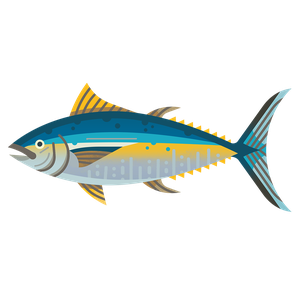
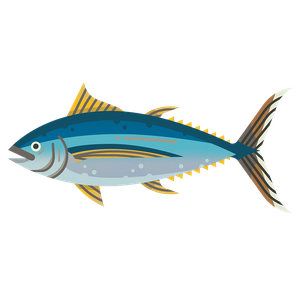
Skipjack tuna
Euthynnus pelamis, Katsuwonus pelamis
What to check for
Location
West Atlantic
Technical location
Atlantic, Northwest, Atlantic, Southwest, Atlantic, Western Central, All areas, All areas, All areas
Caught by
Net (purse seine on aggregating devices or free-schooling fish)
Rating summary
Western Atlantic skipjack tuna is abundant and not subject to overfishing. However, few appropriate management measures are in place. There are no catch limits or stock-specific management measures. Some skipjack tuna from the west Atlantic is caught by purse seining. This method is associated with bycatch of species such as sharks, turtles and marine mammals.Rating last updated January 2023.
Technical consultation summary
West Atlantic skipjack tuna is abundant and not subject to overfishing. A new stock assessment was carried out in 2022, the first since 2014. It indicates that biomass was 160% of BMSY and fishing mortality was 41% of FMSY. The new assessment is a considerable improvement in understanding the stock, considering the length of time between assessments. However, few appropriate management measures are in place for this stock. Catches are below MSY, but there is no TAC or HCR to keep them at sustainable levels. The primary management measure is a limit on Fish Aggregating Devices (FADs). This does not benefit the west Atlantic stock, which is caught primarily by baitboats. Some skipjack tuna from the west Atlantic is caught by purse seining. This method is associated with bycatch of species such as sharks, turtles and marine mammals.
How we worked out this Rating
West Atlantic skipjack tuna is abundant and not subject to overfishing.Skipjack stocks in the Atlantic are assessed by the International Commission for the Conservation of Atlantic Tunas (ICCAT). A new stock assessment was carried out in 2022, the first since 2014. It uses data up to 2020. It is unclear when the next assessment is expected. West Atlantic skipjack catches peaked in 1985 at 40,000 tonnes. They have since declined, reaching around 18,800t in 2020.The biomass (B) of the stock was fairly constant until 1980, when it declined but fluctuated above the level associated with Maximum Sustainable Yield (B MSY). In 2020, B was 160% of BMSY. Therefore the stock is not in an overfished state.Fishing mortality (F) was low the 1960s, but increased and has fluctuated around 40% of FMSY since then. In 2020, F was 41% of FMSY. Therefore, the stock is not subject to overfishing.Projections indicate that future constant catches of 20,000 t, close to the current catch (19,951 t in 2021) are expected to maintain the stock above BMSY and below FMSY through to 2028. Catches at MSY (35,277t) would result in a less than 1% probability of the stock being below Blim (20% of BMSY) in 2028.
Few appropriate management measures are in place for this stock. There are no catch limits and few fishing controls.Tuna, marlin, and swordfish are highly migratory species, found on the high seas and in numerous countries' waters. This makes harmonised and effective management challenging. Regional Fisheries Management Organisations (RFMOs) are responsible for monitoring and managing these stocks on behalf of the countries that access them. However, the degree to which management is implemented, monitored and enforced by each country varies significantly.West Atlantic skipjack tuna is managed and assessed by the International Commission for the Conservation of Atlantic Tunas (ICCAT).There is no catch limit (Total Allowable Catch, TAC) or Harvest Control Rule (HCR) in place for this stock. The primary management measure is a limit on Fish Aggregating Devices (FADs), but this does not affect the west Atlantic stock.A new stock assessment for Atlantic skipjack was carried out in 2022. This was a significant improvement in the understanding of the stock, as there had not been an assessment since 2014.The new assessment indicates that the stock is in a healthy state and that a constant catch at MSY (35,277t) would result in a less than 1% probability of the stock being below Blim (20% of BMSY) in 2028. Recent catches (2017-2021) have been below MSY, averaging 21,250 tonnes. However, there is no catch limit to ensure they stay at this level.Most tropical tuna management focuses purse seine nets, many of which use Fish Aggregating Devices (FADs). FADs are floating objects that attract tuna and other species, making it easier to set nets around them to catch them. Many juvenile fish are caught in these fisheries, which can have implications for future population growth. Therefore, there is a ban on using FADs throughout the Atlantic (ICCAT convention area) for 72 days in January to mid-March. This is intended to reduce fishing pressure on bigeye and yellowfin tuna. In 2022, the scientific committee concluded that it also may have reduced skipjack catches in the east Atlantic. However, in 2022 the scientific committee noted that no fleets were targeting west Atlantic skipjack using FADs, so the measure has had minimal effect on this stock.Most western skipjack tuna catches are by bait boats, or pole and line. However, there are few management measures to control this fishery. Therefore, few appropriate management measures are in place. Work is underway in 2023 to develop management objectives. Management measures also include:Countries must calculate the fishing capacity needed to deliver their set quotas, and reduce current capacity, e.g. by reducing licenses or vessel sizes, if it is too high. An analysis in 2022 estimated that in total there are 72 purse seine vessels actively fishing in the area, with a higher capacity (fish-hold volume) than needed. There were 99 vessels licensed to fish in the area, so there is also excess latent capacity.Countries are 'encouraged' not increase fishing effort above the 2018 level.Countries must submit FAD management plans to improve knowledge about FADs being used, manage deployment and recovery, and reduce ecosystem impacts.In 2021 the number of permitted support vessels, which help to increase the efficiency of purse seiners, was frozen.A requirement for 100% observer coverage on large purse seiners targeting tropical tunas all year round. The requirement for longline is only 10% and many fleets are not reaching this level. There does not appear to be a set level for baitboats. Scientific recommendations are 20% for accurate data.There is a ban on discarding skipjack, yellowfin and bigeye tuna: all fish caught must be landed. There is also a tagging programme to improve stock assessments for tropical tunas and gauge effectiveness of management measures.In terms of monitoring and surveillance, other management by ICCAT includes:A ban on drift nets by the EU in 2002 and by ICCAT in the Mediterranean in 2003.A list of vessels authorised to fish for this species, and a list of vessels caught carrying out Illegal, Unreported or Unregulated activities. At-sea transhipment is prohibited unless pre-authorised and the vessel has an observer on board.Work is underway to improve electronic monitoring. Vessel Monitoring Systems are required for all vessels over 24m.
Some skipjack tuna from the west Atlantic is caught by purse seining. This method is associated with bycatch of species such as sharks, turtles and marine mammals.Purse seining accounted for around 7% of west Atlantic skipjack tuna catches in 2021, at around 1,500 tonnes. It involves setting a net around a group of tuna and then tightening at the bottom, then hauling it into the boat. Some purse seine catches are from Fish Aggregating Devices (FADs) and the rest is on free schooling tuna. It is not always possible to separate FAD and FAD-free catches, so they are covered in the same rating.Monitoring and reporting of bycatch in fisheries managed by ICCAT is generally poor. Most data come from scientific observers on vessels. Recommendations are that 20% of a fishery should be observed for accurate data, but most ICCAT fleets have just 10%. While coverage on large purse seiners targeting tropical tunas is 100%, the data provided is for all gears combined so this does not do enough to improve understanding of bycatch. This makes it difficult to assess the impact of these fisheries on vulnerable species.Purse seining is associated with bycatch of species such as sharks, turtles and marine mammals, although less so than longlining. Bycatch is higher when FADs are used. FADs are floating objects that tuna and other species tend to aggregate around. It is estimated that 7% of the total catch (by weight) in FAD fisheries in the Atlantic is non-target species, as opposed to 1.8% in free-schooling fisheries.From 2021, FADs used in Atlantic tuna fisheries must not not have elements that could entangle other species. However, there is a risk that FADs can become lost at sea, continuing to ghost fish and be a source of marine debris. Some mitigation measures are in place. Countries should phase out non-biodegradable FADs. They must also have FAD Management Plans that improve understanding of FADs and limit their impacts on the ecosystem.The main bycatch concern is sharks, which are severely threatened by fishing activity. Sharks are both bycaught and targeted in fisheries in the Atlantic. Bycatch species include the critically endangered scalloped hammerhead, silky shark, and the bigeye thresher, which is endangered in Europe and the Mediterranean. Observer data for all gears for the whole Atlantic for October 2021 - October 2022 indicates: 804 dead discards of sharks and 1,082 live discards. Data on the impact of individual fisheries is not publicly available. Given the poor observer coverage, this is likely to be an underestimate of the total catch. There are some mitigation measures, such as restrictions on finning, but no gear-specific measures. Catching silky sharks, hammerheads, oceanic whitetips, and bigeye threshers is prohibited, and catching other thresher species is discouraged. Shortfin mako, which is heavily overfished, can be caught and retained. However, measures came into force in 2022 and 2023, aimed at ending overfishing of this species. Currently there is not enough data to properly assess the status of many pelagic sharks. No shark assessments have been carried out for the Mediterranean.There is a bycatch of loggerhead, leatherback and olive ridley turtles in longline and purse seine fisheries, especially when FADs are used. According to the IUCN Red List, loggerhead turtles are endangered in the north east Atlantic and leatherbacks are endangered in the north west Atlantic and critically endangered in the southwest Atlantic. Observer data for all gears for the whole Atlantic for October 2021 - October 2022 indicates: 190 dead discards of turtles, 3,752 live discards and 69 discards of unknown status. Given the poor observer coverage, this is likely to be an underestimate of the total catch. Data on the impact of individual fisheries is not publicly available. Post-release mortality is 1-4%. Longliners are required to use circle hooks or finfish bait and safely unhook and release alive turtles, and purse seiners must avoid encircling them.There are no specific management measures to protect marine mammals, including cetaceans. ICCAT has not prioritised collecting data on mammal bycatch to date. More needs to be done to understand and reduce the impact of ICCAT fisheries on marine mammals.The fishery is not considered to be a threat to seabirds.FADs are also of concern due to the unknown impacts such gear might have on other tuna and fish species in relation to species composition of schools, migratory patterns, growth rates and predation rates. Juvenile and bigeye tuna are caught by purse seining, and scientific recommendations are for these impacts to be reduced to protect the stocks.
References
Anon., 2021. Advances on the collaborative work to assess sea turtle bycatch in pelagic longline and purse seine fleets (Atlantic and Indian oceans and Mediterranean Sea). SCRS/2021/076. Collect. Vol. Sci. Pap. ICCAT, 78(4): 155-166. Available at https://www.iccat.int/Documents/CVSP/CV078_2021/n_4/CV078040156.pdf [Accessed on 16.12.2021].Dulvy, N.K., Pacoureau, N., Rigby, C.L., Pollom, R.A., Jabado, R.W., Ebert, D.A., Finucci, B., Pollock, C.M., Cheok, J., Derrick, D.H., Herman, K.B., Sherman, C.S., VanderWright, W.J., Lawson, J.M., Walls, R.H.L., Carlson, J.K., Charvet, P., Bineesh, K.K., Fernando, D., Ralph, G.M., Matsushiba, J.H., Hilton-Taylor, C., Fordham, S.V., Simpfendorfer, C.A., 2021. Overfishing drives over one-third of all sharks and rays toward a global extinction crisis. Current Biology 31: 21. pp. 4773-4787. https://doi.org/10.1016/j.cub.2021.08.062.ICCAT, 2022. Report of the Standing Committee on Research and Statistics (SCRS). Revision, 6 October 2022. 26-30 September 2022. Madrid, Spain and Online. Available at https://www.iccat.int/com2022/ENG/PLE_104_ENG.pdf [Accessed on 04.01.2023].ICCAT, 2022. Resolutions, Recommendations and other Decisions. Available at https://www.iccat.int/en/RecRes.asp [Accessed on 04.01.2023].ICCAT, 2022. 2022 Secretariat Report on Research and Statistics. PLE-105/2022 presented to the 23rd Special Meeting of the Commission. 13-21 November 2022, Vale do Lobo, Portugal. Available at https://www.iccat.int/com2022/ENG/PLE_105_ENG.pdf [Accessed on 10.01.2023].Mucientes, G., Vedor, M., Sims, D. and Queiroz, N., 2022. Unreported discards of internationally protected pelagic sharks in a global fishing hotspot are potentially large. Biological Conservation: 269. https://doi.org/10.1016/j.biocon.2022.109534.Murua, H., Dagorn, L., Justel-Rubio, A., Moreno, G. and Restrepo, V. 2021. Questions and Answers about FADs and Bycatch (Version 3). ISSF Technical Report 2021-11. International Seafood Sustainability Foundation, Washington, D.C., USA. Available at https://www.iss-foundation.org/downloads/22377/.Restrepo, V., Dagorn, L., Itano D., Justel-Rubio A., Forget F. and Moreno, G., 2017. A summary of bycatch issues and ISSF mitigation initiatives to-date in purse seine fisheries, with emphasis on FADs. ISSF Technical Report 2017-06. International Seafood Sustainability Foundation, Washington, D.C., USA. Available at https://www.iss-foundation.org/downloads/15500/.
Sustainable swaps
Learn more about how we calculate our sustainability ratings.
How our ratings work