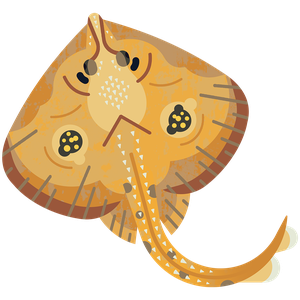
Smalleyed ray
Raja microocellata
What to check for
Location
Bristol Channel, Celtic Sea (North)
Technical location
Atlantic, Northeast, Bristol Channel, Celtic Sea (North)
Caught by
Net (gill or fixed)
Rating summary
Updated: October 2020. The stock status of small-eyed ray in this area is unknown. The stock size indicator has decreased since last year and the precautionary buffer has been applied leading to a decrease in advised landing of more than 20%. There is no specific management plan for skates and rays but the North Devon Fishermen's Association (NDFA) have implemented better management for example closed areas and a minimum landing size (so that skates and rays get a chance to reproduce before being caught). However, there are a lack of data, which precludes effective management and whilst the area have implemented a voluntary minimum landing size for the species, it is set at too small a level to sufficiently protect the species. Gillnets generally cause low impacts to the habitat, although ghost fishing is occasionally reported.
How we worked out this Rating
Smalleyed ray in the Bristol Channel and Celtic Sea (North) is not overfished or subject to overfishing.A survey biomass index has been used as an indicator of how the stock is doing. In 2021, the stock size indicator declined but it remains above the MSY Btrigger proxy (Itrigger).Fishing pressure is just below the FMSY proxy.ICES advises that when the MSY approach is applied, landings should be no more than 86 tonnes in each of the years 2023 and 2024.
There is no management plan for skates and rays and the joint TAC has been deemed an unsuitable method for protecting individual species.There is no direct management plan for skates and rays in these waters. They are usually caught as bycatch in otter and beam trawl fisheries, which target finfish (including flatfish and gadoids).Skates and rays are managed under five regional quotas (called TACs) which are applied to a group of species, rather than individual skate and ray species. This includes cuckoo ray, thornback ray, blonde ray, spotted ray, and small-eyed ray (undulate ray has a separate TAC). This has been deemed as an unsuitable method for protecting individual species, but species-specific quotas may increase discarding. Alternatives to the current TAC system are being explored, which may include the possible introduction of individual TACs for key stocks.A high-survivability exemption to the Landings Obligation was provided for skates and rays in the Celtic Seas ecoregion. Any skates and rays that are discarded are required to be released immediately and below the sea surface.Other management methods being considered are fishing gear modifications, education, conservation measures (such as closed seasons during spawning times). Some protected areas have been designated in these waters but offshore areas are not sufficiently managed. There are no official minimum landing sizes except for some IFCAs, which, mandate a minimum landing size (40-45 cm disc width) in inshore waters in England and Wales.Both the EU and UK have fishery management measures in place, which can include catch limits, targets for population sizes and fishing mortality, and controls on what fishing gear can be used and where. In the EU, compliance with regulations has been variable, and there are ongoing challenges with implementing some of them. There was a target for fishing to be at Maximum Sustainable Yield by 2020, but this was not achieved. The Landing Obligation (LO), an EU law that the UK has kept after Brexit, requires all quota fish to be landed, even if they are unwanted (over-quota or below minimum size). It aims to promote more selective fishing methods, reduce bycatch, and improve recording of everything that is caught, not just what is wanted. Compliance with the LO is generally poor and actual levels of discards are difficult to quantify using the current fisheries observer programme. UK administrations are in the process of replacing the landing obligation with country-specific Catching Policies.In the UK, it is too early to tell how effective management is, as the Fisheries Act only came into force in January 2021. The Act requires the development of Fisheries Management Plans (FMPs) (replacing EU Multi-Annual Plans). FMPs are currently in development, but the scope of them remains unclear. They have the potential to be very important tools for managing UK fisheries, although data limitations may delay them for some stocks. MCS is keen to see publicly available FMPs for all commercially exploited stocks, especially where stocks are depleted, that include:Targets for fishing pressure and biomass, and additional management when those targets are not being met, based on the best available scientific evidenceTimeframes for stock recoveryImproved data collection, transparency and accountability, supported by technologies such as Remote Electronic Monitoring (REM)Consideration of wider environmental impacts of the fishery
Small eyed rays are a coastal species. It is most often caught as bycatch in trawl and gillnet fisheries, but can be retained as a non-target species in the Bristol Channel skate fishery. They are also targeted by sea anglers.
Common bycatch in fixed nets include lesser spotted dogfish, nursehound and Starry ray. However, catches in gillnets are often not monitored and they are not very selective gear. Therefore, the net can interact with a wide range of fish, skates and rays, invertebrates, birds and marine mammals.
Discard rates of skates and rays vary dramatically (30 - 70%), depending on the marketability and management measures in place. For example, nearly all skates below 30 cm LT are discarded by English vessels. Bycatch can include juvenile skate as they can hatch from their egg cases at sizes of 10-20 cm LT and therefore, may be able to escape through the nets. Their survival rates upon discarding is extremely variable, depending on the fishing and handling methods used to capture them. Elasmobranchs have the potential for relatively high survival rates because they do not have swim bladders (and thereby are not as impacted by pressure changes), they can have thick and abrasive skins and thorns (which protect them) and some have spiracles and a buccal-pump respiratory which excrete a mucus, which allows the skate or ray to ventilate and acquire oxygen when out of the water. Inshore and coastal fisheries using trawls, longlines, gillnets and tangle nets generally show low at-vessel mortality. There are a lack of studies available on long-term skate and ray survival when they are released into the wild.
Gillnets generally cause low impacts to the habitat, although ghost fishing is reported occasionally. When captured with tangle nets, the condition of skates are significantly better during shorter (17-28 hours) soak times, compared with (42-48 h soak time).
References
Ellis, J. R., Burt, G.J., Grilli, G., McCully Phillips, S.R., Catchpole, T.L., Maxwell, D.L. 2018. At-vessel mortality of skates (Rajidae) taken in coastal fisheries and evidence of longer-term survival. Journal of Fish Biology. 92, 1702-1719. doi:10.1111/jfb.13597
ICES. 2020. Small-eyed ray (Raja microocellata) in divisions 7.f and 7.g (Bristol Channel, Celtic Sea North). In Report of the ICES Advisory Committee, 2020. ICES Advice 2020, rje.27.7fg. Available at https://doi.org/10.17895/ices.advice.5790. [Accessed on 15.10.2020].
ICES. 2020. Working Group on Elasmobranch Fishes (WGEF). ICES Scientific Reports, 2:77. Available at https://doi.org/10.17895/ices.pub.7470 [Accessed on 15.10.2020].
Mangi, S., Kupschus, S., Mackinson, S., Rodmell, D., Lee, A., Bourke, E., Rossiter, T., Masters, J., Hetherington, S., Catchpole, T. and Righton, D. 2018. Progress in designing and delivering effective fishing industry science data collection in the UK. Fish 00:1-21. https://doi.org/10.1111/faf.12279.
Marandel, F., Lorance, P., Andrello, M., Charrier, G., Le Cam, S., Lehuta, S. Trenkel, V.M. 2017. Insights from genetic and demographic connectivity for the management of rays and skates. Canadian Journal of Fisheries and Aquatic Sciences IN PRESS.
McCully, S. R., Scott, F., and Ellis, J. R. 2012. Lengths at maturity and conversion factors for skates (Rajidae) around the British Isles, with an analysis of data in the literature. -ICES Journal of Marine Science, 69: 1812-1822.
North Devon Fishermen- s Association. What we do. Available at http://www.northdevonfishermen.co.uk/what-we-do [Accessed on 15.10.2020].
Scientific, Technical and Economic Committee for Fisheries (STECF) - 56th Plenary Meeting Report (PLEN-17-03); Publications Office of the European Union, Luxembourg.
Silva, J. F., Ellis, J. R. and Catchpole, T. L. 2012. Species composition of skates (Rajidae) in commercial fisheries around the British Isles and their discarding patterns. Journal of Fish Biology, 80: 1678-1703. doi:10.1111/j.1095-8649.2012.03247.
Sustainable swaps
Learn more about how we calculate our sustainability ratings.
How our ratings work