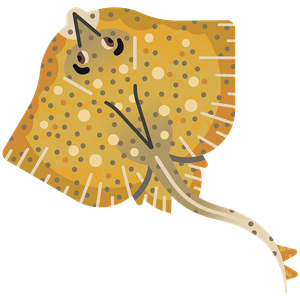
Spotted ray
Raja montagui
What to check for
Location
Southern Celtic Seas
Technical location
Atlantic, Northeast, Bristol Channel, Celtic Sea (North), Celtic Sea (South), English Channel (West), Irish Sea
Caught by
Bottom trawl (beam)
Rating summary
For more information about this rating please visit: http://www.cornwallgoodseafoodguide.org.uk/fish-guide/spotted-ray.php
Technical consultation summary
ICES data show biomass is above trigger, but still a low data species so used route 2. There is no concern for biomass but there is concern for fishing pressure and resilience of species is low. Spotted rays are managed through the combined total allowable catch which means the species cannot be managed properly. It is also very difficult to differentiate from blonde rays which increases likelihood of misidentification. Vulnerability to fishing from Fishbase is 57/100, categorized as ‘high’. IUCN classed as least concern and populations as stable when last assessed in 2007. Landings to Cornwall stable ~45t p/year. For more information about this rating please visit: http://www.cornwallgoodseafoodguide.org.uk/fish-guide/spotted-ray.php
How we worked out this Rating
Spotted ray in this area is data limited, with low resilience to fishing pressure. However, there is currently no concern for fishing pressure or biomass.Route 2 (data limited) scoring has been applied to this rating due to the lack of reference points. The most recent assessment was published in 2024 by the International Council for the Exploration of the Sea (ICES), with the next one due in 2026.Spotted ray has a low resilience to fishing pressure. Currently, fishing pressure is equal to the FMSY proxy. However, as landings have been decreasing since 2012, and remain below the scientific advice by ICES, there is currently no concern for fishing pressure. Stock size is monitored using a biomass index (Itrigger). Although biomass has fluctuated since the timeseries began in 1993, it most recently fell below Itrigger (0.2) in 2008 but has remained above this threshold since. In recent years, biomass indices indicate a slight increase: Index A (mean of 2022–2023) is 0.52 compared with Index B (mean of 2019 and 2021) at 0.51. As the stock has slightly increased and remains above Itrigger, there is currently no concern for biomass.ICES advice on landings follows the MSY approach. It is determined from the most recent advised landings (from 2023-2024), adjusted by several factors: the ratio of Index A to Index B, the ratio of observed mean catch length to target mean catch length, a biomass safeguard, and a precautionary multiplier. As a result, advised landings decreased by 7% from 814 tonnes to 757 tonnes for 2025 and 2026. Discard rates remain unquantified.
For more information about this rating please visit: http://www.cornwallgoodseafoodguide.org.uk/fish-guide/spotted-ray.php

References
For more information about this rating please visit: http://www.cornwallgoodseafoodguide.org.uk/fish-guide/spotted-ray.php
Sustainable swaps
Learn more about how we calculate our sustainability ratings.
How our ratings work