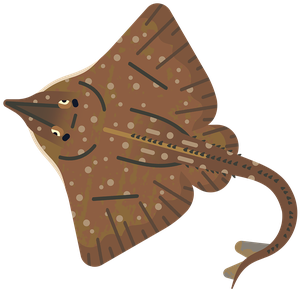
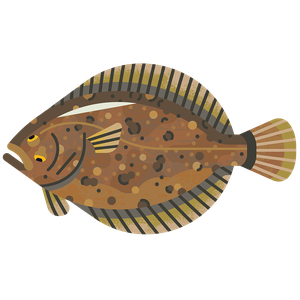
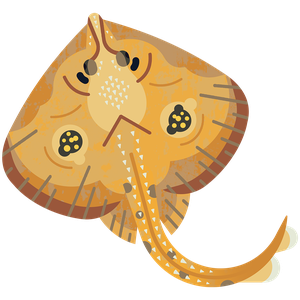
Spotted ray
Raja montagui
What to check for
Location
Southern Celtic Seas
Technical location
Atlantic, Northeast, Bristol Channel, Celtic Sea (North), Celtic Sea (South), English Channel (West), Irish Sea
Caught by
Bottom trawl (otter)
Rating summary
Spotted ray in the Celtic Seas area is data limited, with low resilience to fishing pressure. However, there is currently no concern for fishing pressure or biomass. Spotted ray is a vulnerable species and management needs to be more precautionary. The joint TAC in place is not a suitable management method. Otter trawling is likely to cause some damage to the seabed. Bycatch is moderate and may include vulnerable species.Rating last updated January 2026.
Technical consultation summary
Spotted ray in the Celtic Seas area is data limited, with low resilience to fishing pressure. There is no concern for fishing pressure as this is currently equal to the FMSY proxy, and landings are decreasing. There is also no concern for biomass as stock size estimates remain above Itrigger. Spotted ray is a vulnerable species and management needs to be more precautionary. The joint TAC in place is not a suitable management method. Otter trawling is likely to cause some damage to the seabed. Bycatch is moderate and may include vulnerable species.
How we worked out this Rating
Spotted ray in this area is data limited, with low resilience to fishing pressure. However, there is currently no concern for fishing pressure or biomass.Route 2 (data limited) scoring has been applied to this rating due to the lack of reference points. The most recent assessment was published in 2024 by the International Council for the Exploration of the Sea (ICES), with the next one due in 2026.Spotted ray has a low resilience to fishing pressure. Currently, fishing pressure is equal to the FMSY proxy. However, as landings have been decreasing since 2012, and remain below the scientific advice by ICES, there is currently no concern for fishing pressure. Stock size is monitored using a biomass index (Itrigger). Although biomass has fluctuated since the timeseries began in 1993, it most recently fell below Itrigger (0.2) in 2008 but has remained above this threshold since. In recent years, biomass indices indicate a slight increase: Index A (mean of 2022–2023) is 0.52 compared with Index B (mean of 2019 and 2021) at 0.51. As the stock has slightly increased and remains above Itrigger, there is currently no concern for biomass.ICES advice on landings follows the MSY approach. It is determined from the most recent advised landings (from 2023-2024), adjusted by several factors: the ratio of Index A to Index B, the ratio of observed mean catch length to target mean catch length, a biomass safeguard, and a precautionary multiplier. As a result, advised landings decreased by 7% from 814 tonnes to 757 tonnes for 2025 and 2026. Discard rates remain unquantified.
Spotted ray is a vulnerable species and management needs to be more precautionary. The joint TAC in place is not a suitable management method.There is no management plan in place for spotted ray in this area. Demersal elasmobranchs are usually caught as bycatch in the mixed demersal fisheries for roundfish and flatfish. Species identification issues between blonde ray and spotted ray may affect landings, observer and survey data. There is also no official Minimum Conservation Reference Size (MCRS) in place, so juveniles may also be landed.In 1999, a common Total Allowable Catch (TAC) for 'skates and rays' was first introduced. Five regional quotas are in place for the group of skates and rays, rather than for the individual species. This method of management has been deemed as unsuitable for protecting individual species, but species-specific quotas may also lead to discarding. In 2025, the TAC for skates and rays were set as follows:3168 tonnes for ICES areas 2.a and 487 tonnes for ICES area 3.a9430 tonnes for ICES areas 6.a, 6.b, 7a-c, and 7e-k2688 tonnes for ICES area 7.d5576 tonnes for ICES areas 8 and 9 (2024)A high-survivability exemption to the Landings Obligation was provided for skates and rays in the Celtic Seas ecoregion. Any skates and rays that are discarded are required to be released immediately and below the sea surface.There are some local management measures in place by Inshore Fisheries and Conservation Authorities (IFCAs) for rays and skates. These may include closed areas/seasons and Minimum Conservation Reference Sizes (MCRS).The EU and UK both have fishery management measures, which can include catch limits, population targets, and gear restrictions. However, compliance in the EU and UK has been inconsistent, with ongoing challenges in implementing some regulations. The goal of reaching Maximum Sustainable Yield (MSY) by 2020 was missed, with less than half of UK TACs in 2024 following ICES advice. In 2024, the EU and UK reaffirmed their commitment to sustainable fisheries by aligning management with scientific advice to gradually approach MSY. However, no new target date has been set for achieving MSY across all fisheries. The Landing Obligation (LO), an EU law retained by the UK post-Brexit, requires all quota fish to be landed, even if unwanted (over-quota or below minimum size). It aims to encourage more selective fishing methods, reduce bycatch, and improve catch reporting. However, compliance is poor, and accurate discard levels are hard to quantify with current monitoring programmes. The UK is in the process of replacing the LO with country-specific Catching Policies.The Marine Conservation Society views Remote Electronic Monitoring (REM) with cameras is one of the most cost-effective tools for providing reliable fisheries data and aiding informed management decisions. Fully monitored fisheries enhance collaboration, data accuracy, stock recovery, and reduce impacts on marine wildlife and habitats. However, the full potential of REM may only be achieved when it tracks fishing location and documents catch and bycatch, particularly where vulnerable species and habitats are at risk. As of January 2024, the EU is introducing a Remote Electronic Monitoring (REM) mandate for EU vessels, including CCTV cameras on vessels 18m or more that pose a potential risk of non-compliance, within the next 4 years. Across the UK, different approaches to REM are being taken and legislation is expected to be in place across all 4 countries within the next few years.The Fisheries Act (2020) requires the development of Fisheries Management Plans (FMPs) (replacing EU Multi-Annual Plans) in the UK. 43 FMPs have been proposed and are at various stages of development and implementation, these should all be published by the end of 2028. FMPs have the potential to be very important tools for managing UK fisheries, although data limitations may delay them for some stocks. It is also essential the UK governments define and adopt a standardised approach or model across the four nations to a universally defined FMP design, to ensure the consistence, quality and coherence of all the proposal FMPs.The Marine Conservation Society is keen to see publicly available Fishery Management Plans for all commercially exploited stocks, especially where stocks are depleted, that include:An overview of the fishery including current stock status, spatial coverage, current fishing methods and impactsTargets for fishing pressure and biomass, and additional management when those targets are not being met, based on the best scientific evidenceTimeframes for stock recoveryImproved data collection, transparency, and accountability, supported by technologies such as Remote Electronic Monitoring (REM)Consideration of wider environmental impacts of the fishery, including habitat impacts and minimising bycatchStakeholder engagementThe spotted ray is included in the Southern North Sea and Channel skates and rays FMP, coordinated by Defra. At the time of writing, it is too soon to know whether proposed management measures will be effective in managing the stock. For more information about this FMP and expected progress and timelines, see [https://www.gov.uk/government/publications/joint-fisheries-statement-jfs/list-of-fisheries-management-plans].
Otter trawling is likely to cause some damage to the seabed. Bycatch is moderate and may include vulnerable species.Spotted ray is a shelf species that is a bycatch in trawl and gillnet fisheries, including in mixed demersal fisheries for groundfish and fisheries targeting the overall skate complex. As one of the smaller and less valuable species in the skate complex, it is not targeted, and a relatively high proportion of the catch may be discarded.Elasmobranchs generally show relatively high survival rates because they lack swim bladders and are therefore less affected by changes in water pressure. Their thick, abrasive skin also provides additional protection. Inshore and coastal fisheries using trawls, longlines, gillnets, and tangle nets typically report low at-vessel mortality. However, it is widely considered that discard levels are several times higher than the quantities landed.Demersal trawls have the potential to take relatively high quantities of bycatch. In the Celtic Seas ecoregion, bycatch from otter trawls can include marine mammals, seabirds, fish, elasmobranchs, and endangered, threatened and protected (ETP) species. Bycatch data is limited in many UK and EU fisheries as they are generally not well monitored.One notable ETP species frequently taken as bycatch in otter trawls is the harbour porpoise. This species is included on OSPAR’s List of Threatened and/or Declining Species and Habitats for the Greater North Sea and Celtic Seas, due to documented population declines and the ongoing threat of being bycaught. They are also considered a priority species under UK and EU law, under which there are explicit bycatch requirements. In the Celtic Seas ecoregion, annual bycatch rates of harbour porpoise are estimated at around 48 individuals annually in otter trawls. Acoustic Deterrent Devices (ADDs), such as pingers, have demonstrated effectiveness in reducing harbour porpoise bycatch in gillnets. However, their deployment is inconsistent, and their efficacy is unknown for other species.Demersal trawls have contact with the seabed resulting in penetration and abrasion of habitat features. The impact of trawling on the seabed depends on the location and scale in which trawling occurs. For example, areas that are used to natural disturbance through tides and waves, are less sensitive to habitat impacts. Areas not used to mobile towed gears are typically more sensitive to trawling. Trawl gears are known to have some of the greatest impacts on Vulnerable Marine Ecosystems (VMEs).In the Celtic Seas region, an estimated 66% of the 0-200m zone, and 59% of the 200-800m zone, has been at least partially trawled. Fishing effort in the area has been decreasing since the early 2000s. This has reduced the spatial fishing footprint and the average number of times the seabed is trawled per year. Most habitats are mud and sand, which are less vulnerable to trawling. However, in the Celtic Seas, 95% of areas where VMEs such as cold-water corals and sponges occur or are likely were found to have been fished between 2009 and 2011.Mitigation measures include a ban on bottom trawling below 800m, and restrictions from 400-600m – the areas where most VMEs are found. There remains some uncertainty about the location of some sensitive seabed habitats, so these remain at risk.There are Marine Protected Areas (MPAs) in this area, some of which are designated to protect seabed features from damaging activities. This fishery overlaps with parts of these MPAs, but the proportion of the catch coming from these areas is expected to be relatively low in relation to the unit of assessment (i.e. less than 20% of the catch or effort), and so these impacts have not been assessed within the scale of this rating. Given the important role that MPAs have in recovering the health and function of our seas, MCS encourages the supply chain to identify if their specific sources are being caught from within MPAs. If sources are suspected of coming from within designated and managed MPAs, MCS advises businesses to establish if the fishing activity is operating legally inside a designated and managed MPA, and request evidence from the fishery or managing authority to demonstrate that the activity is not damaging to protected features or a threat to the conservation objectives of the site(s).To improve monitoring and reporting of fishing activity, MCS would like to see remote electronic monitoring (REM) with cameras implemented, used and enforced.
References
Eigaard, O.R., Bastardie, F., Breen, M., Dinesen, G.E., Hintzen, N.T., Laffargue, P., Mortensen, L.O., Nielsen, J.R., Nilsson, H.C., O'Neill, F.G., Polet, H., Reid, D.G., Sala, A., Sköld, M., Smith, C., Sorensen, T.K., Tully, O., Zengin, M., Rijnsdorp, A.D., 2016. Estimating seabed pressure from demersal trawls, seines, and dredges based on gear design and dimensions. ICES Journal of Marine Science, Volume 73, Issue suppl 1. Pages i27-i43. Available at https://academic.oup.com/icesjms/article/73/suppl_1/i27/2573989 [Accessed on 08.01.2025]Froese, R. and D. Pauly, 2025. FishBase: Raja montagui, Spotted ray Available at: Raja montagui, Spotted ray : fisheries [Accessed on 12.01.2026]Hiddink, J., Jennings, S., Sciberras, M., Szostek, C.L., Hughes, K.M., Ellis, N., Rijnsdorp, A.D., McConnaughey, R.A., Mazor, T., Hilborn, R., Collie, J.S., Pitcher, C.R., Amoroso, R.O., Parma, A.M., Suuronen, P. and Kaiser, M.J. 2017. Global analysis of depletion and recovery of seabed biota after bottom trawling disturbance. PNAS. 114:31, pp. 8301-8306. Available at https://doi.org/10.1073/pnas.1618858114 [Accessed on 08.01.2025]ICES. 2025. Working Group on Elasmobranch Fishes (WGEF). ICES Scientific Reports. 7:92. 943 pp. https://doi.org/10.17895/ices.pub.30137623ICES. 2025 Celtic Seas Ecosystem – fisheries Overview. In Report of the ICES Advisory Committee, 2025. ICES Advice 2025, section 7.2. https://doi.org/10.17895/ices.advice.30710879ICES. 2024. Celtic Seas Ecoregion – Ecosystem overview. In Report of the ICES Advisory Committee, 2024. ICES Advice 2024, Section 7.1, https://doi.org/10.17895/ices.advice.25713033ICES. 2024. Spotted ray (Raja montagui) in divisions 7.a and 7.e-h (southern Celtic Seas and western English Channel). In Report of the ICES Advisory Committee, 2024. ICES Advice 2024, rjm.27.7ae-h. https://doi.org/10.17895/ices.advice.25019591Kennelly, S. J. & Broadhurst, M. K., 2021. A review of bycatch reduction in demersal fish trawls. Rev Fish Biol Fisheries 31, 289–318. Available at https://doi.org/10.1007/s11160-021-09644-0. [Accessed on 08.01.2025]Kynoch, R., Fryer, R. & Neat, F., 2015. A simple technical measure to reduce bycatch and discard of skates and sharks in mixed-species bottom-trawl fisheries. ICES J Mar Sci,72(6):1861. Available at https://academic.oup.com/icesjms/article/72/6/1861/921176 [Accessed on 08.01.2025]Peverley, M. and Stewart, J.E. (2021). Fisheries Research & Management Plan: Skates & Rays in the North of Devon and Severn IFCA’s District. Devon and Severn Inshore Fisheries and Conservation Authority & North Devon Biosphere. 63 pp + appendices Shark Trust, 2025. Fisheries Advisories. Available at: Fisheries Advisories | The Shark Trust [Accessed on 08.01.2025]Silva, J. F. and Ellis, J. R. 2019. Bycatch and discarding patterns of dogfish and sharks taken in English and Welsh commercial fisheries. Journal of Fish Biology. 94 (6). Available at https://doi.org/10.1111/jfb.13899 [Accessed on 08.01.2025]van Denderen, P. Bolam, S., Hiddink, J.G., Jennings, S., Kenny, A., Rijnsdorp, A., and van Kooten, T., 2015. Similar effects of bottom trawling and natural disturbance on composition and function of benthic communities across habitats. Mar Ecol Prog Ser. 2015;541:31–43. Available at https://backend.orbit.dtu.dk/ws/portalfiles/portal/119579329/Post_print.pdf [Accessed on 08.01.2025]

Sustainable swaps
Learn more about how we calculate our sustainability ratings.
How our ratings work