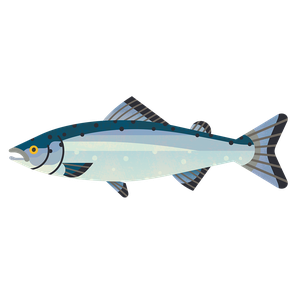
Sprat
Sprattus sprattus
What to check for
Location
English Channel
Technical location
Atlantic, Northeast, English Channel (East), English Channel (West)
Caught by
Net (pelagic trawl)
Rating summary
The sprat population in the English Channel is healthy and fishing pressure is within sustainable limits. There is no management plan but catches are within scientifically recommended limits. Most catches are by mid-water trawlers, with low or no bycatch and no impact on the seabed.Rating last updated May 2024.
Technical consultation summary
The sprat population in the English Channel is healthy and fishing pressure is within sustainable limits. Stock assessments for sprat in this area are carried out annually by the International Council for the Exploration of the Sea (ICES). In 2024, no reference point was defined for biomass. As a result, scoring for this rating has moved from Route 1 to Route 2 (data limited). Sprat has medium resilience to fishing pressure. The stock size indicator (biomass index) is based on annual pelagic surveys (the PELTIC survey). In 2023, it was 61,270t, which is comparable to the long-term average. Therefore, there is no concern for the biomass. The harvest rate has been less than 1% since measurements began in 2013, while MSY is set at 8.57%. In 2023 it was 0.0007%. Therefore, there is no concern for the fishing pressure.There is no management plan for sprat in the English Channel, but some measures are in place. TACs have been set in line with scientific advice since 2020. Catches are below TACs and have been consistently declining since 2016. There is no minimum landing size for sprat in this area, but small sprat are not generally marketable. The recent low landings are thought to be because there are too few large sprat in catches, leading to a short season for the UK fleet. An FMP for North Sea and Channel sprat is expected in 2024.English Channel sprat is mainly caught by small mid-water or pelagic trawlers, with low or no bycatch and no impact on the seabed. Fishermen find sprat by sonar search: they use the size and shape of the marks on the sonar to assess the likely composition of the shoals. They can usually distinguish between herring, sprat and mackerel. Sprat is an important prey species in the North Sea ecosystem. The implications of the environmental change for sprat and the influence of the sprat fishery on other fish species and sea birds are at present unknown.
How we worked out this Rating
The sprat population in the English Channel is healthy and fishing pressure is within sustainable limits.Stock assessments for sprat in this area are carried out annually by the International Council for the Exploration of the Sea (ICES). The most recent assessment was published in 2024 using data up to 2023. The next assessment is expected in 2025. The stock assessment is Category 3, indicating that there are some data limitations.In 2024, no reference point was defined for biomass. As a result, scoring for this rating has moved from Route 1 to Route 2 (data limited). Sprat has medium resilience to fishing pressure.Sprat is a short-lived species and there are large fluctuations in biomass between years, driven by recruitment. The stock size indicator (biomass index) is based on annual pelagic surveys (the PELTIC survey). Data is available from 2013, with a low of 10,000t in 2016 and a peak of 100,000t in 2021. In 2023, it was 61,270t, which is comparable to the long-term average. Therefore, there is no concern for the biomass.Fishing pressure is well below the proxy for Maximum Sustainable Yield. The harvest rate has been less than 1% since measurements began in 2013, while MSY is set at 8.57%. In 2023 it was 0.0007%. Therefore, there is no concern for the fishing pressure.ICES advises that when the MSY approach is applied, catches in the period from 1 July 2024 to 30 June 2025 should be no more than 5,250 tonnes. This is an increase of 115% form the previous year's advice because of the increase in the stock-size indicator.It is thought that the main driver for sprat stock size is environmental pressures and annual recruitment levels, rather than fishing pressure. The low catches in recent years are related to reduced fishing activity.The stock structure of sprat in the Celtic Seas ecoregion is unknown. The PELTIC survey covers the western Channel, which may only be part of the potential distribution of this stock. However, ICES considers that most of the stock is within the PELTIC survey area.
There is no management plan for sprat in the English Channel, but some measures are in place. Catches are within scientifically recommended limits.Most sprat in the English Channel is caught by the UK (around 93%), with occasional catches in some years by the Netherlands and Denmark. Most of the sprat is found in the Lyme Bay area of the western English Channel. There is no specific management plan for this stock, and it is not covered by the EU Western Waters Multi Annual Management Plan, which focuses on demersal and deep-sea fisheries. Most landings are sold for human consumption, unlike other fisheries where sprat is used for feed.This fishery is, however, managed through Total Allowable Catch (TAC), which is set annually and distributed between the catching countries. TACs have been set in line with scientific advice since 2020. Catches are below TACs and have been consistently declining since 2016. Catch in 2022 was 12 tonnes, a substantial reduction since 2016 when it was around 3,300t.There is no minimum landing size for sprat in this area, but small sprat are not generally marketable. The recent low landings are thought to be because there are too few large sprat in catches, leading to a short season for the UK fleet. Sprat is found using sonar, and sometimes shoals are too far offshore to make pursuing them economically viable. These changes in distribution could be relayed to environmental conditions such as temperature and salinity.Discarding is not currently quantified but assumed to be negligible.The EU and UK both have fishery management measures, which can include catch limits, population targets, and gear restrictions. However, compliance in the EU and UK has been inconsistent, with ongoing challenges in implementing some regulations. The goal of reaching Maximum Sustainable Yield (MSY) by 2020 was missed, with less than half of UK TACs in 2024 following ICES advice. In 2024, the EU and UK reaffirmed their commitment to sustainable fisheries by aligning management with scientific advice to gradually approach MSY. However, no new target date has been set for achieving MSY across all fisheries. The Landing Obligation (LO), an EU law retained by the UK post-Brexit, requires all quota fish to be landed, even if unwanted (over-quota or below minimum size). It aims to encourage more selective fishing methods, reduce bycatch, and improve catch reporting. However, compliance is poor, and accurate discard levels are hard to quantify with current monitoring programmes. The UK is in the process of replacing the LO with country-specific Catching Policies.The Marine Conservation Society views Remote Electronic Monitoring (REM) with cameras is one of the most cost-effective tools for providing reliable fisheries data and aiding informed management decisions. Fully monitored fisheries enhance collaboration, data accuracy, stock recovery, and reduce impacts on marine wildlife and habitats. However, the full potential of REM may only be achieved when it tracks fishing location and documents catch and bycatch, particularly where vulnerable species and habitats are at risk. As of January 2024, the EU is introducing a Remote Electronic Monitoring (REM) mandate for EU vessels, including CCTV cameras on vessels 18m or more that pose a potential risk of non-compliance, within the next 4 years. Across the UK, different approaches to REM are being taken and legislation is expected to be in place across all 4 countries within the next few years.The Fisheries Act (2020) requires the development of Fisheries Management Plans (FMPs) (replacing EU Multi-Annual Plans) in the UK. 43 FMPs have been proposed and are at various stages of development and implementation, these should all be published by the end of 2028. FMPs have the potential to be very important tools for managing UK fisheries, although data limitations may delay them for some stocks. It is also essential the UK governments define and adopt a standardised approach or model across the four nations to a universally defined FMP design, to ensure the consistence, quality and coherence of all the proposal FMPs.The Marine Conservation Society is keen to see publicly available Fishery Management Plans for all commercially exploited stocks, especially where stocks are depleted, that include:An overview of the fishery including current stock status, spatial coverage, current fishing methods and impactsTargets for fishing pressure and biomass, and additional management when those targets are not being met, based on the best scientific evidenceTimeframes for stock recoveryImproved data collection, transparency, and accountability, supported by technologies such as Remote Electronic Monitoring (REM)Consideration of wider environmental impacts of the fishery, including habitat impacts and minimising bycatchStakeholder engagementA North Sea and Channel Sprat FMP has been proposed, coordinated by Defra that incorporates this stock. At the time of writing, it is too soon to know whether proposed management measures will be effective in managing the stock. For more information about this FMP and expected progress and timelines, see [https://www.gov.uk/government/collections/fisheries-management-plans#published-fmps].

English Channel sprat is mainly caught by small mid-water or pelagic trawlers, with low or no bycatch and no impact on the seabed.Sprat is a pelagic (mid-water) species, which travel in large schools with other fish (e.g., herring). The fishery is well targeted. Fishermen find sprat by sonar search: they use the size and shape of the marks on the sonar to assess the likely composition of the shoals. They can usually distinguish between herring, sprat and mackerel.Sprat is an important prey species in the North Sea ecosystem. The implications of the environmental change for sprat and the influence of the sprat fishery on other fish species and sea birds are at present unknown.In Lyme Bay the primary gear used for sprat is midwater trawl. Within that gear type a very small number of vessels under 15m actively target sprat and are responsible for the majority of landings (since 2014, an average 85% of the total landings). The size of vessels is limited by English Inshore Fisheries and Conservation Authorities (IFCAs), which have jurisdiction within the 0-6nm limit. Cornwall and Devon prevent entry of vessels larger than 18.28m and 14m, respectively.Pelagic trawls are towed in mid-water with no intentional contact with the seabed, and therefore have negligible impact on the seabed environment. Pelagic trawls are species specific in operation, but on occasion can bycatch marine mammals, other pelagic fish and surface-dwelling birds on hauling. There are no known reports of bycatch of endangered, threatened or protected (ETP) species in this fishery. Where unwanted bycatch does occur, species may include herring or mackerel (bycatch limits are associated with these species).UK regulations to reduce the impacts of fishing on marine habitats and wider species are under development, in the meantime most EU regulation have been adopted. Under EU legislation, bycatch species should be managed within scientifically defined or, where data isn’t available, suitability precautionary sustainable exploration limits. If stocks fall below a certain threshold, measures can be brought in such as gear limitations (e.g., mesh size or depth of use), time and/or areas closures, and Minimum Conservation Reference Sizes (MCRS).
References
ICES, 2019. Stock Annex: Sprat (Sprattus sprattus) in divisions 7.de (English Channel). Available at https://ices-library.figshare.com/articles/report/Stock_Annex_Sprat_Sprattus_sprattus_in_divisions_7_d_and_7_e_English_Channel_/18623369 [Accessed on 09.05.2024].ICES, 2022a. Greater North Sea ecoregion – Ecosystem Overview. ICES Advice: Ecosystem Overviews. Report. https://doi.org/10.17895/ices.advice.21731912.v1 [Accessed 03.07.2023].ICES, 2022b. Greater North Sea ecoregion – fisheries overview. ICES Advice: Fisheries Overviews. Report. https://doi.org/10.17895/ices.advice.21641360.v1 [Accessed 03.07.2023].ICES, 2024a. Herring assessment Working group for the area south of 62° North (HAWG). ICES Scientific Reports. 06:24. 289 pp. Available at https://doi.org/10.17895/ices.pub.25305532 [Accessed on 08.05.2024].ICES, 2024b. Sprat (Sprattus sprattus) in divisions 7.d and 7.e (English Channel). In Report of the ICES Advisory Committee, 2024. ICES Advice 2024, spr.27.7de. Available at https://doi.org/10.17895/ices.advice.25019693 [Accessed on 09.05.2024].MCS, 2023. MPA Reality Check. Available at https://mpa-reality-check.org/ [Accessed 03.07.2023].Seafish, 2022. Pelagic Trawl. Available at: https://www.seafish.org/responsible-sourcing/fishing-gear-database/gear/pelagic-trawl/ [Accessed 03.07.2023].UK Government, 2024. Policy paper: North Sea and Channel sprat fisheries management plan (FMP). Published15 February 2024. Available at https://www.gov.uk/government/publications/north-sea-and-channel-sprat-fisheries-management-plan-fmp [Accessed on 08.05.2024].
Sustainable swaps
Learn more about how we calculate our sustainability ratings.
How our ratings work