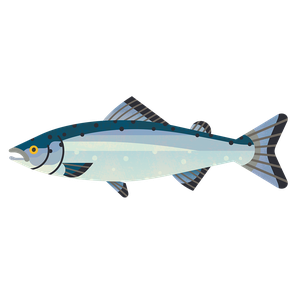
Sprat
Sprattus sprattus
What to check for
Location
West of Scotland, Celtic Seas (South)
Technical location
Atlantic, Northeast, Bristol Channel, Celtic Sea (North), Celtic Sea (South), Irish Sea, Porcupine Bank, Rockall, West of Scotland, Southwest of Ireland (East), Southwest of Ireland (West), West of Ireland
Caught by
Net (pelagic trawl)
Rating summary
Sprat in the Celtic Seas is data limited. There is concern for the level of fishing pressure but no concern for biomass. Few appropriate management measures are in place. Catches have exceeded advice since 2013. Sprat in this area are caught by mid-water trawling. This method generally has low bycatch and few habitat impacts.Rating last updated September 2024.
Technical consultation summary
The sprat populations in the Celtic Seas are poorly understood and very data limited. Route 2 scoring has been applied to this rating owing to the lack of reference points for fishing pressure and biomass. Sprat has medium resilience to fishing pressure. Acoustic surveys are carried out in various areas but it is not clear which populations they apply to. In the Celtic Sea Herring Acoustic Survey (CSHAS), sprat biomass in the 2020 survey was the lowest for a decade. The Agri-Food and Biosciences Institute (AFBI) acoustic survey in Northern Ireland shows that biomass in that area declined from 2016 to reach a 15-year low in 2022. There are substantial data limitations and some conflicting trends. However, these surveys indicate that biomass in some areas in recent years may have been at the lowest levels for the past 10-15 years. Therefore, we consider there to be concern for the biomass. Catches have exceeded advice since 2013. Therefore we consider there to be concern for the fishing pressure.Few appropriate management measures are in place for sprat in the Celtic Seas. There is no management plan and catches have exceeded advice since 2013. There are no catch limits for sprat in this area, but there are quotas for the herring fishery which have some influence on the sprat fishery. There is no specific management plan for this stock, and it is not covered by the EU Western Waters Multi Annual management Plan, which focuses on demersal and deep sea fisheries. FMPs are currently in development in the UK, but sprat is not explicitly mentioned in any FMPs for the Celtic and Irish Seas.Sprat in this area are caught by mid-water trawling. This method generally has low bycatch and few habitat impacts. Sprat is an important prey species in the North Sea ecosystem for fish, mammals, and seabirds. Impacts of removals need to be better understood. Levels of herring bycatch are unknown. There is little data on Endangered Threatened or Protected (ETP) species because only vessels above 15m are surveyed and a significant proportion of the fleet are vessels of less than this size.
How we worked out this Rating
Sprat in the Celtic Seas is data limited. There is concern for the level of fishing pressure and but no concern for biomass.Stock assessments for sprat in this area are carried out every two years by the International Council for the Exploration of the Sea (ICES). The most recent assessment was published in 2023 using data up to 2022. The next assessment is expected in 2025. The stock assessment is Category 5, indicating substantial data limitations. Stock structure is unclear, and it is not known whether there should be one or several assessment units.Route 2 scoring has been applied to this rating owing to the lack of reference points for fishing pressure and biomass. Sprat has medium resilience to fishing pressure.Sprat is a short-lived species and there are large fluctuations in biomass between years. There is no assessment of the biomass against reference points. Acoustic surveys are carried out in various areas but it is not clear which populations they apply to. The Celtic Sea Herring Acoustic Survey (CSHAS) is timed for herring abundance and sprat catches are incidental. Sprat in the Celtic Seas are often more abundant after the survey has ended, meaning trends are potentially lower estimates of abundance. Sprat biomass in the 2020 survey was the lowest for a decade, followed an increase to 2022. In 2023 it decreased back to 2021 levels. The Agri-Food and Biosciences Institute (AFBI) acoustic survey in Northern Ireland shows that biomass in that area declined from 2016 to reach a 15-year low in 2022, however this was followed by a doubling in 2023. There are substantial data limitations and some conflicting trends. However, the increase in 2023 combined with the survey biomass, on average, exceeding average catches by several orders of magnitude, indicate that there is currently no concern for biomass.Since 2013, catch advice has been based on the precautionary approach, which includes a 20% decrease every three years. ICES advises that catches in 2024 and 2025 should be no more than 2,240 tonnes in each year. This is the same as the advice given for 2022-2023 and a 20% decrease on the advice from 2018-2021. Catches since 2013 have ranged from 3,590 to 15,172t. As catches have exceeded advice, we consider there to be concern for the fishing pressure.ICES notes that annual variation in biomass is mainly driven by recruitment rather than fishing pressure. On average, survey biomass exceeds average catches by several orders of magnitude.Historical landings data may not be accurate and landings may be underestimated due to difficulties in quantifying the landings from vessels of less than 10m in length. Given the uncertainty in stock structure and the limited survey coverage, issues of potential local depletion should be monitored.
Few appropriate management measures are in place for sprat in the Celtic Seas. There is no management plan and catches have exceeded advice since 2013.Sprat fisheries in the Celtic Seas are sporadic, occurring in different places at different times. The stock structure is not clear, and it is not known if one or multiple assessment and management areas are needed. As a result, the evidence base for management decisions is limited.In 2023, only Ireland and Scotland reported catches for this fishery. Most sprat are caught by small pelagic vessels that also catch herring. Sprat is targeted when there are known abundances. In Ireland, larger sprats are sold for human consumption and smaller ones for fishmeal. Other fisheries are mainly industrial. There are no catch limits for sprat in this area, but there are quotas for the herring fishery which have some influence on the sprat fishery.There is no specific management plan for this stock, and it is not covered by the EU Western Waters Multi Annual management Plan, which focuses on demersal and deep sea fisheries. Catch has exceeded scientifically advised limits since they were first provided in 2013.The level of discarding is unknown, but based on a limited number of samples, this is estimated to be less than 1% of the catch. The EU and UK both have fishery management measures, which can include catch limits, population targets, and gear restrictions. However, compliance in the EU and UK has been inconsistent, with ongoing challenges in implementing some regulations. The goal of reaching Maximum Sustainable Yield (MSY) by 2020 was missed, with less than half of UK TACs in 2024 following ICES advice. In 2024, the EU and UK reaffirmed their commitment to sustainable fisheries by aligning management with scientific advice to gradually approach MSY. However, no new target date has been set for achieving MSY across all fisheries. The Landing Obligation (LO), an EU law retained by the UK post-Brexit, requires all quota fish to be landed, even if unwanted (over-quota or below minimum size). It aims to encourage more selective fishing methods, reduce bycatch, and improve catch reporting. However, compliance is poor, and accurate discard levels are hard to quantify with current monitoring programmes. The UK is in the process of replacing the LO with country-specific Catching Policies. The Marine Conservation Society views Remote Electronic Monitoring (REM) with cameras is one of the most cost-effective tools for providing reliable fisheries data and aiding informed management decisions. Fully monitored fisheries enhance collaboration, data accuracy, stock recovery, and reduce impacts on marine wildlife and habitats. However, the full potential of REM may only be achieved when it tracks fishing location and documents catch and bycatch, particularly where vulnerable species and habitats are at risk. As of January 2024, the EU is introducing a Remote Electronic Monitoring (REM) mandate for EU vessels, including CCTV cameras on vessels 18m or more that pose a potential risk of non-compliance, within the next 4 years. Across the UK, different approaches to REM are being taken and legislation is expected to be in place across all 4 countries within the next few years.
Sprat in this area are caught by mid-water trawling. This method generally has low bycatch and few habitat impacts.100% of the 2022 sprat catch in the West of Scotland and Celtic Seas was taken by mid-water (pelagic) trawl. Most catches were by Ireland, and some by Scotland.Sprat is an important prey species in the North Sea ecosystem for fish, mammals, and seabirds. However, there are no analyses available on the total amount of sprat and other pelagic species taken by seabirds, marine mammals and large predators in the Celtic Seas Ecoregion. The Celtic Seas Ecoregion is a feeding ground for several species of large baleen whales. These whales feed primarily on sprat and herring from September to February.Most sprat in the Celtic Seas Ecoregion are caught by small pelagic vessels, using relatively small meshes of 16-31 mm. This is permitted as long as the catch contains a minimum percentage of the target species. Targeted fishing takes place when there are known sprat abundances. However, sprat may also be caught in mixed shoals with herring. The fishermen find shoals of sprat using sonar, and can usually distinguish between herring, sprat and mackerel. The shoals are then targeted using pelagic trawls fishing above the seabed, with minimal impacts on seabed habitats.Because they are targeting pelagic fish there is a risk of capture of other pelagic species of fish, marine mammal and surface dwelling birds on hauling. For many sprat fisheries, there are bycatch limits for herring designed to limit catch of these species in small meshed fisheries. However, these are not set in this fishery. It is known that fishermen can recognise and target sprat shoals but the levels of herring bycatch are unknown. There is little data on Endangered Threatened or Protected (ETP) species because only vessels above 15m are surveyed and a significant proportion of the fleet are vessels of less than this size. No cetacean bycatch has been recorded, and thresher sharks have only occasionally been bycaught (none observed between 1996 and 2010).
References
Froese R. and Pauly D. (Editors), 2024. Sprattus sprattus, European sprat. Available at: https://www.fishbase.se/summary/Sprattus-sprattus.html. [Accessed on 08.05.2024].ICES, 2023. Sprat (Sprattus sprattus) in Subarea 6 and Divisions 7.a-c and 7.f-k (West of Scotland, southern Celtic Seas). In Report of the ICES Advisory Committee, 2023. ICES Advice 2023, spr.27.67a-cf-k. Available at https://doi.org/10.17895/ices.advice.21975368 [Accessed on 08.05.2024].ICES, 2024. Herring assessment Working group for the area south of 62° North (HAWG). ICES Scientific Reports. 06:24. 289 pp. Available at https://doi.org/10.17895/ices.pub.25305532 [Accessed on 08.05.2024].MCS, 2023. MPA Reality Check. Available at https://mpa-reality-check.org/ [Accessed 03.07.2023]Seafish, 2022. Pelagic Trawl. Available at: https://www.seafish.org/responsible-sourcing/fishing-gear-database/gear/pelagic-trawl/ [Accessed 03.07.2023]UK Government, 2022. Policy paper: List of fisheries management plans (FMPs). Updated 6 December 2022. Available at https://www.gov.uk/government/publications/joint-fisheries-statement-jfs/list-of-fisheries-management-plans [Accessed on 08.05.2024].
Sustainable swaps
Learn more about how we calculate our sustainability ratings.
How our ratings work