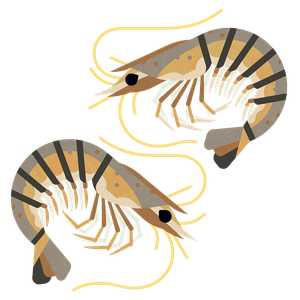
Tiger prawn
Penaeus monodon
What to check for
Location
All areas
Production method
Pond, freshwater
Certification

Global Seafood Alliance Best Aquaculture Practices (GAA BAP) 2*

Global Seafood Alliance Best Aquaculture Practices (GAA BAP) 3*
Rating summary
Giant tiger prawns certified by the Global Seafood Alliance (GSA), formerly Global Aquaculture Alliance (GAA), Best Aquaculture Practices (BAP) are managed well and the Farm Standard mitigates many areas of environmental concern in prawn farming, including freshwater depletion, habitat alteration, discharge of effluents, chemical usage, escapes and disease and parasite interactions. The Farm Standard also has criteria in place to ensure animal welfare and humane slaughter. A 4* rating ensures compliance with the BAP Feed Mill Standard. However, there are still improvements that could be made, including the addition of a mandatory Environmental Impact Assessment, and increasing the percentage inclusion more criteria on the sourcing of responsible feed ingredients.This rating is based on full compliance with certification requirements. Commercial buyers should therefore ensure that full compliance has been achieved in order for this rating to be applicable.Rating last updated December 2024.
References
Aninakwah, R. 2019. 22 years of promoting best practice in shrimp aquaculture. The Fish Site. Available at: https://thefishsite.com/articles/22-years-of-promoting-best-practice-in-shrimp-aquaculture [Accessed on 09.12.2024].Best Aquaculture Practices, 2024. Aquaculture Facility Certification: Feed Mills Standard, Issue 3.2, 9 December 2024. Available at: https://www.bapcertification.org/Downloadables/pdf/standards/BAP%20-%20Feed%20Mills%20-%20Issue%203.2%20-%2009-December-2024.pdf [Accessed on 09.12.2024].Best Aquaculture Practices, 2023. Aquaculture Facility Certification: BAP Farm Standard, Issue 3.1, 3 February 2023. Available at: https://www.bapcertification.org/Downloadables/pdf/BAP%20-%20BAP%20Farm%20Standard%20-%20Issue%203.1%20-%2007-February-2023.pdf [Accessed on 09.12.2024].Best Aquaculture Practices, 2023. Hatchery Standard. Available at: https://www.bapcertification.org/Downloadables/pdf/BAP%20-%20Hatchery%20Standard%20-%20Issue%202.1%20-%2030-January-2023.pdf [Accessed on 09.12.2024].Best Aquaculture Practices, 2017. Finfish and Crustacean Farm Standard (FCFS). Issue 2.4 – 23 May 2017. Available at: https://www.bapcertification.org/Downloadables/pdf/standards/PI%20-%20Standard%20-%20Finfish%20and%20Crustacean%20Farms%20%E2%80%93%20Issue%202.4%20%E2%80%93%2023-May-2017.pdf [Accessed on 09.12.2024].Flegel, T.W. 2019. A future vision for disease control in shrimp aquaculture. Journal of the World Aquaculture Society 2019; 50:249–266. Available at: https://onlinelibrary.wiley.com/doi/pdf/10.1111/jwas.12589 [Accessed on 09.12.2024].Monterey Bay Aquarium Seafood Watch. 2015. Whiteleg shrimp. China. Ponds. Available at: https://www.seafoodwatch.org/recommendation/shrimp/red-shrimp-whiteleg-shrimp-china-ponds?species=156 [Accessed on 09.12.2024].Monterey Bay Aquarium Seafood Watch. 2021. Whiteleg shrimp. Ecuador. Semi-intensive ponds. Available at: https://www.seafoodwatch.org/recommendations/search?query=%3Aspecies%3BWhiteleg%20shrimp%3Acountry%3BEcuador [Accessed on 09.12.2024].Naylor, R.L., Hardy, R.W., Buschmann, A.H. et al. 2021. A 20-year retrospective review of global aquaculture. Nature 591, 551–563. Available at: https://doi.org/10.1038/s41586-021-03308-6 [Accessed on 09.12.2024].Shinn, A.P., Pratoomyot, J., Griffiths, D., Trong, T.Q., Vu, N.T., Jiravanichpaisal, P. and Briggs, M. 2018. Asian Shrimp Production and the Economic Costs of Disease. Asian Fisheries Science 31S(2018): 29–58. Available at: http://www.asianfisheriessociety.org/publication/downloadfile.php?id=1217&file=Y0dSbUx6QXhOVFF5TWpNd01ERTFORGMzTXpJM05UZ3VjR1Jt#page=35 [Accessed on 09.12.2024].Tacon, A.G.J., Jory, D., Nunes, A. 2013. Shrimp feed management: issues and perspectives. In M.R. Hasan and M.B. New, eds. On-farm feeding and feed management in aquaculture. FAO Fisheries and Aquaculture Technical Paper No. 583. Rome, FAO. pp. 481–488. Available at: http://www.fao.org/tempref/FI/CDrom/T583/root/18.pdf [Accessed on 09.12.2024].
Sustainable swaps
Learn more about how we calculate our sustainability ratings.
How our ratings work