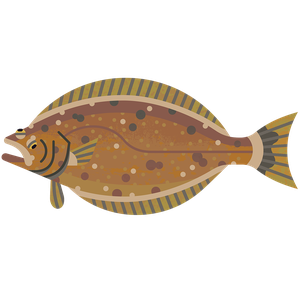
Turbot
Psetta maxima
What to check for
Location
North Sea
Technical location
Atlantic, Northeast, North Sea
Caught by
Net (gill or fixed)
Rating summary
The spawning stock biomass of turbot in the North Sea is in a healthy state and is harvested sustainably. Management of turbot and brill is under a combined species Total Allowable Catch (TAC) which prevents effective control of fishing pressure on either species. However, this does not currently appear to be having a negative impact on the stock in the North Sea. Whilst gill net fisheries can be very selective with regards to targeted fish species, they can encounter bycatch of vulnerable species including porpoise, sharks and seabirds. Bycatch of harbour porpoise in the North Sea is not considered to be a threat to the population, but localised depletion may be an issue in some areas.Rating last updated July 2022.
How we worked out this Rating
The spawning stock biomass of turbot in the North Sea is in a healthy state and is harvested sustainably.Stock assessments are carried out annually by the International Council for the Exploration of the Sea (ICES). The most recent assessment was published in 2024.The stock assessment defines reference points for fishing pressure (F) and biomass (B). For fishing pressure, there is a target to keep F at or below Maximum Sustainable Yield (MSY). For biomass, there is no target. However, there is a trigger point (MSY BTrigger). Below this level, F should be reduced to allow the stock to increase. Because BMSY is not defined, the Good Fish Guide applies its own definition of 1.4 x MSY BTrigger.Spawning stock biomass (SSB) increased steadily from 2005 to 2018, and has since been in a gradual decline, but remains above MSY Btrigger (6,353 tonnes). In 2023, SSB is 6,882 tonnes and in 2025 it is predicted to increase to 7,223 tonnes.Fishing mortality in 2023 (0.30) is below FMSY (0.36) and has been in decline since 2021. Catches in 2022 and 2023 are the lowest in the times series (since 1981).ICES advises that when the MSY approach is appliced, catches in 2025 should be no more than 2,426 tonnes. This is an 18.2% increase from the previous year due to a bigger stock size at the beginning of the advice year and is derived from stronger recruitment in 2022-2023 compared to 2020-2021.
There is no management plan for turbot in the North Sea, but some measures are in place.Until 2024, turbot in the North Sea was managed under a combined total allowable catch (TAC) together with brill. ICES indicated that management of turbot and brill under a combined species TAC prevents effective control of the single-species exploitation rates which can result in high-grading and discarding of the lesser value species and overexploitation of the high value one, turbot. In 2024, a separate TAC has been given for turbot and brill. However, the TAC for turbot is for turbot in both ICES subarea 4 (North Sea) and division 2.a (Norwegian Sea).Catches are thought to consist predominantly of immature fish, which is having a negative impact on the potential yield from the stock. As turbot is a fast-growing species, reduction in the exploitation on younger ages would lead to an increase in maximum sustainable yield, supporting the need to reduce catching turbot under its length at maturity of between 30 and 35 cm for males and females respectively.Turbot is mainly a bycatch species in fisheries for plaice and sole. As such, fishing mortality for turbot is influenced by the management of plaice and sole fisheries.For plaice and sole fisheries, technical measures are in place in this area. These include:Mesh size regulations for towed trawl gears require that vessels fishing North of 55° (or 56°N east of 5°E, since January 2000) should have a minimum mesh size of 100 mm, while to the south of this limit, where the majority of the sole fishery takes place, an 80 mm mesh is allowed. In the fishery with fixed gears a minimum mesh size of 100 mm is required.A closed area has been in operation since 1989 (the plaice box) - this applies to vessels using towed gears, but vessels smaller than 300 HP are exempt.In the plaice box, and in the 12 nautical mile zone, the maximum aggregated beam length is 9m. The EU and UK both have fishery management measures, which can include catch limits, population targets, and gear restrictions. However, compliance in the EU and UK has been inconsistent, with ongoing challenges in implementing some regulations. The goal of reaching Maximum Sustainable Yield (MSY) by 2020 was missed, with less than half of UK TACs in 2024 following ICES advice. In 2024, the EU and UK reaffirmed their commitment to sustainable fisheries by aligning management with scientific advice to gradually approach MSY. However, no new target date has been set for achieving MSY across all fisheries. The Landing Obligation (LO), an EU law retained by the UK post-Brexit, requires all quota fish to be landed, even if unwanted (over-quota or below minimum size). It aims to encourage more selective fishing methods, reduce bycatch, and improve catch reporting. However, compliance is poor, and accurate discard levels are hard to quantify with current monitoring programmes. The UK is in the process of replacing the LO with country-specific Catching Policies. The Marine Conservation Society views Remote Electronic Monitoring (REM) with cameras is one of the most cost-effective tools for providing reliable fisheries data and aiding informed management decisions. Fully monitored fisheries enhance collaboration, data accuracy, stock recovery, and reduce impacts on marine wildlife and habitats. However, the full potential of REM may only be achieved when it tracks fishing location and documents catch and bycatch, particularly where vulnerable species and habitats are at risk. As of January 2024, the EU is introducing a Remote Electronic Monitoring (REM) mandate for EU vessels, including CCTV cameras on vessels 18m or more that pose a potential risk of non-compliance, within the next 4 years. Across the UK, different approaches to REM are being taken and legislation is expected to be in place across all 4 countries within the next few years. The Fisheries Act (2020) requires the development of Fisheries Management Plans (FMPs) (replacing EU Multi-Annual Plans) in the UK. 43 FMPs have been proposed and are at various stages of development and implementation, these should all be published by the end of 2028. FMPs have the potential to be very important tools for managing UK fisheries, although data limitations may delay them for some stocks. It is also essential the UK governments define and adopt a standardised approach or model across the four nations to a universally defined FMP design, to ensure the consistence, quality and coherence of all the proposal FMPs. The Marine Conservation Society is keen to see publicly available Fishery Management Plans for all commercially exploited stocks, especially where stocks are depleted, that include: An overview of the fishery including current stock status, spatial coverage, current fishing methods and impacts Targets for fishing pressure and biomass, and additional management when those targets are not being met, based on the best scientific evidence Timeframes for stock recovery Improved data collection, transparency, and accountability, supported by technologies such as Remote Electronic Monitoring (REM) Consideration of wider environmental impacts of the fishery, including habitat impacts and minimising bycatch Stakeholder engagement A Southern North Sea and Eastern Channel mixed flatfish FMP has been proposed, coordinated by Defra that covers the English waters within ICES divisions 4b, 4c and 7d. The FMP covers the following flatfish species (quota and non-quota): sole, dab, plaice, flounder, halibut, lemon sole, witch, turbot, brill. It is too soon to know whether the proposed management measures will be effective in managing the stock. For more information about this FMP and expected progress and timelines, see https://www.gov.uk/government/collections/fisheries-management-plans#published-fmps.
Gill net fisheries can be very selective with regards to targeted fish species. However, they can encounter bycatch of vulnerable species including porpoise, sharks and seabirds.Turbot is a valuable bycatch species in beam (66%) and otter trawl (25%) and gillnet and trap (9%) fisheries for flatfish (plaice and sole) and other demersal species.Gillnets and fixed nets can be very size selective, but can bycatch species such as sharks, cetaceans and other marine mammals. Reports indicate that there is concern regarding the bycatch of cetaceans, particularly harbour porpoise, by gillnets. The IUCN lists harbour porpoise as being of least concern globally, but vulnerable in Europe. They are also classified as a priority species under the UK Post-2010 Biodiversity Framework and are protected under the European Union (EU) Habitats Directive and Habitats Regulations as transposed into UK law, under which there are explicit bycatch requirements. To comply with the Habitats Directive, the UK has recently designated five Special Areas for Conservation for harbour porpoises, however, there is currently no management in place for these.One of the areas of most concern is off the South West of England, where areas of higher gillnet fishing effort coincide with areas of larger harbour porpoise populations. While cetacean bycatch has been a long-term problem around Cornwall, the occurrence of stranded cetaceans has increased over the last two decades. In 2019, 24% of stranded cetaceans exhibited features consistent with bycatch or entanglement in fishing gear, a further 19% were assessed as being possible bycatch, and 52% had an unknown cause of death.However, harbour porpoise bycatch is not considered to be a problem in the North Sea where the majority of turbot catches take place.Because of gillnets' durability (they are made of nylon), if lost, they can continue to fish for several weeks before becoming tangled and bundled up, a phenomenon known as 'ghost fishing'. However, static nets, as with all gear, represent an investment by fishermen, and therefore there are incentives to avoid losing or damaging gear.
References
ASCOBANS, 2009. Conservation Plan for Harbour Porpoises in the North Sea as adopted at the 6th Meeting of the Parties to ASCOBANS, Bonn, Germany. 16 - 18 September 2009. Available at https://www.ascobans.org/sites/default/files/document/ASCOBANS_NorthSeaPlan_MOP6.pdf [Accessed on 06.07.2022].Calderan, S. and Leaper, R., 2019. Review of harbour porpoise bycatch in UK waters and recommendations for management. January 2019, WWF. Available at https://www.wwf.org.uk/sites/default/files/2019-04/Review_of_harbour_porpoise_in_UK_waters_2019.pdf [Accessed on 06.07.2022].Carlén, I., Nunny, L. and Simmonds, M. P. 2021. Out of Sight, Out of Mind: How Conservation Is Failing European Porpoises. Frontiers in Marine Science. Available at https://www.frontiersin.org/articles/10.3389/fmars.2021.617478/full [Accessed on 06.07.2021].Chadwick, H., Clear, N., Crosby, A., Hawtrey-Collier, A. and Williams, R. 2019 Annual Report. Marine Strandings in Cornwall and the Isles of Scilly. Available at https://www.cornwallwildlifetrust.org.uk/sites/default/files/2020-12/2019%20Summary%20Report%20-%20Marine%20Strandings%20in%20Cornwall%20and%20the%20Isles%20of%20Scilly.pdf [Accessed on 06.07.2022].Clean Catch UK. Joint Action To Reduce Wildlife Bycatch. Available at https://www.cleancatchuk.com/ [Accessed on 06.07.2022].ICES. 2021. Greater North Sea Sea Ecoregion – Ecosystem overview. In Report of the ICES Advisory Committee, 2021. ICES Advice 2021, Section 9.1, https://doi.org/10.17895/ices.advice.9434 [Accessed on 19.07.2022].ICES. 2022. Turbot (Scophthalmus maximus) in Subarea 4 (North Sea). In Report of the ICES Advisory Committee, 2022. ICES Advice 2022, tur.27.4. https://doi.org/10.17895/ices.advice.19453871.ICES. 2022. Working Group on the Assessment of Demersal Stocks in the North Sea and Skagerrak (WGNSSK). ICES Scientific Reports. 4:43. http://doi.org/10.17895/ices.pub.19786285. In prep.ICES, 2018. ICES Advice: Bycatch of small cetaceans and other marine animals - review of national reports under Council Regulation (EC) No. 812/2004 and other information. Published 11 September 2018. Available at https://www.ices.dk/sites/pub/Publication%20Reports/Advice/2018/2018/byc.eu.pdf [Accessed on 06.07.2022].Leeney, R. H., Amies, R., Broderick, A.C., Witt, M. J., Loveridge, J., Doyle, J. and Godley, B. J. 2008. Spatio-temporal analysis of cetacean strandings and bycatch in a UK fisheries hotspot. Biodiversity and Conservation. 17, 2323. Available at https://link.springer.com/article/10.1007/s10531-008-9377-5#citeas [Accessed on 06.07.2022].Leeney, R. H., Witt, M. J., Broderick, A. C., Buchanan, J., Jarvis, D. S., Richardson, P. B. and Godley, B. J. 2011. Marine megavertebrates of Cornwall and the Isles of Scilly: relative abundance and distribution. Journal of the Marine Biological Association of the United Kingdom, 92(8), 1823-1833. Available at https://www.cambridge.org/core/journals/journal-of-the-marine-biological-association-of-the-united-kingdom/article/marine-megavertebrates-of-cornwall-and-the-isles-of-scilly-relative-abundance-and-distribution/7981AA197C2320B6A9E2C01BD7A1F7B7 [Accessed on 06.07.2022].Moan, A., Skern-Mauritzen, M., Vølstad, J. H., Bjørge, A. 2020. Assessing the impact of fisheries-related mortality of harbour porpoise (Phocoena phocoena) caused by incidental bycatch in the dynamic Norwegian gillnet fisheries, ICES Journal of Marine Science, Volume 77, Issue 7-8, Pages 3039–3049. Available at https://doi.org/10.1093/icesjms/fsaa186 [Accessed on 06.07.2022].North Atlantic Marine Mammal Commission and the Norwegian Institute of Marine Research. 2019. Report of Joint IMR/NAMMCO International Workshop on the Status of Harbour Porpoises in the North Atlantic. Tromsø, Norway. Available at https://www.ascobans.org/sites/default/files/document/ascobans_ac25_inf.4.3a_joint-imr-nammco-ws-harbour-porpoise.pdf [Accessed on 06.07.2022].Omeyer, L. C. M., Doherty, P. D., Dolman, S., Enever, R., Reese, A., Tregenza, N., Williams, R. and Godley, B. J. 2020. Assessing the Effects of Banana Pingers as a Bycatch Mitigation Device for Harbour Porpoises (Phocoena phocoena). Frontiers in Marine Science. Available at https://www.frontiersin.org/articles/10.3389/fmars.2020.00285/full [Accessed on 06.07.2022].OSPAR, 2017. Intermediate Assessment 2017: Harbour Porpoise Bycatch. Available at https://oap.ospar.org/en/ospar-assessments/intermediate-assessment-2017/biodiversity-status/marine-mammals/harbour-porpoise-bycatch/ [Accessed on 06.07.2022].

Sustainable swaps
Learn more about how we calculate our sustainability ratings.
How our ratings work