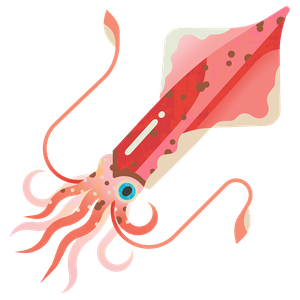
Veined squid
Loligo forbesii
What to check for
Location
English Channel
Technical location
Atlantic, Northeast, English Channel (East), English Channel (West)
Caught by
Bottom trawl (otter)
Rating summary
Updated: February 2021There are indicators that veined squid biomass in the English Channel is at low levels, so there is concern for stock biomass. Fishing pressure is also of concern as landings have continued to rise without limits. In UK waters, squid fishing is unregulated and no appropriate management is in place for these fisheries. Towed fishing gear, including demersal otter trawls, is associated with damage to seabed flora and fauna, non-target bycatch and discarding of juvenile fish.
How we worked out this Rating
There are indicators that veined squid biomass in the English Channel is at low levels, so there is concern for stock biomass. Fishing pressure is also of concern as landings have continued to rise without limits. Route 2 scoring has been applied to this rating owing to the lack of reference points for fishing pressure and biomass. Veined squid has high vulnerability (56 out of 100).Veined squid, Loligo forbesii, is one of the two loliginid (Loliginidae or long-finned squid) species of significant commercial importance in the Northeast Atlantic. In the northernmost areas, squid are the main cephalopod resources. L. forbesii is the most frequently caught squid species in UK waters.In the English Channel, the catch per unit of effort (CPUE) of veined squid is still very low compared to the historical mean, and shows a decreasing trend. The biomass in 2016–2018 was lower than in 2013–2015. Regional fishery CPUEs datasets by species or groups of species need further improvement to be used as a proxy of biomass. However, this indicates that there could be concern for the biomass. Veined squid is usually landed mixed with European squid (Loligo vulgaris) and the two species are usually not separated in official statistics. As squid landings are mainly reported at family level, rather than by species, this makes it harder to infer species-specific trends. From 2016-2018, 42-44% of catches of loliginids or long-finned squids (landings and discards) in Northeast Atlantic occurred in the English Channel. In 2016–2018, loliginid landings here were above the mean. Landings in the English Channel have continued to increase despite a lower biomass of L. forbesii, apparently reflecting an increase of European squid (L. vulgaris) biomass. L. vulgaris biomass supported the increase in squid production in the English Channel.Overall, UK catches of Loligo species in the Northeast Atlantic have increased 40.4% from 2015 to 2019 (2,362 tonnes to 3,315 tonnes) and the average price increased 16.6% from £3.61/kg to £4.21/kg. Squid fisheries are likely to continue to grow in importance and magnitude as many finfish stocks either are fully or over-exploited. Without adequate stock assessments, there could be concern for future impacts on stocks.
In UK waters, squid fishing is unregulated and no appropriate management is in place for these fisheries.Despite the importance of several species for European fisheries, there is limited management of the fisheries and no routine assessment. Data collection is often either not part of routine fishery data collection or the data are inadequate for assessment. Increasingly, however, cephalopods are seen as alternative target species to replace overexploited finfish stocks, and the growing fishing effort means that management will almost certainly be needed within the next few years.Squid catches are not subject to landings quotas and there is no routine assessment of squid stock(s) to inform management.Management of cephalopod fishing in Europe is largely limited to Minimum Landing Size (MLS) regulations in southern Europe. No minimum legal size applies to squid in this region of the Northeast Atlantic, but in Spain and Portugal a 100 mm MLS for Loligo species is imposed.Trawling is restricted by the present EC regulations on mesh size. However, studies on the selectivity of diamond, hexagonal, and square-mesh codends confirmed that the legal minimum mesh size and codend configurations for demersal trawling are not suitable for regulating fishing on cephalopod species.Loliginid discards are generally negligible and in 2016–2018 represented around 1% of total catches. However, in some areas (7e) discards can range between 2 and 5% (2016-2018).Loss of eggs either due to trawling over spawning grounds or egg laying on fixed gear may be important and there has been evidence of growth overfishing (high catches of very small squid followed by lower catches later in the season) in the Moray Firth.Both the EU and UK have fishery management measures in place, which can include catch limits, targets for population sizes and fishing mortality, and controls on what fishing gear can be used and where. In the EU, compliance with regulations has been variable, and there are ongoing challenges with implementing some of them. There was a target for fishing to be at Maximum Sustainable Yield by 2020, but this was not achieved. The Landing Obligation (LO), an EU law that the UK has kept after Brexit, requires all fish and shellfish to be landed, even if they are unwanted (over-quota or below minimum size). It aims to promote more selective fishing methods, reduce bycatch, and improve recording of everything that is caught, not just what is wanted. Compliance with the LO is generally poor and actual levels of discards are difficult to quantify using the current fisheries observer programme. In the UK, it is too early to tell how effective management is, as the Fisheries Act only came into force in January 2021. The Act requires the development of Fisheries Management Plans (FMPs) (replacing EU Multi-Annual Plans) but there are no details yet on how and when these will be developed. FMPs have the potential to be very important tools for managing UK fisheries, although data limitations may delay them for some stocks. MCS is keen to see FMPs for all commercially exploited stocks, especially where stocks are depleted, that include: Targets for fishing pressure and biomass, and additional management when those targets are not being met Timeframes for stock recovery Technologies such as Remote Electronic Monitoring (REM) to support data collection and improve transparency and accountability Consideration of wider environmental impacts of the fishery
Most squid is caught by trawlers. There is a potential for damage to the seabed by trawling, and bycatch of unwanted species.In the Northeast Atlantic long-finned squids are mainly landed by the trawl fleet; 92% 2016–2018.Similar to the northern areas, loliginids are mainly exploited by the trawl fishery in the English Channel, although the seine fleet also makes an important contribution, generating 33% of landings. Squids represent a bycatch of larger demersal otter trawl fisheries targeting finfish in which discarded undesirable bycatch can represent over a quarter of the total catch. This may include endangered, threatened or protected species in certain circumstances.Nonetheless, there has been intermittent interest in directed squid fishing in UK waters over the years and directed fishing on squid occurs (e.g., Rockall Bank (West of Scotland) and in the Moray Firth (North Sea). Where trawlers target squid, a “clean” catch can be obtained, but may also occasionally catch larger amounts of unwanted species (25% of total catches by weight).The main population of Veined squid, Loligo forbesii, in UK waters is distributed over the continental shelf and shelf edge, mostly in water 50–250 m deep and within 200 km of the coast. L. forbesii have been recorded at depths of 20–171 m in the North Sea during bottom-trawl surveys.Identification of long-finned squids in the stomach contents of numerous predator species in European seas remains at the level of the family Loliginidae. Nonetheless, L. vulgaris has been identified in the stomach contents of several large pelagic and demersal fish as well as marine mammals.Demersal otter trawling can catch a number of unwanted species, including commercial species, and vulnerable species such as sharks and rays. However, in the North Sea, discard rates of unwanted species are lower than the average (which in general is 30-40% of total catch by weight), at around 16% for commercial species.Demersal otter trawls use doors to hold nets open that penetrate the seabed, resulting in the abrasion of habitat features. The ground ropes, sweeps and bridles of the trawl can have similar abrasive impact. Various closures are in place in the area of this stock, including UK and European Marine Protected Areas. Some MPAs are designated to protect benthic features. If those MPAs were found to be subjected to bottom trawling, MCS would consider it a default red rating unless there is evidence (e.g. environmental impact assessment) indicating the activity does not damage the integrity of the site.
References
Arkhipkin, A., Rodhouse, P., Pierce, G., Sauer, W., Sakai, M., Allcock, L., Arguelles, J., Bower, J., Castillo, G., Ceriola, L., Chen, C., Chen, X., Diaz-Santana, M., Downey, N., Gonzalez, A., Amores, J., Green, C., Guerra, A., Hendrickson, L., Ibanez, C., Ito, K., Jereb, P., Kato, Y., Katugin, O., Kawano, M., Kidokoro, H., Kulik, V., Laptikhovsky, V., Lipinski, M., Liu, B., Mariategui, L., Marin, W., Medina, A., Miki, K., Miyahara, K., Moltschaniwskyj, N., Moustahfid, H., Nabhitabhata, J., Nanjo, N., Nigmatullin, C., Ohtani, T., Pecl, G., Perez, J., Piatkowski, U., Saikliang, P., Salinas-Zavala, C., Steer, M., Tian, Y., Ueta, Y., Vijai, D., Wakabayashi, T., Yamaguchi, T., Yamashiro, C., Yamashita, N. and Zeidberg, L. (2015). World Squid Fisheries. Reviews in Fisheries Science & Aquaculture, 23(2), pp.92-252. Available at https://www.tandfonline.com/doi/full/10.1080/23308249.2015.1026226 [Accessed 08.02.2021]DEFRA (2013). EVID4 Evidence Project Final Report (Rev. 06/11), pp.1-30.Hastie, L., Pierce, G., Pita, C., Viana, M. , Smith, J. and Wangvoralak, S. (2009). Squid Fishing in UK Waters: A Report to SEAFISH Industry Authority. Project Report. University of Aberdeen. Available at https://www.seafish.org/document/?id=72bdf841-6e5b-435f-9dee-b87ffd2c481b [Downloaded 08.02.2021]ICES (2020). Working Group on Cephalopod Fisheries and Life History (WGCEPH; outputs from 2019 meeting). ICES Scientific Reports. 2:46. 121pp. http://doi.org/10.17895/ices.pub.6032. Available at http://www.ices.dk/sites/pub/Publication%20Reports/Expert%20Group%20Report/EPDSG/2020/Working%20Group%20on%20Cephalopod%20Fisheries%20and%20Life%20History%20(WGCEPH).pdf [Accessed 02.02.2021]Jereb, P., Allcock, L., Lefkaditou, E., Piatkowski, U., Hastie, L. and Pierce, G. (2015). Cephalopod biology and fisheries in Europe: II. Species Accounts. 360 pp. ICES Cooperative Research Report, ICES. https://doi.org/10.17895/ices.pub.5493. Available at http://www.ices.dk/sites/pub/Publication%20Reports/Cooperative%20Research%20Report%20(CRR)/CRR325.pdf [Accessed 02.02.2021]Regulation (EU) 2019/1241 of the European Parliament and of the Council. Available at https://www.legislation.gov.uk/eur/2019/1241 [Accessed 11.02.2021]Seafish (2017). RASS Profile: Squid in ICES areas VIIe-h (Celtic Sea and Western English Channel: Loligo vulgaris, Loligo forbesi. Available at https://www.seafish.org/responsible-sourcing/risk-assessment-for-sourcing-seafood-rass/records/squid-in-ices-areas-viie-h-celtic-sea-and-western-english-channel-demersal-otter-trawl/ [Accessed 02.02.2021]Sealife Base (2021). Veined squid (Loligo forbesii). Available at https://www.sealifebase.se/summary/Loligo-forbesii.html [Accessed 02.02.2021]Sustainable Fisheries Partnership (2016). Veined squid NE Atlantic shelf. FishSource profile. In: FishSource [online]. Updated 27 June 2016. Available at https://www.fishsource.org/stock_page/1369 [Accessed 11.02.2021]Sustainable Fisheries Partnership (2016). Inshore squids nei NE Atlantic shelf. FishSource profile. In: FishSource [online]. Updated 4 November 2016. Available at https://www.fishsource.org/stock_page/2013 [Accessed 15.02.2021]

Sustainable swaps
Learn more about how we calculate our sustainability ratings.
How our ratings work