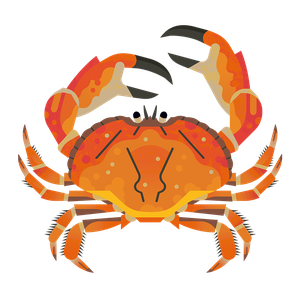
Velvet swimming crab
Necora puber
What to check for
Location
Scotland (Shetland)
Technical location
Atlantic, Northeast, North Sea (North)
Caught by
Pot, trap or creel
Rating summary
Based on limited data, there is no concern for fishing pressure or biomass for velvet crabs in Shetland. Velvet crabs also have medium vulnerability to fishing pressure. Some appropriate management measures are in place, such as a minimum landing size, restrictions on landing soft-shelled or berried crabs, licence requirements, and effort controls. However, without fishery-independent assessments, the effectiveness of these measures remains uncertain. Potting, or creeling, for velvet crab, is associated with negligible bycatch and habitat impacts but may result in the entanglement of marine mammals in this area.Rating last updated November 2025
Technical consultation summary
Route 2 (data-limited) scoring has been applied to this rating, with velvet crab having medium vulnerability to fishing pressure. There is no concern for fishing pressure as landings in 2024 appear consistent with the recent average. There is also no concern for biomass as LPUE values for Shetland have been increasing since 2021. Some appropriate management measures are in place, such as a minimum landing size, restrictions on landing soft-shelled or berried crabs, licence requirements, and effort controls. There is also a Harvest Control Rule (HCR) in place. However, without fishery-independent assessments, the effectiveness of these measures remains uncertain. Potting, or creeling, for velvet crab, is associated with negligible bycatch and habitat impacts but may result in the entanglement of marine mammals in this area.
How we worked out this Rating
Based on limited data, there is no concern for fishing pressure or biomass for velvet crabs in Shetland. Velvet crabs also have medium vulnerability to fishing pressure.Route 2 (data limited) scoring has been applied to this rating owing to the lack of data about the species biomass. There is no available data on velvet crab resilience to fishing pressure, but they are considered to have medium (0.33) vulnerability to fishing.Shetland landings of velvet crab peaked in 2009 at over 250 tonnes but declined to around 60 tonnes by 2018. Since then, landings have stabilised at around 100 tonnes, despite fluctuations in fishing effort. Landings in 2024 appear consistent with the recent average, however exact values are unavailable. Based on the stability, there is currently no concern for fishing pressure.There is no fishery-independent biomass assessment for velvet crab around Shetland, so there are no biomass reference points to assess stock size. Instead, Landings Per Unit Effort (LPUE) serves as a proxy for stock status. While exact values are unavailable LPUE peaked in 2007 at close to 0.7kg per creel, then declined and remained relatively stable between 0.4 and 0.5 kg per creel from 2010 onward. Since 2021, LPUE has steadily increased, reaching 0.58kg per creel in 2024, which is above the long-term average of 0.46kg per creel. This suggests no current concern for velvet crab biomass.Importantly, the report notes that areas with higher fishing effort do not align to areas with higher LPUE, suggesting that fishing activity may be influence stock health. As LPUE is a commercially dependent indicator, which can be influenced by market value, it may not accurately represent stock status. To strengthen future assessments, fishery-independent biomass surveys and inclusion of bycatch data is essential.
Some appropriate management measures are in place, such as a minimum landing size, restrictions on landing soft-shelled or berried crabs, licence requirements, and effort controls. However, without fishery-independent assessments, the effectiveness of these measures remains uncertain.The Shetland velvet crab fishery is managed by the Shetland Shellfish Management Organisation (SSMO). Velvet crabs cannot be routinely aged to establish conventional biomass or fishing mortality reference points. As a result, this is a data-limited fishery that relies primarily on fishery-dependent information which can be affected by when, where, and how fishing takes place. Without commercially independent assessments, it remains difficult to evaluate the effectiveness of current management measures. In 2018, the fishery lost its Marine Stewardship Council (MSC) certification due to concerns that management was not adequately protecting stocks.Regulations on the landing of velvet crab and gear used in Shetland include:Crabs must be landed whole.Landings of berried or soft-shell crab is prohibited.Licensed Shetland vessel cannot exceed 17m in length.Vessels over 14m not permitted to deploy creels within Scottish inshore waters.Vessels over 12m, and catches of over 200 tonnes of brown crab and lobster in any 12 month period since 2020, must work outside of 6 nautical miles.The Shetland Regulating Order requires logbook returns detailing catch location (5 nautical mile scale) and number of creels/pots fished.Creel limits: 600 per vessel, of which up to 240 may target velvet crabs (these are exempt from escape-gap requirements).Minimum Landing Size (MLS) of 70mm carapace width.The MLS for velvet crabs in Shetland is larger than the UK standard of 65mm and exceeds the estimated maturity size of 50mm. However, maturity varies spatially, meaning that the MLS may not optimise reproduction and landings as some stocks mature smaller or larger than this size.Seasonal closures are in place to protect crabs during their vulnerable moulting period. In 2025, vessels were required to observe a four-week closure between 16 June and 30 September, in line with when soft crab catches increased. Due to the current unpredictability of breeding and moulting in velvet crabs around Shetland, the closure was adapted from fixed closures on the west and east side of Shetland to vessel-specific closures to better account for spatial variability.The fishery also operates under a Harvest Control Rule (HCR), which is based on four reference criteria: landings per unit effort (LPUE), mean male size, sex ratio, and fishing effort. Management actions depend on whether indicators are above, between, or below target and limit reference points.Above all targets: no additional management.Any indicator between target and limit: no new licences, increased MLS, closures implemented.Any indicator below limit: extended closures or full fishery closure, increased monitoring and research.In recent years, effort has reduced and LPUE has increased, allowing closure periods to be shortened from 8 weeks to 4 weeks.All vessels registered in the UK must have a domestic fishing vessel license to fish within the UK EEZ for sea fish that will be sold on. Commercial vessels under 10m with a shellfish licence must submit weekly FISH1 forms, while vessels over 10m complete EU logbooks of catches. Marine Scotland also monitors hobby fishers in Shetland. Licensed vessels without shellfish entitlement may land up to 25 crabs per day, while unlicensed vessels are restricted to five crabs per day. No new licences or entitlements are currently being granted in Shetland, however there is potential from increased activity if existing non-active license entitlements are used.The Marine Conservation Society views Remote Electronic Monitoring (REM) with cameras is one of the most cost-effective tools for providing reliable fisheries data and aiding informed management decisions. Fully monitored fisheries enhance collaboration, data accuracy, stock recovery, and reduce impacts on marine wildlife and habitats. However, the full potential of REM may only be achieved when it tracks fishing location and documents catch and bycatch, particularly where vulnerable species and habitats are at risk. As of January 2024, the EU is introducing a Remote Electronic Monitoring (REM) mandate for EU vessels, including CCTV cameras on vessels 18m or more that pose a potential risk of non-compliance, within the next 4 years. Across the UK, different approaches to REM are being taken and legislation is expected to be in place across all 4 countries within the next few years.The Fisheries Act (2020) requires the development of Fisheries Management Plans (FMPs) (replacing EU Multi-Annual Plans) in the UK. 43 FMPs have been proposed and are at various stages of development and implementation, these should all be published by the end of 2028. FMPs have the potential to be very important tools for managing UK fisheries, although data limitations may delay them for some stocks. It is also essential the UK governments define and adopt a standardised approach or model across the four nations to a universally defined FMP design, to ensure the consistence, quality and coherence of all the proposal FMPs.The Marine Conservation Society is keen to see publicly available Fishery Management Plans for all commercially exploited stocks, especially where stocks are depleted, that include:An overview of the fishery including current stock status, spatial coverage, current fishing methods and impactsTargets for fishing pressure and biomass, and additional management when those targets are not being met, based on the best scientific evidenceTimeframes for stock recoveryImproved data collection, transparency, and accountability, supported by technologies such as Remote Electronic Monitoring (REM)Consideration of wider environmental impacts of the fishery, including habitat impacts and minimising bycatchStakeholder engagement
Potting, or creeling, for velvet crab, is associated with negligible bycatch and habitat impacts but may result in the entanglement of marine mammals in this area.Velvet crabs are fished within mixed creel/pot fisheries that also target brown crab, lobster, and whelk. These pots may be deployed individually or by fleets operating large numbers. These portable traps, made of wood, steel wire, or plastic, lure crabs into a chamber before they move into a parlour section where they become trapped. Bait choice for pots depends largely on availability and cost, often consisting of fish waste, or oily species like mackerel and herring.Bycatch from creel fishing can occur both during active fishing or when pots are lost, leading to ghost fishing. Juvenile cod and common starfish are among species hauled alongside velvet crab. Most non-target species eventually escape, particularly when pots include escape gaps for smaller animals. Survival is thought to be generally high in discarded bycatch from pots when stress remains low.Creel ropes also pose a bycatch risk through entanglement, particularly in the case of endangered, threatened, or protected (ETP) species. Minke and humpback whales, as well as basking sharks, are most at risk from creel rope entanglement – recent data indicates that annually up to 2.2% of the minke whale population on Scotland’s west coast may die from entanglement. Other species also at risk include fin, killer, pilot, and sei whales, harbour porpoises, and Risso’s dolphins. A 2021 study indicates that entanglement rates are lower in the shallow-water lobster and velvet crab fisheries compared to the deeper-water brown crab fishery. UK requirements for marine mammal bycatch reporting were only introduced in November 2021, meaning monitoring is still limited and current data likely underestimates marine mammal bycatch. Work with fishers to reduce risks is ongoing, but no large-scale mitigation measures are in place yet. As potting effort for velvet crab is relatively low, entanglement risks are considered less severe than in other fisheries.Habitat impacts from potting are low but can occur during deployment, soak time or hauling of the pot, impacting the benthic habitat and associated species through contact with the pot or end weight, or by scouring from ropes. Research that has taken place suggests that while some damage does occur, it is unlikely to be significant unless potting intensity is high (defined as approximately 30 pots per 500 square metres). The most damage occurs when traps are set in sensitive habitats such as rocky reefs, seagrass beds, and maerl beds. These ecosystems play a crucial role in supporting marine biodiversity by providing nursery grounds, shelter from predators, and settlement areas for invertebrate spat.To improve monitoring and reporting of fishing activity, MCS would like to see remote electronic monitoring (REM) with cameras implemented, used and enforced.
References
Acoura Marine Ltd on behalf of MSC, 2018. Marine Stewardship Council, SUSTAINABLE FISHERIES CERTIFICATION SSMO Shetland inshore brown & velvet crab and scallop fishery. Public Certification Report for the scallop and brown crab. Velvet crab is not re-certified. Available at: Assessments SSMO Shetland inshore brown crab and scallop - MSC Fisheries [Accessed on 19.11.2025]Coleman, R.A., Hoskin, M.G., von Carlshausen, E. and Davis, C.M., 2013. Using a No-take Zone to Assess the Impacts of Fishing: Sessile Epifauna Appear Insensitive to Environmental Disturbances From Commercial Potting. Journal of experimental marine biology and ecology, v. 440 ,. pp. 100-107. doi: 10.1016/j.jembe.2012.12.005Gall, S.C., Rodwell, L.D., Clark, S., Robbins, T., Attrill, M.J., Holmes, L.A. and Sheehan, E.V., 2020. The impact of potting for crustaceans on temperate rocky reef habitats: Implications for management, Marine Environmental Research, Volume 162, 105134, https://doi.org/10.1016/j.marenvres.2020.105134.GOV.UK, 2025. Guidance: Record your catch. Available at: Record your catch - GOV.UK [Accessed on 20.11.2025]GOV.UK, 2025. Marine Mammal Reporting Requirements. Available at: Marine Mammal Reporting Requirements - GOV.UK [Accessed on 20.11.2025]Leaper, R., 2021. An evaluation of cetacean bycatch in UK fisheries: problems and solutions. A report to WDC and HIS. Available at https://uk.whales.org/wp-content/uploads/sites/6/2021/02/cetacean-bycatch-uk-fisheries-problems-solutions.pdf [Accessed on 20.11.2025]MacLennan, E., Hartny-Mills, L., Read, F.L., Dolman, S.J., Philp, A., Dearing, K.E., Jarvis, D. and Brownlow, A.C. 2021. Scottish Entanglement Alliance (SEA) - understanding the scale and impacts of marine animal entanglement in the Scottish creel fishery. NatureScot Research Report 1268. Available at: https://www.nature.scot/doc/naturescot-research-report-1268-scottish-entanglement-alliance-sea-understanding-scale-and-impacts#Entanglements+in+Scotland [Accessed on 20.11.2025]MMO, 2025. Minimum Conservation Reference Sizes (MCRS) in UK waters. Available at: Minimum Conservation Reference Sizes (MCRS) in UK waters - GOV.UK [Accessed 19.11.2025]Palomares, M.L.D. and D. Pauly. Editors. 2025. SeaLifeBase. Necora puber, Velvet swimming crab, World Wide Web electronic publication. www.sealifebase.org, version (04/2025) [Accessed on 18.11.2025].Scottish Government, 2025. Crab and lobster landing controls: poster. Available at: Crab and lobster landing controls: poster - gov.scot [Accessed on 18.11.2025]Scottish Government, 2022. Marine compliance: FISH1 form. Available at: Marine compliance: FISH1 form - gov.scot [Accessed on 20.11.2025]Seafish. Pots and Traps – General. Available at: seafish.org/responsible-sourcing/fishing-gear-database/gear/pots-and-traps-general/#target-species [Accessed on 18.11.2025]Spoors, F., Mendom T., Khan, N., James, M. (2021) Assessing bait use by static gear fishers of the Scottish Inshore fisheries: A preliminary study. Available at: Spoors_2021_Assessing_bait_use_by_static_FisheriesRes_AAM.pdf [Accessed on 20.11.2025]SSMO, 2025. Calendar of velvet crab closures. Available at: Calendar of velvet crab closures | SSMO [Accessed on 19.11.2025]SSMO, 2024. Shetland Shellfish Stock Assessment 2024: Velvet Crab Fishery. Available: velvet_crab_2024.pdf [Accessed 19.11.2025]SSMO, 2024. SSMO Regulations. Available at: ssmo_regulations_ssmop2_-_april_2024.pdf [Accessed on 19.11.2025]Tallack, S. 2007. The reproductive cycle and size at maturity observed in the velvet swimming crab, Necora puber, in the Shetland Islands, Scotland. Journal of the Marine Biological Association of the United Kingdom, 87(5), 1161-1168. doi:10.1017/S0025315407059784

Sustainable swaps
Learn more about how we calculate our sustainability ratings.
How our ratings work