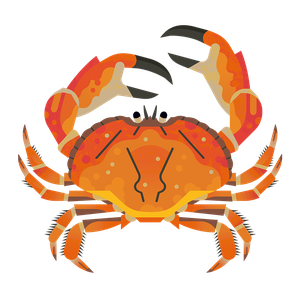
Velvet swimming crab
Necora puber
What to check for
Location
Northern Ireland
Technical location
Atlantic, Northeast, Irish Sea, West of Scotland
Caught by
Pot, trap or creel
Rating summary
Based on limited data, there is concern for fishing pressure and biomass of velvet crabs in Northern Ireland. Velvet crabs also have medium vulnerability to fishing pressure. Management requires considerable improvement. Further data is needed to reliably assess biomass and responsive effort controls are needed to improve velvet crab stocks around Northern Ireland. Velvet crabs are usually caught as bycatch in the potting fishery for brown crab and lobster. Crab pots have low seabed impacts when deployed and retrieved correctly.Rating last updated November 2025.
Technical consultation summary
Route 2 (data limited) scoring has been applied to this rating, with velvet crab having medium vulnerability to fishing. There is concern for fishing pressure as the average number of pots used in the last 5 years (13,958) exceeds the 18-year average (12,663) and landings in 2023 (204 tonnes) were above the long-term average (180 tonnes). There is also concern for biomass as length-based assessments indicate that males have been overexploited throughout the timeseries, and there is no fisheries-independent assessment of biomass. Management of velvet crab in Northern Ireland requires considerable improvement, with currently no responsive effort limits in place. There is a minimum landing size of 65mm in place, but this is below the Lopt (mean length for a healthy stock) for both sexes, leaving the stock overexploited. Velvet crabs are usually caught as bycatch in the potting fishery for brown crab and lobster. Crab pots have low seabed impacts when deployed and retrieved correctly.
How we worked out this Rating
Based on limited data, there is concern for fishing pressure and biomass of velvet crabs in Northern Ireland. Velvet crabs also have medium vulnerability to fishing pressure.Route 2 (data limited) scoring has been applied to this rating owing to the lack of data about the species biomass. There is no available data on velvet crab resilience to fishing pressure, but they are considered to have medium (0.33) vulnerability to fishing.In 2023, Northern Ireland vessels landed 204 tonnes of velvet crab, down from the peak of over 250 tonnes in 2021. Despite the recent downward trend, 2023 landings remained above the long-term average catch, recorded since 2006, at around 180 tonnes. Over the last 5 years, an average of 13,958 pots were used annually, which is higher than the 18-year average of 12,663 pots. Therefore, there remains a concern for fishing pressure.There is no fishery-independent biomass assessment for velvet crab around Northern Ireland, so there are no biomass reference points to assess stock size. Instead, Landings Per Unit Effort (LPUE) and length data are used as proxies for stock status. LPUE has generally increased since 2015, but in 2023 it declined and now sits below the timeseries average. For a stock to be considered healthy, the mean length should be Lopt. Female velvet crabs have remained above their Lopt (69mm) for most of the timeseries, and are therefore considered to be exploited sustainably. However, males have remained below their Lopt (80.4mm) throughout the timeseries, indicting they are overexploited. This data relies on accurate reporting by fisheries, and may be influenced by where, how, and when fishing takes place. As a result, it is not as reliable as fisheries-independent data. Given that LPUE is declining, males are consistently landed smaller than Lopt, and there is no independent biomass assessment, there is concern for biomass.
Management requires considerable improvement. Further data is needed to reliably assess biomass and responsive effort controls are needed to improve velvet crab stocks around Northern Ireland.The Northern Ireland (NI) velvet crab fishery is managed by the Northern Ireland Department of Agriculture, Environment and Rural Affairs (DAERA). This is a data limited fishery but stock advice sheets that are produced annually by the Agri-Food and Biosciences Institute (AFBI) allow for a better understanding of the stock.There is a Minimum conservation Reference Size (MCRS) of 65mm carapace width, and velvet crabs must be landed whole across UK waters. The MCRS is larger that size at first maturity, estimated at around 50mm, but is below the Lopt for both sexes, leaving the stock vulnerable to overexploitation. Also, maturity varies spatially, meaning that the MCRS may not optimise reproduction and landings as some stocks mature smaller or larger than this size.In Strangford Lough, there are also restrictions on fishing in certain areas below 10 metres deep.All vessels registered in the UK must have a domestic fishing vessel license to fish within the UK EEZ for sea fish that will be sold. No new licenses are being issued. All commercial vessels under 10m, with a shellfish license, are required to complete Monthly Shellfish Activity Return (MSAR) forms for the Marine Management Organisation (MMO). These must include the catch and retained weight each day along with the date, name of the vessel, vessel registration number, gear type, area and port of landing. All vessels over 10m do not need to complete MSAR as they will be completing an EU logbook of catches. For all vessels, effort is reported as days fished, and not as pots fished.However, the restrictive shellfish license is not thought to restrict expansion of the NI fishing fleet as licenses with shellfish entitlements can be imported from anywhere in UK. In NI, you also do not need a permit to fish recreationally for crabs and lobsters, with a daily limit of five crabs and one lobster. DAERA have also not introduced a pot limit for crab and lobster fisheries. As velvet crabs are often bycatch in the brown crab fishery, the Western Waters Regime can limit effort, with vessels 15m and above restricted to 220 days at sea in ICES area 7 between 1 January and 31 December.Crab and lobster fisheries are not subject to Total Allowable Catch (TAC) regulations or national quotas, meaning there are no formal limits on the quantities that can be landed. Instead, AFBI provides annual scientific advice on sustainable catch levels for ICES rectangles 37E3, 37E4, 38E4, 39E3 and 39E4. For 2025, recommended landings should not exceed 182 tonnes, representing a 20% reduction compared to the average landings between 2021 and 2023. Catches have remained below the advised levels in recent years – landings reached 92.9% of the recommended limit in 2023, and 98.5% in 2022. However, current assessments do not account for landings by vessels from other nations, which reduces the accuracy of the stock assessment.The Marine Conservation Society views Remote Electronic Monitoring (REM) with cameras is one of the most cost-effective tools for providing reliable fisheries data and aiding informed management decisions. Fully monitored fisheries enhance collaboration, data accuracy, stock recovery, and reduce impacts on marine wildlife and habitats. However, the full potential of REM may only be achieved when it tracks fishing location and documents catch and bycatch, particularly where vulnerable species and habitats are at risk. As of January 2024, the EU is introducing a Remote Electronic Monitoring (REM) mandate for EU vessels, including CCTV cameras on vessels 18m or more that pose a potential risk of non-compliance, within the next 4 years. Across the UK, different approaches to REM are being taken and legislation is expected to be in place across all 4 countries within the next few years.The Fisheries Act (2020) requires the development of Fisheries Management Plans (FMPs) (replacing EU Multi-Annual Plans) in the UK. 43 FMPs have been proposed and are at various stages of development and implementation, these should all be published by the end of 2028. FMPs have the potential to be very important tools for managing UK fisheries, although data limitations may delay them for some stocks. It is also essential the UK governments define and adopt a standardised approach or model across the four nations to a universally defined FMP design, to ensure the consistence, quality and coherence of all the proposal FMPs.The Marine Conservation Society is keen to see publicly available Fishery Management Plans for all commercially exploited stocks, especially where stocks are depleted, that include:An overview of the fishery including current stock status, spatial coverage, current fishing methods and impactsTargets for fishing pressure and biomass, and additional management when those targets are not being met, based on the best scientific evidenceTimeframes for stock recoveryImproved data collection, transparency, and accountability, supported by technologies such as Remote Electronic Monitoring (REM)Consideration of wider environmental impacts of the fishery, including habitat impacts and minimising bycatchStakeholder engagementA Northern Ireland non-quota shellfish FMP has been proposed, coordinated by DAERA, which incorporates this stock. At the time of writing, it is too soon to know whether proposed management measures will be effective in managing the stock. For more information about this FMP and expected progress and timelines, see https://www.gov.uk/government/publications/joint-fisheries-statement-jfs/list-of-fisheries-management-plans

Velvet crabs are usually caught as bycatch in the potting fishery for brown crab and lobster. Crab pots have low seabed impacts when deployed and retrieved correctly.Velvet crabs are a common bycatch species in the mixed fishery for brown crab and European lobster. Crabs are caught in pots, also known as creels, and can be fished individually or as part of a fleet of up to 100 pots, depending on the size of the boat and crew. Pots are portable traps made of wood or steel wire and plastic. The crab is baited into the initial part (the chamber) and moves into the secondary part (the parlour) where it becomes trapped.In crab fisheries, there is no legislation or regulation to standardise the type of pot used. They tend to be highly selective as undersized animals can be returned to the sea alive and survival rates for non-target organisms are thought to be high. Studies of Irish Sea potting fisheries shown that other common bycatch species, alongside velvet crabs, are small-spotted catsharks and squat lobsters. While more than half of the bycatch is predicted to survive, there is little research available to support this. Measures to further reduce bycatch include the use of escape panels to allow undersize animals and bycatch to escape pots.Habitat impacts from potting are low but can occur during deployment, soak time or hauling of the pot, impacting the benthic habitat and associated species through contact with the pot or end weight, or by scouring from ropes. Research that has taken place suggests that while some damage does occur, it is unlikely to be significant unless potting intensity is high (defined as approximately 30 pots per 500 square metres). The most damage occurs when traps are set in sensitive habitats such as rocky reefs, seagrass beds, and maerl beds. These ecosystems play a crucial role in supporting marine biodiversity by providing nursery grounds, shelter from predators, and settlement areas for invertebrate spat.To safeguard these vulnerable habitats, potting is prohibited in several designated conservation areas within Northern Irish waters. These include the Red Bay Special Area of Conservation (SAC), Rathlin Island Special Protection Area (SPA), Skerries and Causeway SAC, and the Waterfoot Marine Conservation Zone (MCZ), where the use of static fishing gear is restricted.Lost pots can pose an additional risk to marine life through ‘ghost fishing’, where abandoned gear continues to trap and entangle species. As fishing gear is a financial investment, there is incentive to maintain and recover lost pots. The occurrence of ghost fishing can also be reduced by the use of appropriate gear designs and release devices.To improve monitoring and reporting of fishing activity, The Marine Conservation Society would like to see remote electronic monitoring (REM) with cameras implemented, used and enforced.
References
AFBI, 2025. Velvet Crab Advice 2025. Available at: Advice Sheets 2025 | Agri-Food and Biosciences Institute [Accessed on 24.11.2025]Coleman, R.A., Hoskin, M.G., von Carlshausen, E. and Davis, C.M., 2013. Using a No-take Zone to Assess the Impacts of Fishing: Sessile Epifauna Appear Insensitive to Environmental Disturbances From Commercial Potting. Journal of experimental marine biology and ecology, v. 440 ,. pp. 100-107. doi: 10.1016/j.jembe.2012.12.005DAERA, 2025. Inshore Fisheries Policy. Available at: Inshore fisheries policy | Department of Agriculture, Environment and Rural Affairs [Accessed on 21.11.2025]Gall, S.C., Rodwell, L.D., Clark, S., Robbins, T., Attrill, M.J., Holmes, L.A. and Sheehan, E.V., 2020. The impact of potting for crustaceans on temperate rocky reef habitats: Implications for management, Marine Environmental Research, Volume 162, 105134, https://doi.org/10.1016/j.marenvres.2020.105134.GOV.UK, 2025. Guidance: Record your catch. Available at: Record your catch - GOV.UK [Accessed on 20.11.2025]GOV.UK. 2025. Manage your fishing effort: Western Waters crabs and scallops. Available at https://www.gov.uk/guidance/manage-your-fishing-effort-western-waters-crabs [Accessed on 24.11.2025].MMO, 2025. Minimum Conservation Reference Sizes (MCRS) in UK waters. Available at: Minimum Conservation Reference Sizes (MCRS) in UK waters - GOV.UK [Accessed 19.11.2025]Öndes, F., Kaiser, M., & Murray, L. 2018. Fish and invertebrate by-catch in the crab pot fishery in the Isle of Man, Irish Sea. Journal of the Marine Biological Association of the United Kingdom, 98(8), 2099-2111. doi:10.1017/S0025315417001643Palomares, M.L.D. and D. Pauly. Editors. 2025. SeaLifeBase. Necora puber, Velvet swimming crab, World Wide Web electronic publication. www.sealifebase.org, version (04/2025) [Accessed on 18.11.2025].Seafish. Pots and Traps – General. Available at: seafish.org/responsible-sourcing/fishing-gear-database/gear/pots-and-traps-general/#target-species [Accessed on 18.11.2025]UK Government, 2000. Crabs and Lobsters (Minimum Size) Order (Northern Ireland) 2000. Available at https://www.legislation.gov.uk/nisr/2000/200/made [Accessed on 24.11.2025].
Sustainable swaps
Learn more about how we calculate our sustainability ratings.
How our ratings work