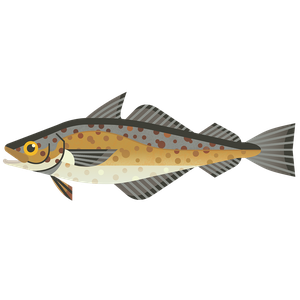
Celtic Sea whiting is below safe biological levels and there is no precautionary recovery plan in place. Therefore, it receives a critical fail for stock status and is a default red rating.Stock assessments are carried out by International Council for the Exploration of the Sea (ICES). The most recent assessment was published in 2025 using data up to 2025. The next assessment is expected in 2026The stock assessment defines reference points for fishing pressure (F) and biomass (B). For fishing pressure, there is a target to keep F at or below Maximum Sustainable Yield (MSY). For biomass, there is no target. However, there is a trigger point (MSY BTrigger). Below this level, F should be reduced to allow the stock to increase. Because BMSY is not defined, the Good Fish Guide applies its own definition of 1.4 x MSY BTrigger. Catches have declined from around 30,000 tonnes in 2004 to around 3,675t in 2024.The reproductive capacity of the stock - or spawning stock biomass (SSB) - has fallen rapidly from 61,580 tonnes in 2015 to 9,496 tonnes in 2025. It has been below MSY Btrigger (50,818t) since 2016, and below safe biological limits (Blim, 36,571t) since 2017. It is therefore in a severely depleted state, with a high risk of reduced recruitment, resulting in a critical fail.Catches are declining. In 2024, fishing mortality (F) was 0.53. Remaining above levels associated with maximum sustainable yield (FMSY, 0.375).ICES advises that when the MSY approach is applied, there should be zero catch in 2026. Advice for 2026 is zero catch because there is no fishing pressure senaerio that would being the stock above Blim in 2027 with at least 50% probability. Additionally, incoming recruitment remains low, and even with zero catch in 2026.Recruitment of young fish into the stock has been consistently low since 2014, with no signs of improvement.