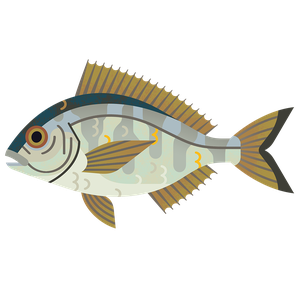
Whiting
What to check for
Location
West of Scotland
Technical location
Atlantic, Northeast, West of Scotland
Caught by
Bottom trawl (otter)
Rating summary
The whiting population in the West of Scotland is below target levels, but is not subject to overfishing. Some appropriate management measures are in place for West of Scotland whiting. Historically, the stock has been subject to significant overfishing. Most whiting catches are by trawling, which is likely to cause some damage to the seabed. Bycatch is moderate and may include vulnerable species.Rating last updated August 2025.
Technical consultation summary
The whiting population in the West of Scotland is slightly below target levels, but is not subject to overfishing. SSB recovered to above MSY BTrigger (25,597t) in the early 2020s but has again declined slightly. In 2025 it was 19,372t, which is just below MSY BTrigger and Bpa (21,442t) but above Blim (17,286t). Therefore, the stock is in an overfished state. Fishing mortality (F) was 0.030 in 2024 - well below FMSY (0.21). Some appropriate management measures are in place, but there is no specific management plan. Historically, the stock has been subject to significant overfishing. Recent management has been in line with scientific advice, but illegal discarding is still taking place. From 2006-2021, scientific advice was for zero catch of the stock, but a TAC was still set and catches continued. From 2017-2021, catches averaged 300% of TACs. This indicates that compliance has been poor and management has not been adequately controlling the fishery. In 2021, the perception of this stock changed dramatically. While this is positive, it is not the result of good management. However, there is now a more precautionary approach. The advice for 2024 and 2025 was around 3,879t and 5,116t, respectively. TACs were set well below this at 3,163t and 4952t. Total catch in 2024 was 716 tonnes. Therefore, TACs and catches are now partly following scientific advice. However, the TAC is set for a much larger area than just West of Scotland (area 6a). This prevents adequate control of the fishing pressure on individual stocks and therefore does not protect this stock from overexploitation. Since 2019 it has been illegal to discard unwanted (e.g. under-size or over-quota) whiting at sea, but observers on boats estimate that illegal discarding is still taking place. The proportion of total catch discarded was 23% in 2021 and 16% in 2022. This is much lower than the 63% of total discards in 2024. Most whiting catches are by trawling, which is likely to cause some damage to the seabed. There remains some uncertainty about the location of some sensitive seabed habitats, so these remain at risk. Bycatch is moderate and may include vulnerable species. For blue and flapper skate, mitigation measures include a prohibition on landing either species, and some protection for nursery areas. It is not clear if this fishery is having an impact at population level for any of these species.