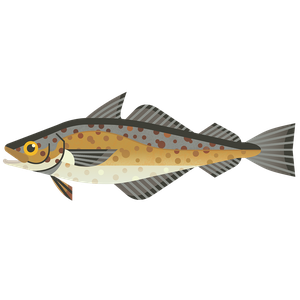
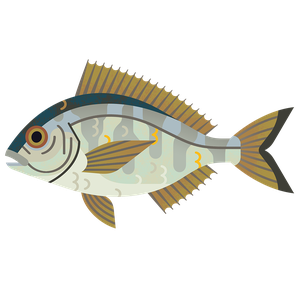
Whiting
Merlangius merlangus
What to check for
Location
North Sea, English Channel (East)
Technical location
Atlantic, Northeast, English Channel (East), North Sea
Caught by
Bottom trawl (otter)
Rating summary
North Sea whiting is not overfished and not subject to overfishing. There are some but not all appropriate management measures in place. They are caught as part of a human consumption fishery and catch limits are the main management measure. From 2023 onward, human consumption catch does not have a separate quota. Most whiting catches are by otter trawls, which are likely to cause some damage to the seabed. Bycatch is moderate and may include vulnerable species such as blue and flapper skate, and cod.Rating last updated August 2024.
Technical consultation summary
North Sea whiting is not overfished and not subject to overfishing. In 2024, biomass is estimated to be 373,970t, 60% above GFG definition of BMSY (234,387t). The stock is therefore not in an overfished state. In 2023 fishing mortality (F) was 0.083, 88% below FMSY (0.68). The stock is therefore not subject to overfishing. Catch limits have been exceeded in recent years, indicating that there need to be improvements in enforcement and compliance. Most whiting catches are by otter trawls, which are likely to cause some damage to the seabed. Bycatch is moderate and may include vulnerable species such as blue and flapper skate, and cod.
How we worked out this Rating
North Sea whiting is not overfished and not subject to overfishing.Stock assessments are carried out annually by the International Council for the Exploration of the Sea (ICES). The most recent assessment was published in 2024 using data up to 2023. The next assessment is expected in 2025.The stock assessment defines reference points for fishing pressure (F) and biomass (B). For fishing pressure, there is a target to keep F at or below Maximum Sustainable Yield (MSY). For biomass, there is no target. However, there is a trigger point (MSY BTrigger). Below this level, F should be reduced to allow the stock to increase. Because BMSY is not defined, the Good Fish Guide (GFG) applies its own definition of 1.4 x MSY BTrigger.Whiting catches have steadily declined since peaking at over 200,000 tonnes in the 1980s. Historically, there was very high bycatch (up to 60,000t) by the industrial fisheries for sandeel and Norway pout, but those fisheries have since declined. Since 2004, catches have been fairly constant at 20-30,000t.Spawning-stock biomass (SSB) declined sharply from around 430,000t in 1980 to 200,000t by 1985. There were further declines after this, with the stock falling close to the level at which reproduction could be impaired (Blim, 119,585t) during the late 2000s. It has since recovered, and has been above target levels (MSY BTrigger, 167,419t) since 2018. In 2024, it is estimated to be 373,970t, 60% above GFG definition of BMSY (234,387t). The stock is therefore not in an overfished state.Fishing mortality (F) has steadily declined since the late 1980s, and has been below levels associated with Maximum Sustainable Yield (FMSY, 0.68) since 2000. In 2023, it was 0.083 - 88% below FMSY. The stock is therefore not subject to overfishing.ICES advises that when the MSY approach is applied, catches in 2025 should be no more than 237,008 tonnes. This is an 85% increase on the previous year's advice, owing to an increase in SSB and changes to the reference points during updates to the stock assessment in 2024. This follows a 236% increase in catch advice between 2021 and 2022 thanks to changes to the stock assessment in 2021 that changed the perception of the stock.
There are some but not all appropriate management measures in place for North Sea and eastern English Channel whiting.Whiting in the North Sea is caught in a human consumption fishery and as bycatch in an industrial fishery targeting fish such as sandeel and Norway pout. Within the human consumption fishery, the UK is responsible for most of the landings (roughly 70%), followed by Denmark, France and Norway. The EU has a Multiannual Plan (MAP) for its fleets, but Norway and the UK are not part of it. Instead, there is a separate agreed management approach between the EU, UK, and Norway, which includes an agreement to develop a joint long-term management plan. There is a precautionary management plan, developed and adopted by one of the relevant management authorities for this stock.Catch limits, known as Total Allowable Catches (TACs), are the main management measure for the human consumption fishery. Scientific advice on catch limits covers this whiting stock (i.e. North Sea and eastern English Channel). However, two different catch limits are set: one just for the North Sea, and a separate one for the of the Eastern English Channel. Since 2024, the TAC for Division 7d (Eastern English Channel) has been separated from the combined TAC for divisions 7.b–7.k, previous to this year landings for 7d were counted against the combined TAC. This has allowed for greater alignment between management and stock areas to better achieve the objectives of fishing at MSY.Historically, TACs have been comprised of human consumption fishery catch and the industrial fisheries catch split between the Subarea 4 (North Sea) and Division 7d (Eastern English Channel). However, from 2023 onwards the human consumption catch does not have a separate quota, instead 80.23% of the TAC is allocated to the North Sea (Subarea 4) and 19.77% to the Eastern English Channel (7d).In 2022 and 2023 the average combined TAC for 7b-k was 8,400t, in 2024 the separate TAC for Division 7d was 18,899 tonnes. The TAC for the North Sea (Subarea 4) has increased in recent years, in 2022 it was 26,636 t, for 2023 it was 34,294t and in 2024 it was 76,697t.On top of landings by the human consumption and industrial fisheries, there is also a significant level of discarding at sea. It is illegal to discard unwanted, e.g. undersized, whiting at sea. Very little undersized whiting is reported in landings, however 63% of landings had associated discards in 2023.Though the TACs have increased they are currently set below advice, which is no more than 128,290t in 2024, and 237,008t in 2025, following the MSY approach. This is an 85% increase in advice and is predicted to correlate with a 47% decrease in biomass for 2026. Total catches for 2022 (27,878t) and 2023 (27,559t) have been 20% and 36% below TACs, respectively. Therefore, catches and management are in line with advice.The 2021 ICES stock assessment significantly changed the perception of the stock. Advice for the catch limit in 2022 more than doubled compared to 2021, and further increased for 2023 to 110,172 tonnes. Hopefully this indicates that overfishing is not likely to take place in the coming years. The EU, UK and Norwegian delegations agreed not to increase the whiting TAC to the full extent because of the potential increase in cod bycatch that it would cause.Other management measures include:Real-time closures: For cod, haddock, saithe and whiting in the North Sea and Skagerrak, if more than 10% of the catch by weight is juveniles (smaller than 35cm, 30cm, 35cm, or 27cm respectively), the area in which they were caught is closed for 3 weeks.Whiting has a minimum conservation reference size of 27cm, where they can legally be caught and sold. Below this size, whiting has to be landed but can't be sold for human consumption and so have a lower value.Various other measures are in place to protect young fish, spawning areas, sensitive species, and marine habitats. There are some closed areas to protect juveniles and vulnerable habitats. In the EU and UK, the minimum mesh size that trawl nets may use is 120mm, to prevent catching undersize cod, haddock or saithe. Smaller mesh can be used if by-catches of those species do not exceed 20% of the total by weight, or if there are selectivity modifications. In Norway, the minimum mesh size is 120mm south of 64 degrees N and 130mm north of it.In the eastern English Channel, the minimum mesh size is much smaller, at 80mm, which means there could be more bycatch of young fish and other species. The EU and UK both have fishery management measures, which can include catch limits, population targets, and gear restrictions. However, compliance in the EU and UK has been inconsistent, with ongoing challenges in implementing some regulations. The goal of reaching Maximum Sustainable Yield (MSY) by 2020 was missed, with less than half of UK TACs in 2024 following ICES advice. In 2024, the EU and UK reaffirmed their commitment to sustainable fisheries by aligning management with scientific advice to gradually approach MSY. However, no new target date has been set for achieving MSY across all fisheries. The Landing Obligation (LO), an EU law retained by the UK post-Brexit, requires all quota fish to be landed, even if unwanted (over-quota or below minimum size). It aims to encourage more selective fishing methods, reduce bycatch, and improve catch reporting. However, compliance is poor, and accurate discard levels are hard to quantify with current monitoring programmes. The UK is in the process of replacing the LO with country-specific Catching Policies. The Marine Conservation Society views Remote Electronic Monitoring (REM) with cameras is one of the most cost-effective tools for providing reliable fisheries data and aiding informed management decisions. Fully monitored fisheries enhance collaboration, data accuracy, stock recovery, and reduce impacts on marine wildlife and habitats. However, the full potential of REM may only be achieved when it tracks fishing location and documents catch and bycatch, particularly where vulnerable species and habitats are at risk. As of January 2024, the EU is introducing a Remote Electronic Monitoring (REM) mandate for EU vessels, including CCTV cameras on vessels 18m or more that pose a potential risk of non-compliance, within the next 4 years. Across the UK, different approaches to REM are being taken and legislation is expected to be in place across all 4 countries within the next few years.The Fisheries Act (2020) requires the development of Fisheries Management Plans (FMPs) (replacing EU Multi-Annual Plans) in the UK. 43 FMPs have been proposed and are at various stages of development and implementation, these should all be published by the end of 2028. FMPs have the potential to be very important tools for managing UK fisheries, although data limitations may delay them for some stocks. It is also essential the UK governments define and adopt a standardised approach or model across the four nations to a universally defined FMP design, to ensure the consistence, quality and coherence of all the proposal FMPs.The Marine Conservation Society is keen to see publicly available Fishery Management Plans for all commercially exploited stocks, especially where stocks are depleted, that include:An overview of the fishery including current stock status, spatial coverage, current fishing methods and impactsTargets for fishing pressure and biomass, and additional management when those targets are not being met, based on the best scientific evidenceTimeframes for stock recoveryImproved data collection, transparency, and accountability, supported by technologies such as Remote Electronic Monitoring (REM)Consideration of wider environmental impacts of the fishery, including habitat impacts and minimising bycatchStakeholder engagementThe North Sea Whiting FMP has been proposed, coordinated by Marine Scotland that incorporates this stock. At the time of writing, it is too soon to know whether proposed management measures will be effective in managing the stock. For more information about this FMP and expected progress and timelines, see [https://www.gov.uk/government/collections/fisheries-management-plans#published-fmps].
Most whiting catches are by otter trawls, which are likely to cause some damage to the seabed. Bycatch is moderate and may include vulnerable species such as blue and flapper skate, and cod.Most whiting (around 80%) are caught by trawling. This includes demersal trawls and seines with large mesh size (120mm +) (73%) and small-meshed trawls targeting Nephrops (aka scampi) (7%). A mesh size of 120mm or more has a lower chance of catching juvenile fish and other species.Demersal otter trawls have the potential to take relatively high quantities of bycatch. In the Northeast Atlantic there are reported catches of demersal elasmobranchs and endangered, threatened and protected (ETP) species (e.g. sharks, rays and marine mammals). Bycatch data is limited in many UK and EU fisheries as they are generally not well monitored. However, a proportion of the trawl fisheries in the North Sea are Marine Stewardship Council-certified and record bycatch. The Marine Conservation Society assumes these records would also represent bycatch concerns in the uncertified components. Bycatch in the certified fishery includes the vulnerable North Sea cod, which is below safe reproductive levels. Endangered, threatened or protected species included the Critically Endangered common skate complex (blue skate and flapper skate), porbeagle, and other skates and rays.Some mitigation measures are in place in some areas. There is a UK North Sea cod avoidance plan, requiring a minimum 120mm mesh size in the Scottish North Sea, seasonal closures to protect spawning stocks, and a requirement to move away from areas where large numbers of cod are observed in catches. In Sweden, vessels have increased bycatch avoidance measures by using larger-meshed panels in their nets, which allow juvenile cod to escape. ICES indicates that the roundfish-directed fishery (demersal trawling with over 120mm mesh size) has the biggest impact on the North Sea cod stock, accounting for 75% of catches. Therefore, this fishery is likely to be affecting the population.For blue and flapper skate, mitigation measures include a prohibition on landing either species, and some protection for nursery areas. It is not clear if this fishery is having an impact at population level for any of these species. Given that bycatch is ongoing, the Marine Conservation Society considers it possible that the bycatch level is contributing to population decline and/or preventing recovery.Demersal trawls have contact with the seabed resulting in penetration and abrasion of habitat features. The impact of trawling on the seabed depends on the location and scale in which trawling occurs. For example, areas that are used to natural disturbance through tides and waves, are less sensitive to habitat impacts. Areas not used to mobile towed gears are typically more sensitive to trawling.In the North Sea area, impacts from bottom trawling are variable. Fishing grounds for whiting vary, but the habitat is generally mud and sand, which are less vulnerable to trawling than features such as reefs and seagrass. Data from 2022 indicates that trawling was happening on 70% of the seabed area between 0-200m, and 27% of the seabed for areas 200-800m in depth. Fishing effort in the region has halved since 2002, mainly in the trawl fisheries, which is reducing pressure on the seabed and on bycatch species. However, fishing in the North Sea in general has reduced the number of large fish in the ecosystem (mostly cod, saithe, ling, sturgeon, and some elasmobranchs). There are concerns about the impact of North Sea trawling on sea pens.There are Marine Protected Areas (MPAs) in this area, some of which are designated to protect seabed features from damaging activities. This fishery overlaps with parts of these MPAs, but the proportion of the catch coming from these areas is expected to be relatively low in relation to the unit of assessment (i.e. less than 20% of the catch or effort), and so these impacts have not been assessed within the scale of this rating. Given the important role that MPAs have in recovering the health and function of our seas, the Marine Conservation Society encourages the supply chain to identify if their specific sources are being caught from within MPAs. If sources are suspected of coming from within designated and managed MPAs, the Marine Conservation Society advises businesses to establish if the fishing activity is operating legally inside a designated and managed MPA, and request evidence from the fishery or managing authority to demonstrate that the activity is not damaging to protected features or a threat to the conservation objectives of the site(s).To improve monitoring and reporting of fishing activity by otter trawls, the Marine Conservation Society would like to see remote electronic monitoring (REM) with cameras implemented, used and enforced. To reduce the impacts of fishing on the marine environment we would like to see a just transition to a complete ban on bottom towed gear in offshore Marine Protected Areas designed to protect the seabed and reduction and mitigation of environmental impacts including emissions and blue carbon habitat damage.
References
Anon, 2022. Agreed record of fisheries consultations between the European Union, Norway and the United Kingdom for 2023. 9 December 2022. Available at https://assets.publishing.service.gov.uk/government/uploads/system/uploads/attachment_data/file/1123184/Agreed_record_of_fisheries_consultations_between_the_European_Union__Norway_and_the_United_Kingdom_for_2023.pdf [Accessed on 17.07.2024].Cook, R., Gaudian, G., des Clers, S. and Seip- Markensteijn, C.M., 2022. Marine Stewardship Council (MSC) Public Certification Report: Scottish Fisheries Sustainable Accreditation Group (SFSAG) Northern Demersal Stocks. Prepared by Control Union (UK) Limited on behalf of Scottish Fisheries Sustainable Accreditation Group (SFSAG). May 2022. Available at https://cert.msc.org/FileLoader/FileLinkDownload.asmx/GetFile?encryptedKey=BdxOJoY7Sf4DmNJEB/m47M6xx0rRfgP/niGx3vj5Ud8hadYI3XCNrnlSFL/jlTgK [Accessed on 19.07.2024].Eigaard, O. R., Bastardie, F., Breen, M., Dinesen, G. E., Hintzen, N. T., Laffargue, P., Mortensen, L. O., Nielsen, J. R., Nilsson, H. C., O- Neill, F. G., Polet, H., Reid, D. G., Sala, A., Skold, M., Smith, C., Sorensen, T. K., Tully, O., Zengin, M. and Rijnsdorp, A. D., 2016. Estimating seabed pressure from demersal trawls, seines, and dredges based on gear design and dimensions. ICES Journal of Marine Science, 73:1, pp. i27- i43. https://doi.org/10.1093/icesjms/fsv099.EU, 2011. Regulation (EU) No 783/2011 of 5 August 2011 amending Regulation (EU) No 724/2010 laying down detailed rules for the implementation of real-time closures of certain fisheries in the North Sea and Skagerrak. Available at https://eur-lex.europa.eu/legal-content/EN/TXT/?uri=celex:32011R0783.Hiddink, J., Jennings, S., Sciberras, M., Szostek, C.L., Hughes, K.M., Ellis, N., Rijnsdorp, A.D., McConnaughey, R.A., Mazor, T., Hilborn, R., Collie, J.S., Pitcher, C.R., Amoroso, R.O., Parma, A.M., Suuronen, P. and Kaiser, M.J. 2017. Global analysis of depletion and recovery of seabed biota after bottom trawling disturbance. PNAS. 114:31, pp. 8301-8306. https://doi.org/10.1073/pnas.1618858114.ICES, 2024a. Whiting (Merlangius merlangus) in Subarea 4 and Division 7.d (North Sea and eastern English Channel). In Report of the ICES Advisory Committee, 2024. ICES Advice 2024, whg.27.47d, Available at: https://doi.org/10.17895/ices.advice.25019720 [Accessed on 25.07.2024].ICES, 2024b. Greater North Sea ecoregion – Ecosystem overview. In Report of the ICES Advisory Committee, 2024. ICES Advice 2024, Section 7.1, Available at: https://doi.org/10.17895/ices.advice.25714239 [Accessed 19.07.2024].ICES, 2024c. Working Group on the Assessment of Demersal Stocks in the North Sea and Skagerrak (WGNSSK). ICES Scientific Reports. 6:38. 1249 pp. Available at: https://doi.org/10.17895/ices.pub.25605639 [Accessed on 17.07.2024].ICES, 2023. Stock Annex: Cod (Gadus morhua) in Subarea 4, divisions 6.a and 7.d, and Subdivision 20 (North Sea, West of Scotland, eastern English Channel, Skagerrak). ICES Stock Annexes. 36 pp. Available at: https://doi.org/10.17895/ices.pub.22633843.v2 [Accessed 19.07.2024].Kennelly, S. J. & Broadhurst, M. K., 2021. A review of bycatch reduction in demersal fish trawls. Rev Fish Biol Fisheries 31, 289–318. https://doi.org/10.1007/s11160-021-09644-0.Kynoch, R., Fryer, R. & Neat, F., 2015. A simple technical measure to reduce bycatch and discard of skates and sharks in mixed-species bottom-trawl fisheries. ICES J Mar Sci,72(6):1861.MMO, 2023. UK National North Sea Cod Avoidance Plan. Issued January 2023. Available at:https://assets.publishing.service.gov.uk/government/uploads/system/uploads/attachment_data/file/1129724/UK_National_Cod_Avoidance_Plan__Jan2023update_.pdf [Accessed 19.07.2024].Silva, F., Ellis, J. & Catchpole, T., 2012. Species composition of skates (Rajidae) in commercial fisheries around the British Isles and their discarding patterns. J Fish Biol., 80:1678–1703.van Denderen, P. Bolam, S., Hiddink, J.G., Jennings, S., Kenny, A., Rijnsdorp, A., and van Kooten, T., 2015. Similar effects of bottom trawling and natural disturbance on composition and function of benthic communities across habitats. Mar Ecol Prog Ser. 2015;541:31–43.Wilson, D., Borges, L., Hoare, D., and Norbury, H., 2023. Marine Stewardship Council (MSC) 1 st Surveillance Audit Report: SFSAG Northern Demersal stocks. Prepared by Control Union (UK) Limited on behalf of Scottish Fisheries Sustainability Accreditation Group (SFSAG). October 2023. Available at:https://cert.msc.org/FileLoader/FileLinkDownload.asmx/GetFile?encryptedKey=hJcPTKb9wBBNs44CBo73WtCO6werzCJbk6+jM81mPCGscZM3CEGZgEnvwk6xCPbj [Accessed 19.07.2024].

Sustainable swaps
Learn more about how we calculate our sustainability ratings.
How our ratings work