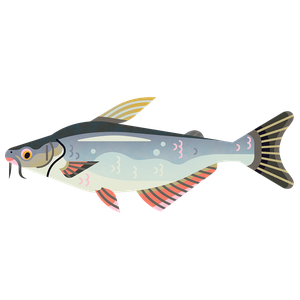
Tub gurnard
Triglia or Chelidonichthys lucerna
What to check for
Location
Northeast Atlantic
Technical location
Atlantic, Northeast, Barents Sea, Bay of Biscay, Iceland and Faeroes Grounds, Irish Sea, Porcupine Bank, English Channel, Bristol Channel, Celtic Seas, West and Southwest of Ireland, North Sea, Norwegian Sea, Spitzbergen, and Bear Island, Portuguese Waters, Rockall, West of Scotland, Skagerrak, Kattegat, Transition Area, Baltic Sea
Caught by
Net (gill or fixed)
Rating summary
The stock status of yellow gurnard is unknown. Relatively little data are collected for gurnards, and even less data are collected for yellow gurnard as they are often misidentified with the red gurnard. There is concern for the biomass, as there is no available biomass data, and no concern for fishing pressure. More research is needed to obtain a better understanding of the impact of fishing on the stock and provide information for its sustainable management. There is no specific management in place for this stock, including no catch limits, which is of concern for such a data limited species. No minimum landing size or seasonal closures are in place. Gillnets in this area can encounter bycatch of non-target fish, mammals and birds.Rating last updated July 2022.
How we worked out this Rating
This stock is data limited. There is concern for the biomass and no concern for fishing pressure.The stock status of tub gurnard is unknown. Relatively little data are collected for gurnards, and even less data are collected for tub gurnard as they are often misidentified with the red gurnard. There is concern for the biomass, as there is no available biomass data, and no concern for fishing pressure. Tub gurnard has a low resilience to fishing pressure.Yellow gurnards represent a very small proportion of landings in each of Scotland, Wales, Northern Ireland and England (<1%) and are normally caught as bycatch in mixed demersal fisheries for flatfish and roundfish. Recent landings data for tub gurnard is not reliable as species misidentification continues to be a major problem in estimating the landings of all gurnards and subsequently, they are just recorded as gurnards in the landings data. In 2020, landings of yellow gurnard (tub gurnard) were 476 tonnes, and landings of unidentified 'gurnards' were 833 tonnes. Over the last 5 years (2016-2020), there has been an average of 379 tonnes of yellow gurnard landed per year, and 1042 tonnes of unidentified 'gurnards'.
There is no management plan in place for yellow gurnard and management requires considerable improvement.There is currently no management for any of the gurnard species in the EU, e.g. no minimum conservation reference size (MCRS), no regulation on effort, gear or closed seasons (e.g. for spawning). No Total Allowable Catch (TAC) has been set for yellow gurnard in this area, and the EU Landings Obligation doesn't apply to this stock, as it is not subject to catch limits.Yellow gurnard is a very data limited species, with poor understanding of stock distribution and trends. ICES does not provided advice on yellow gurnard in this area. It is not a targeted stock, but is mainly caught as bycatch by the industrial fisheries, although when landed it is for human consumption. It is also caught in demersal fisheries for species such as cod and haddock. MCS would like to see bycatch species monitored and taken into account once fisheries management plans are implemented.Reporting at a species level has improved since 2012, allowing estimations of landings, but some are still reported as 'mixed gurnards' (e.g. Germany and England). Species misidentification continues to be a major problem in estimating the landings of all gurnards, including yellow gurnard.Both the EU and UK have fishery management measures in place, which can include catch limits, targets for population sizes and fishing mortality, and controls on what fishing gear can be used and where. In the EU, compliance with regulations has been variable, and there are ongoing challenges with implementing some of them. There was a target for fishing to be at Maximum Sustainable Yield by 2020, but this was not achieved. The Landing Obligation (LO), an EU law that the UK has kept after Brexit, requires all quota fish to be landed, even if they are unwanted (over-quota or below minimum size). It aims to promote more selective fishing methods, reduce bycatch, and improve recording of everything that is caught, not just what is wanted. Compliance with the LO is generally poor and actual levels of discards are difficult to quantify using the current fisheries observer programme. UK administrations are in the process of replacing the landing obligation with country-specific Catching Policies.In the UK, it is too early to tell how effective management is, as the Fisheries Act only came into force in January 2021. The Act requires the development of Fisheries Management Plans (FMPs) (replacing EU Multi-Annual Plans). FMPs are currently in development, but the scope of them remains unclear. They have the potential to be very important tools for managing UK fisheries, although data limitations may delay them for some stocks. MCS is keen to see publicly available FMPs for all commercially exploited stocks, especially where stocks are depleted, that include:Targets for fishing pressure and biomass, and additional management when those targets are not being met, based on the best available scientific evidenceTimeframes for stock recovery Improved data collection, transparency and accountability, supported by technologies such as Remote Electronic Monitoring (REM)Consideration of wider environmental impacts of the fishery

Gillnets in this area have little impact on the seabed but can encounter bycatch of non-target fish, mammals and birds.Yellow gurnard is mainly discarded in fisheries for roundfish and flatfish and taken as bycatch in the industrial fishery for sandeel and sprat.Gillnets and fixed nets can be very size selective, but can bycatch species such as sharks, cetaceans and other marine mammals. In particular, there is concern about bycatch of harbour porpoise. The IUCN lists harbour porpoise as being of least concern globally, but vulnerable in Europe. OSPAR has included the species on its List of Threatened and / or Declining Species and Habitats for the Greater North Sea and Celtic Seas, owing to evidence of a decline in populations, their sensitivity and the threat of incidental capture and drowning in fishing nets. They are also classified as a priority species in UK and EU law, under which there are explicit bycatch requirements. To comply with this, the UK recently designated five Special Areas for Conservation for harbour porpoises, including the Bristol Channel Approaches SAC in the southwest UK, but these areas are not yet managed. The UK Dolphin and Porpoise Conservation Strategy lists harbour porpoise as having 'medium' vulnerability to gillnetting for the UK as a whole. This is based on the species having a high sensitivity to gillnetting and medium exposure.Some pilot projects are underway to improve reporting of bycatch and find ways to reduce it. This includes trialling various types of 'pingers' that would discourage cetaceans from approaching the nets. Pingers have been very effective at reducing porpoise bycatch in some fisheries, but haven't been adopted on a large enough scale to significantly tackle the issue. There can be concerns about the use of pingers, as if the nets coincide with important feeding grounds for the porpoises and scare the animals away, the porpoises would then lose access to those feeding grounds. Testing and trials are therefore crucial and may need to be supported by other measures such as seasonal closures.Because of gillnets' durability (they are made of nylon), if lost, they can continue to fish for several weeks before becoming tangled and bundled up, a phenomenon known as 'ghost fishing'. However, static nets, as with all gear, represent an investment by fishermen, and therefore there are incentives to avoid losing or damaging gear.
References
ASCOBANS, 2009. Conservation Plan for Harbour Porpoises in the North Sea as adopted at the 6th Meeting of the Parties to ASCOBANS, Bonn, Germany. 16 - 18 September 2009. Available at https://www.ascobans.org/sites/default/files/document/ASCOBANS_NorthSeaPlan_MOP6.pdf [Accessed on 10.06.2021].Calderan, S. and Leaper, R., 2019. Review of harbour porpoise bycatch in UK waters and recommendations for management. January 2019, WWF. Available at https://www.wwf.org.uk/sites/default/files/2019-04/Review_of_harbour_porpoise_in_UK_waters_2019.pdf [Accessed on 10.06.2021].FishBase. 2016. Chelidonichthys lucerna. Tub gurnard. Available at: http://www.fishbase.se/summary/Chelidonichthys-lucerna.html [Accessed on 10.06.2021].ICES. 2020. Grey gurnard (Eutrigla gurnardus) in Subarea 4 and divisions 7.d and 3.a (North Sea, eastern English Channel, Skagerrak and Kattegat). In Report of the ICES Advisory Committee, 2020. ICES Advice 2020, gug.27.3a47d. Available at https://doi.org/10.17895/ices.advice.5822 [Accessed on 10.06.2021].ICES. 2020. ICES Working Group on the Assessment of Demersal Stocks in the North Sea and Skagerrak (WGNSSK).ICES Scientific Reports. 2:61. Available at http://doi.org/10.17895/ices.pub.6092 [Accessed on 10.06.2021].McCarthy, I.D. and Marriott. A.L. 2018. Age, growth and maturity of tub gurnard (Chelidonichthys lucerna Linnaeus 1758; Triglidae) in the inshore coastal waters of Northwest Wales, UK. Applied Ichthyology. 34 (3). 581-589.OSPAR, 2017. Intermediate Assessment 2017: Harbour Porpoise Bycatch. Available at https://oap.ospar.org/en/ospar-assessments/intermediate-assessment-2017/biodiversity-status/marine-mammals/harbour-porpoise-bycatch/ [Accessed on 10.06.2021].
Sustainable swaps
Learn more about how we calculate our sustainability ratings.
How our ratings work