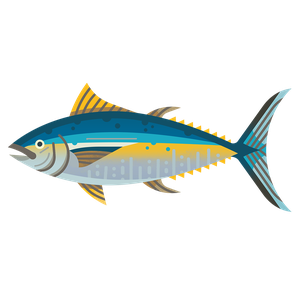
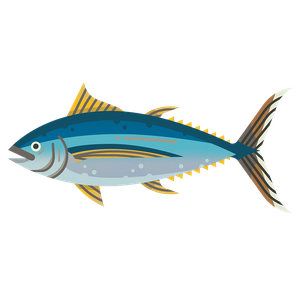
Yellowfin tuna
Thunnus albacares
What to check for
Location
Western and Central Pacific
Technical location
Pacific, Eastern Central, Pacific, Northwest, Pacific, Western Central, All areas, All areas, All areas
Caught by
Net (gill or fixed)
Rating summary
Some yellowfin catches from the west Pacific Ocean are by gillnetting. This receives a default red rating owing to the very high levels of cetacean and turtle bycatch.Rating last updated January 2024
Technical consultation summary
Yellowfin tuna in the western and central Pacific Ocean is not overfished or subject to overfishing. A new stock assessment was carried out in 2023 using data up to 2021. Spawning biomass was 47% of unfished levels between 2018-2021, which meets the harvest strategy target to maintain the stock at 2012 - 2015 levels (44% of unfished levels). Fishing mortality for 2017-2020 was 50% of FMSY. Some appropriate management measures are in place to control fishing activity. However, there is no overall catch limit and catches have increased to record levels, with 2021 being the highest on record (754,442t). Additionally, there has been a sharp increase in juvenile fishing mortality by 24% between 2015 to 2021 (F2015 = 0.22, F2021 = 0.46). Regulations are insufficient to prevent them from increasing further and potentially exceeding sustainable limits. Some yellowfin catches from the west Pacific Ocean are by gillnetting. This receives a default red rating owing to the very high levels of cetacean and turtle bycatch.
How we worked out this Rating
Yellowfin tuna in the western and central Pacific Ocean is not overfished or subject to overfishing.The western and central Pacific Ocean (WCPO) yellowfin tuna stock is managed and assessed by the Western and Central Pacific Fisheries Commission (WCPFC). Fishing for this stock began in the 1950s and catches have steadily increased, peaking in 2021 at around 750,000 tonnes. The WCPO yellowfin tuna fishery is the second largest in the world after WCPO skipjack. The last stock assessment was carried out in 2023 using data up to 2021. The next stock assessment is expected in 2026.Spawning Biomass (SB) continuously declined until the mid-2000s, when it reached around 50% of unfished levels. It has stayed relatively stable since then. The average SB between 2018 – 2021 was 47% of unfished levels and 228% of the level consistent with Maximum Sustainable Yield (MSY). The management objective is to maintain the spawning biomass depletion ratio above the average of 2012–2015, which was 44%. There is also a limit reference point (LRP) of 20%. Below this level, the stock would be considered depleted. As the biomass is above the management target and SBMSY, it is not in an overfished state.Since 2015, fishing mortality (F) has sharply increased for juveniles. In 2015, it was 22% of MSY and in 2021 it had increased to 46%. However, it has stabilized for adults. The average F from 2017-2020 was 50% of MSY, an increase on the previous assessment which was 36%. As F is below FMSY, the stock is not subject to overfishing. All models in the assessment indicated that the stock was above SBMSY, and fishing mortality rates below FMSY, with 100% probability. Therefore, it is not overfished, nor subject to overfishing. Assuming fishing effort and catch levels stay at 2018-2021 levels, there is a zero probability of the stock falling below the LRP.There are some research needs to improve the assessment, including estimation of natural mortality rates using tagging data.
Some appropriate management measures are in place to control fishing activity. However, catches have increased to record levels. Regulations are insufficient to prevent them from increasing further and potentially exceeding sustainable limits.Tuna and swordfish are highly migratory species, found on the high seas and in numerous countries' waters. This makes harmonised and effective management challenging. Regional Fisheries Management Organisations (RFMOs) are responsible for monitoring and managing these stocks on behalf of the countries that access them. However, the degree to which management is implemented, monitored and enforced by each country varies significantly. It is important that commercial buyers choose tuna that has been caught by vessels that are well regulated by their flag state.This stock is managed and assessed by the Western and Central Pacific Fisheries Commission (WCPFC). Some stocks overlap with the Inter-American Tropical Tuna Commission (IATTC). The IATTC and WCPFC endeavour to work together to promote compatibility between their respective conservation and management measures across the Pacific, but this is not always achieved. A significant proportion of West Pacific skipjack and yellowfin tuna is caught within the waters of the Parties to the Nauru Agreement (PNA). These South Pacific island nations have incorporated additional management measures, and pushed for improvements in the wider management of these stocks.The WCPFC has not yet set a target size for the yellowfin stock, although work is underway to achieve this. In the interim, for 2022-2024 there is a harvest strategy that aims to maintain the stock at 2012-2015 average levels, which is 44% of unfished biomass. The 2018-2021 spawning biomass was 47% of unfished levels. There is no explicit target for fishing mortality.There is no Total Allowable Catch. Instead, management is mainly aimed at limiting fishing effort by purse seiners, which are responsible for around 53% of the yellowfin catch. Each country has set their own catch or effort limits for purse seining within their own waters. On the high seas in the tropics (between 20 degrees N and S), each country is allowed to fish for a set number of days. Fishing effort (in days) in the areas outside of this should not increase. Purse seiners must retain and land all bigeye, skipjack, and yellowfin tuna. This is intended to incentivise reductions in bycatch of juvenile fish. Yellowfin catches by other fishing gears are frozen to 2004 levels.This has not prevented catches from increasing. The catch in 2004 was 600,000t. The 2016-2020 average is 700,000t with 2021 seeing the highest catch on record at 754,442t. Management is not, therefore, controlling fishing pressure on the stock. WCPFC has also noted that further increases in fishing mortality are likely to impact other stocks and species due to multispecies and gear interactions.There are also restrictions on the use of drifting fish aggregation devices (dFADs) - floating objects which purse seiners use to attract tuna and increase catches. Each purse seine vessel is limited to 350 dFADs at a time. FADs are banned from July-September, with an additional 2-month closure in parts of the southwest Pacific islands. VMS polling frequency increases to every 30 minutes during the FAD closure.Additional measures for all newly deployed FADs came into place in January 2024. This includes prohibiting mesh netting on any part of a FAD, and only allowing non-entangling materials and designs for raft covers and subsurface structures. Decisions on implementation of biodegradable FAD requirements are scheduled for no later than 2026. Currently, biodegradable and non-plastic materials are encouraged but not required. There is uncertainty about the level of compliance and effectiveness of these new regulations due to varying observer coverage and the recent date of implantation.Observers, to verify catch and bycatch, are required on 100% of purse seiners between 20 degrees N and S, but are low for other areas and gear types at just 5%. These observer levels have not been routinely met, peaking in 2018 and 2019 at 90% for purse seine and 6% for longline. In 2021 observer coverage fell to below 10% and 4% for purse seine and longline fisheries due to the impacts of the COVID-19 pandemic and lonely slightly improved in 2022. Scientific recommendations are for 20%.To help address illegal, unreported, and unregulated (IUU) fishing, the WCPFC maintains an IUU Vessel List, prohibits transhipments at sea between purse seiners (some exemptions apply) and requires all other transhipments to be documented and 100% observed as part of the regional observer programme. In 2017 a Compliance Monitoring Scheme was introduced to assess and improve compliance with obligations, and penalise non-compliance.
Some yellowfin catches from the west Pacific Ocean are by gillnetting. This receives a default red rating owing to the very high levels of cetacean and turtle bycatch.Approximately 25% of the WCPO yellowfin catch is taken in various subsistence style netting operations such as ring and gill nets. Gillnets used for catching tuna and tuna-like species can be 7km long and are known for extremely high bycatch including turtles, whales, dolphins, whale sharks, mobulids, requiem sharks and sunfish. WCPFC bans the use of gillnets over 2.5km long, but monitoring is poor. There is no available data on bycatch by gillnet fisheries in the WCPOGillnetting is known to have significant levels of seabird bycatch, with an estimated 400,000 birds being killed each year, globally. Some of the highest bycatch rates are in the northwest Pacific.The five marine turtle species in the WCPFC Convention Area (green, hawksbill, leatherback, loggerhead and olive ridley) are vulnerable, endangered, or critically endangered, and WCPFC does not have enough data to assess the threat posed by fisheries. There are some mitigation measures, including requirements for safe handling and release.In 2020, an estimated 1.7 million sharks were caught as bycatch or had an interaction with WCPO fisheries. Of these, around 34,000 individuals were caught in FAD-free purse seines, 60,000 in FAD-associated purse seines, and 1.6 million by longlining. Bycatch species include bigeye thresher, shortfin mako, and silky. Of greatest concern is oceanic whitetip shark, which is in a severely overfished state and critically endangered. Further catch mitigation and improved handling and release practices are required. Mobulid rays are also bycaught, but there is very little data on these species.Interactions between cetaceans and WCPFC fisheries have been recorded, with most resulting in the animal being released alive. Species include false killer whales, toothed whales and oceanic dolphins. These interactions are not well recorded and the scale of impact is unclear.
References
Hare S.R., Williams P.G., Castillo Jordán C., Day, J., Hamer P.A., Hampton W.J., Macdonald, J., Magnusson, A., Scutt Phillips, J., Scott R.D., Senina, I., Pilling G.M. 2023. The western and central Pacific tuna fishery: 2022 overview and status of stocks. Tuna Fisheries Assessment Report no. 23. Noumea, New Caledonia: Pacific Community. 68 p. Available at https://purl.org/spc/digilib/doc/to3vf [Accessed on 23.01.2024].Magnusson A., Day J., Teears T., Hampton J., Davies N., Castillo Jord´an C., Peatman T., Scot R., Scutt Phillips J., McKechnie S., Scott F., Yao N., Natadra R., Pilling G., Williams P., Hamer P., 2023. Stock assessment of yellowfin tuna in the western and central Pacific Ocean: 2023. Scientific Committee 19th Regular Session, Koror, Palau 16–24 August 2023. Available at https://meetings.wcpfc.int/node/19352 [Accessed on 23.01.2024].Rigby, C.L., Barreto, R., Carlson, J., Fernando, D., Fordham, S., Francis, M.P., Herman, K., Jabado, R.W., Liu, K.M., Marshall, A., Pacoureau, N., Romanov, E., Sherley, R.B. & Winker, H. 2019. Carcharhinus longimanus. The IUCN Red List of Threatened Species 2019: e.T39374A2911619. Available at https://dx.doi.org/10.2305/IUCN.UK.2019-3.RLTS.T39374A2911619.en [Accessed on 26.01.2022].WCPFC, 2024. Conservation and Management Measures (CMMs) and Resolutions of the Western Central Pacific Fisheries Commission. Compiled 18 Jan 2024 – 11:07. Available at https://cmm.wcpfc.int/sites/default/files/compiled-conservation-measures-and-resolutions.pdf?_dl=1 [Accessed on 23.01.2024].WCPFC, 2021. Public domain Bycatch data (Bycatch Data Exchange Protocol – BDEP), Regional Observer Programme (ROP) Database. 27 July 2021. Available at https://www.wcpfc.int/node/29966 [Accessed on 25.01.2022].WCPFC, 2022. Indicative workplan for the adoption of Harvest strategies under CMM 2022-03 (formerly CMM 2014-06). 19th Regular Session of the Commission, Da Nang, Vietnam, 27 November –3 December 2022. Available at https://meetings.wcpfc.int/file/14129/download [Accessed on 23.01.2024].WCPFC, 2022. Reference Document for Bigeye, Yellowfin and Skipjack tuna for the Review of CMM 2021-01 and Development of Harvest Strategies under CMM 2014-06. 19th Regular Session of the Commission, Da Nang, Vietnam, 27 November –3 December 2022. Available at https://meetings.wcpfc.int/node/18124 [Accessed on 23.01.2024].Zydelis, R., Small, C. and French, G., 2013. The incidental catch of seabirds in gillnet fisheries: A global review. Biol Cons 162. pp. 76-88. http://dx.doi.org/10.1016/j.biocon.2013.04.002.
Sustainable swaps
Learn more about how we calculate our sustainability ratings.
How our ratings work