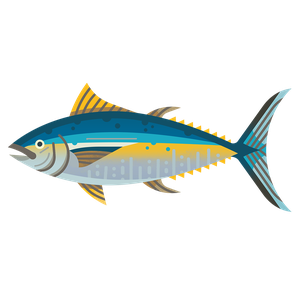
Yellowfin tuna
Thunnus albacares
What to check for
Location
Atlantic
Technical location
Atlantic, Eastern Central, Atlantic, Northeast, Atlantic, Northwest, Atlantic, Southeast, Atlantic, Southwest, Atlantic, Western Central, All areas, All areas, All areas, All areas, All areas, All areas
Caught by
Hook & line (longline)
Rating summary
Atlantic yellowfin tuna is not overfished and is not subject to overfishing. However, there is some uncertainty in this assessment, and recent catches have been above recommended levels, which could cause the stock to decline. Few appropriate management measures are in place. Management is not effective at controlling fishing pressure on this stock as catch limits have been exceeded in every year since 2015. Some yellowfin tuna in the Atlantic are caught by longlining. While longlining is unlikely to have habitat impacts, it can have a bycatch of highly vulnerable species such as sharks, turtles, and seabirds.Commercial buyers should establish what measures the flag state and fleet relating to their source is taking to reduce impacts to and improve reporting of interactions with vulnerable species. Large buyers should consider supporting such improvements. MCS also advocates specifying the need for vessels, in particular purse seiners, to register on the ISSF Proactive Vessel Register.Rating last updated December 2021.
How we worked out this Rating
Atlantic yellowfin tuna is not overfished and is not subject to overfishing. However, there is some uncertainty in this assessment, and recent catches have been above recommended levels, which could cause the stock to decline.Yellowfin tuna in the Atlantic is assessed by the International Commission for the Conservation of Atlantic Tunas (ICCAT). The last stock assessment was carried out in 2019, using data up to 2017. Catches of yellowfin declined from their peak of 190,000 tonnes in 1990 to 100,000t in 2007, and subsequently rose to an average of 140,000 tonnes from 2016-2020. Biomass has continuously declined throughout the lifetime of the fishery, while fishing mortality has been increasing since the mid-2000s.In 2018, biomass (B) was 117% of levels associated with Maximum Sustainable Yield (MSY). Therefore, the stock is not in an overfished state.Fishing mortality (F) in 2018 was just below the level associated with MSY, at 96%. Therefore, the stock is not subject to overfishing. However, the most recent catch estimates suggest that overall catches have exceeded MSY (120,000t) every year since 2015.The preliminary catch in 2020 was 148,894 tonnes. This is of concern to the scientific committee because it exceeds the catch limit (110,000t) and is the highest since 2016. Projections indicate that catches above 120,000t would cause biomass to decline. At 140,000 tonnes, there is only a 20% probability that the stock will be above BMSY and below FMSY by 2030.Some catches are on Fish Aggregating Devices (FADs), which tend to catch smaller tunas, including juveniles. The scientific committee has highlighted that increased catches of small yellowfin (and small bigeye, as they are caught together on FADs) will have negative effects on stock size and future harvest rates.
Few appropriate management measures are in place. Management is not effective at controlling fishing pressure on this stock. Catch limits have been exceeded in every year since 2015, at levels that are expected to cause the stock to decline.Tuna, marlin, and swordfish are highly migratory species, found on the high seas and in numerous countries' waters. This makes harmonised and effective management challenging. Regional Fisheries Management Organisations (RFMOs) are responsible for monitoring and managing these stocks on behalf of the countries that access them. However, the degree to which management is implemented, monitored and enforced by each country varies significantly.Atlantic yellowfin tuna is managed and assessed by the International Commission for the Conservation of Atlantic Tunas (ICCAT). The main management measures are a catch limit (Total Allowable Catch, TAC) and controls on fishing gear.The TAC for yellowfin has been 110,000 tonnes since 2012. Scientific advice is that keeping catches at 120,000t or less is expected to maintain healthy stock status through to 2033. This indicates that catch limits are following scientific advice.However, catches have exceeded the TAC every year since 2015. Average catch from 2016-2020 is 140,000 tonnes, which is expected to cause the stock to decline. The scientific committee has suggested that existing conservation and management measures appear to be insufficient and need to be strengthened.Most yellowfin tuna catches are by purse seine nets, many of which use Fish Aggregating Devices (FADs). FADs are floating objects that attract tuna and other species, making it easier to set nets around them to catch them. Many juvenile fish are caught in these fisheries, which can have implications for future population growth. The recent average weight in European purse seine catches, which represent the majority of the landings, has declined to about half of the average weight of 1990, at least in part due to the use of FADs and the increased catches of small yellowfin.Consequently, a multi-annual management plan has been in place for bigeye and yellowfin since 2012, and eastern skipjack since 2015. It is mostly focussed on FAD management. Initially there was a 2-month FAD ban in an area where there are high concentrations of juveniles, and a 500 FAD limit per vessel for the rest of the year. This failed to reduce the mortality of juvenile bigeye and yellowfin tuna, so additional measures were added in 2019. The number of FADs per vessel was reduced to 300 for 2021 and 2022. The FAD ban was extended to the full convention area, lasting for 72 days in 2022 (January to mid-March). In 2021 the scientific committee advised that it was too soon to evaluate the impact of these changes. In 2021 the number of permitted support vessels, which help to increase the efficiency of purse seiners, was frozen.As well as the above measures, there is a ban on discarding skipjack, yellowfin and bigeye tuna, so that all fish caught must now be landed. There is also a tagging programme to improve stock assessments for tropical tunas and gauge effectiveness of management measures. This helped to improve the quality of the 2019 yellowfin assessment.Other management by ICCAT includes:A ban on drift nets by the EU in 2002 and by ICCAT in the Mediterranean in 2003.A list of vessels authorised to fish for this species, and a list of vessels caught carrying out Illegal, Unreported or Unregulated activities. At-sea transhipment is prohibited unless pre-authorised and the vessel has an observer on board.A requirement for 100% observer coverage on large purse seiners targeting tropical tunas all year round. The requirement for longline is only 5%, increasing to 10% in 2022. Many fleets are not reaching this level. Scientific recommendations are 20% for accurate data. Work is underway to improve electronic monitoring. Vessel Monitoring Systems are required for all vessels over 24m.
Some yellowfin tuna in the Atlantic are caught by longlining. While longlining is unlikely to have habitat impacts, it can have a bycatch of highly vulnerable species such as sharks, turtles, and seabirds.Longline catches for yellowfin in the Atlantic have fluctuated since the 90s, but now account for about 12% of the total catch (around 14,000 tonnes in 2020).Monitoring and reporting of bycatch in fisheries managed by ICCAT is poor. Most data comes from scientific observers on vessels. Scientific recommendations are that 20% of a fishery should be observed for accurate data. ICCAT only requires coverage of 5%, increasing to 10% in 2022. Many fleets are not reaching this level. This makes it difficult to assess the impact of these fisheries on vulnerable species.There is a bycatch of loggerhead, leatherback and olive ridley turtles in longline and purse seine fisheries. According to the IUCN Red List, loggerhead turtles are endangered in the north east Atlantic and leatherbacks are endangered in the north west Atlantic and critically endangered in the southwest Atlantic. Observer data for 2020 indicates 20 dead discards of turtles, 1,308 live discards and 20 discards of unknown status. Given the poor observer coverage, this is likely to be an underestimate of the total catch. Post-release mortality is 1-4%. Longliners are required to safely unhook and release alive turtles, and purse seiners must avoid encircling them. Other scientifically recommended mitigation measures, such as using finfish bait and large circle hooks, are not mandated.Albatrosses and large petrels are amongst the most threatened groups of birds in the world, due in a large part to the impacts of bycatch in longline fisheries. In the Atlantic Ocean, bycatch of seabirds is most problematic in waters south of 25°S, which coincides with the greatest densities of albatrosses and large petrels. Observer data for 2020 indicates 195 dead discards of seabirds, 21 live discards and 2 discards of unknown status. Species recorded included the wandering albatross, the endangered sooty albatross, and the black-browed albatross. Given the poor observer coverage, this is likely to be an underestimate of the total catch. An recent assessment estimated that approximately 30,000-40,000 seabirds were killed by longlining in the Southern Hemisphere (including south Atlantic) between 2012 and 2016. The required mitigation measures do not follow recommended best practice by ACAP (the Agreement on the Conservation of Albatrosses and Petrels). ICCAT requires one or more measures from a set list of options, including weighted hooks, bird scaring lines and night setting, depending on location and target species. ACAP recommends the simultaneous use of all three, or hook-shielding or underwater bait setting devices. In the Mediterranean, all these mitigation measures are voluntary.Sharks are both bycaught and targeted in longline fisheries in the Atlantic. Bycatch species include the critically endangered scalloped hammerhead, silky shark, and the bigeye thresher, which is endangered in Europe and the Mediterranean. Observer data for 2020 indicates 1,098 dead discards of sharks and 1,109 live discards. Given the poor observer coverage, this is likely to be an underestimate of the total catch. There are some mitigation measures, such as restrictions on finning, but no gear-specific measures. This is in spite of repeated recommendations from the scientific committee to use circle hooks, which have been shown to increase survival of shortfin mako, blue marlin and swordfish if accidentally caught. Catching silky sharks, hammerheads, oceanic whitetips, and bigeye threshers is prohibited, and catching other thresher species is discouraged. Shortfin mako, which is heavily overfished, can be caught and retained. However, measures are came into force in 2022 aimed at ending overfishing of this species.There are no specific management measures to protect marine mammals, including cetaceans. ICCAT has not prioritised collecting data on mammal bycatch to date. More needs to be done to understand and reduce the impact of ICCAT fisheries on marine mammals.

References
ACAP, 2021. ACAP Review of mitigation measures and Best Practice Advice for Reducing the Impact of Pelagic Longline Fisheries on Seabirds. Reviewed at the Twelfth Meeting of the Advisory Committee Virtual meeting, 31 August – 2 September 2021. Available at https://www.acap.aq/resources/bycatch-mitigation/mitigation-advice/3956-acap-2021-pelagic-longlines-mitigation-review-bpa/file [Accessed on 09.12.2021].Anon., 2021. Advances on the collaborative work to assess sea turtle bycatch in pelagic longline and purse seine fleets (Atlantic and Indian oceans and Mediterranean Sea). SCRS/2021/076. Collect. Vol. Sci. Pap. ICCAT, 78(4): 155-166. Available at https://www.iccat.int/Documents/CVSP/CV078_2021/n_4/CV078040156.pdf [Accessed on 16.12.2021].BirdLife South Africa, 2019. Report of the Final Seabird Bycatch Assessment Workshop, 25 February – 1 March 2019. GCP/GLO/365/GFF. FAO-GEF Project Sustainable Management of Tuna Fisheries and Biodiversity Conservation in the ABNJ. Available at https://www.fao.org/fileadmin/user_upload/common_oceans/docs/Tuna/ReportFinalGlobalSeabirdBycatchAssessmentWorkshop.pdf.Clarke, S., Sato, M., Small, C., Sullivan, B., Inoue, Y. & Ochi, D. 2014. Bycatch in longline fisheries for tuna and tuna-like species: a global review of status and mitigation measures. FAO Fisheries and Aquaculture Technical Paper No. 588. Rome, FAO. 199 pp. Available at https://www.fao.org/3/i4017e/i4017e.pdf.ICCAT, 2020. The development of the seabird component of the ICCAT ecosystem report card. SCRS/2020/045. Collect. Vol. Sci. Pap. ICCAT, 77(4): 144-156. Available at https://www.iccat.int/Documents/CVSP/CV077_2020/n_4/CV077040144.pdf [Accessed on 16.12.2021].ICCAT, 2021. Report of the Standing Committee on Research and Statistics (SCRS), 27 September - 2 October 2021, Online. Available at https://www.iccat.int/Documents/Meetings/Docs/2021/REPORTS/2021_SCRS_ENG.pdf [Accessed on 14.12.2021].ICCAT, 2021. Report of the Standing Committee on Research and Statistics (SCRS), 27 September - 2 October 2021, Online. Available at https://www.iccat.int/Documents/Meetings/Docs/2021/REPORTS/2021_SCRS_ENG.pdf [Accessed on 14.12.2021].ICCAT, 2021. Resolutions, Recommendations and other Decisions. Available at https://www.iccat.int/en/RecRes.asp [Accessed on 16.12.2021].ICCAT, 2021. 2021 SCRS Report: Panel 1-Tropical Tunas. Presented to the 27th Regular Meeting of the Commission. 15-23 November 2021, Online. Available at https://www.iccat.int/com2021/presentations/SCRS_Chair_2021_PA1_Presentation.pdf [Accessed on 16.12.2021].ICCAT, 2021. 2021 Secretariat Report on Research and Statistics. PLE-105 presented to the 27th Regular Meeting of the Commission. 15-23 November 2021, Online. Available at https://www.iccat.int/com2021/ENG/PLE_105_ENG.pdf [Accessed on 15.12.2021].Okamoto, K., Ochi, D., and Oshima, K., 2017. Review of sea turtle by-catch data in the ICCAT convention area obtained through Japanese scientific observer program. SCRS/2017/155. Collect. Vol. Sci. Pap. ICCAT, 74(7): 3698-3713 (2018). Available at https://www.bmis-bycatch.org/system/files/zotero_attachments/library_1/BYJUU4PR%20-%20CV074073698.pdf [Accessed on 16.12.2021].
Sustainable swaps
Learn more about how we calculate our sustainability ratings.
How our ratings work