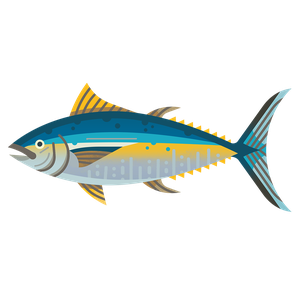
Yellowfin tuna
Thunnus albacares
What to check for
Location
Indian Ocean
Technical location
Indian Ocean, Eastern, Indian Ocean, Western, All areas, All areas
Caught by
Net (purse seine on aggregating devices or free-schooling fish)
Rating summary
The yellowfin tuna stock in the Indian Ocean is overfished and subject to overfishing. Few appropriate management measures are in place for Indian Ocean yellowfin tuna. Stock rebuilding plans have been in place since 2016, but have been ineffective. Catches are too high, and monitoring and enforcement needs to be improved. Some yellowfin tuna from the Indian Ocean is caught by purse seining. This method is associated with bycatch of species such as sharks, rays, and turtles.Commercial buyers should establish what measures the flag state and fleet relating to their source is taking to reduce impacts to and improve reporting of interactions with vulnerable species. Large buyers should consider supporting such improvements. MCS also advocates specifying the need for vessels, in particular purse seiners, to register on the ISSF Proactive Vessel Register.Rating last updated January 2022.
Technical consultation summary
The yellowfin tuna stock in the Indian Ocean is not overfished or subject to overfishing. It is estimated that the stock in 2023 was 44% of unfished levels (SB2023 / SB0 = 0.44) and 32% higher (SB2023/SBMSY = 1.32) than target levels (Maximum Sustainable Yield, MSY). Fishing mortality (F) in 2023 was estimated to be 25% lower than target levels (FMSY) (F2023/Fmsy = 0.75). It is projected that if catches are maintained within the estimated MSY range (416,000-430,000 tons) there is more than a 50% probability that the biomass will remain above SBMSY in 2033. Few appropriate management measures are in place for Indian Ocean yellowfin tuna. Stock rebuilding plans have been in place since 2016. Catches in previous years have been too high, and monitoring and enforcement needs to be improved. Some yellowfin tuna from the Indian Ocean is caught by purse seining. This method is associated with bycatch of species such as sharks, rays, and turtles.
How we worked out this Rating
The yellowfin tuna stock in the Indian Ocean is overfished and subject to overfishing.This stock is managed and assessed by the Indian Ocean Tuna Commission (IOTC). Indian Ocean yellowfin has been caught since the 1950s. Catches peaked at around 540,000 tonnes in 2004, dropped to around 270,000 t in 2009 and in recent years have stabilised at around 435,000 t. A new stock assessment was carried out in 2021, using data up to 2020. The next stock assessment is expected after 2023.Spawning biomass (SSB) has been declining since the 1980s. It is estimated that the stock in 2020 was 31% of unfished levels and 87% of target levels (Maximum Sustainable Yield, MSY). Therefore, it is in an overfished state, but above the lower limit (Blim) of 40% of MSY. This is a small improvement from the previous assessment in 2018, when the stock was estimated to be 83% of SBMSY.Fishing mortality (F) in 2020 was 132% of target levels (FMSY), and so the stock is subject to overfishing. F remains below, but approaching, the upper limit of 140% of MSY. This is an increase from the previous assessment, when F was 120% of FMSY.It is projected that if catches are maintained at 2020 levels (432,624t), there is a 76% probability that biomass will remain below the target level and a 72% probability that fishing mortality will be above it by 2023. This rises to 93% and 85%, respectively, by 2030. The 2016-2020 average catch is 434,239t. This is above the estimated Maximum Sustainable Yield (MSY), which is 349,000t.
Few appropriate management measures are in place for Indian Ocean yellowfin tuna. Stock rebuilding plans have been in place since 2016, but have been ineffective. Catches are too high, and monitoring and enforcement needs to be improved.Tuna, marlin, and swordfish are highly migratory species, found on the high seas and in numerous countries' waters. This makes harmonised and effective management challenging. Regional Fisheries Management Organisations (RFMOs) are responsible for monitoring and managing these stocks on behalf of the countries that access them. However, the degree to which management is implemented, monitored and enforced by each country varies significantly.Indian Ocean yellowfin tuna is managed and assessed by the Indian Ocean Tuna Commission (IOTC). The stock is overfished and subject to overfishing. Interim rebuilding plans have been in place since 2016 to recover it to target levels. These have not succeeded.The rebuilding plans for 2016-2021 were based on reducing catches by 20% from 2014 levels (405,000t), with variations for different gear types. However, even with good compliance, the measures were actually estimated to achieve only a 10% reduction from 2014 levels. However, catches have increased. Provisional catch in 2020 was 432,624t, and the 2016-2020 average is 434,239t. It is projected that if catches are maintained at 2020 levels, there is a 76% probability that yellowfin biomass will remain below the target level and a 72% probability that fishing mortality will be above it by 2023, rising to 93% and 85% by 2030, respectively.Some countries, particularly the longline fleets, achieved the required decreases for 2016-2021, which is positive. The Maldives, which are economically dependent on healthy tuna stocks, decommissioned their longline yellowfin tuna fleet in 2019 (which was catching roughly 3,000 tons per year), to contribute rebuilding of yellowfin tuna. However, these efforts were offset by significant increases elsewhere, especially in the gillnet fleets. The plans to date have not, therefore, been adequately enforced, and management is inadequate to protect the stock.A number of concerns have been expressed relating to the rebuilding plans of 2016-2021. Catch reductions only applied to countries who caught more than 5,000t of yellowfin in 2014, so some countries may have inaccurately reported lower 2014 catches to escape the measures. Countries were allowed to determine their own methods for achieving reductions, resulting in inconsistent and ineffective approaches. The plans appear to have displaced activity onto purse seines using Fish Aggregating Devices (FADs), which has led to an increase in catches of skipjack tuna and juvenile yellowfin and bigeye.A new interim rebuilding plan for 2022 has included additional reductions and freezes on catch levels, which vary depending on catches for 2014/15 and 2017-2019. It is projected that the new measure will reduce catches to 401,000t if fully implemented, but it is too early to tell if it will be successful. A number of countries with high yellowfin catches objected to it, and therefore are exempt from the measure. While total catch reductions are crucial, specific focus is needed on reducing catches of juvenile yellowfin. There are no minimum size limits for this fishery to protect juveniles. Some gears, such as gillnets, FAD-associated purse seines, and poles and lines, catch high proportions of juveniles and may need further restrictions to protect the stock. It is also crucial to improve monitoring and compliance with management measures. Any rebuilding or management plan appears highly unlikely to succeed without significant changes to ensure that catch limits are being complied with.As well as catch limits, there are limits and reductions on the capacity of the fishing fleet. This mainly applies to the purse seine fleet, which accounts for around 30% of catches. The number of supply vessels, which increase fishing capacity of purse seiners, should be reduced. FADs, which attract tuna and increase catches, have also been reduced, from 550 per vessel in 2015 to 300 from 2019 onwards. Countries that use FADs must report regularly to the Commission and submit FAD management plans outlining how they will minimise mortality of juvenile yellowfin and bigeye tuna and vulnerable non-target species such as sharks, turtles and rays.There is a freeze on the capacity of the fishing fleet to 2003 levels, to prevent the fleet from growing. This legislation is very generic, applying across all fleets, and would be better replaced by spatial and temporal closures and quota allocation. There also appear to be concerns that the freeze has not been well enforced thus far.Monitoring and compliance with management measures in the IOTC region is generally poor. Some countries repeatedly fail to report catch data to the commission. In 2018 IOTC introduced a new measure aimed at improving reporting on catch and bycatch, including prohibiting a country from retaining a species if they fail to report catches for it. However, in 2021 the commission noted that data reporting issues persist. Mandatory observer coverage is very low, at just 5% for all vessels over 24m or under 24m and fishing outside of their Exclusive Economic Zone (EEZ). A number of countries fail to meet the 5% threshold. In general, 20% is scientifically recommended to ensure adequate monitoring of catch and bycatch. In 2019 a proposal was put forward to increase coverage to at least 20%, but consensus could not be reached.It is possible that some catches are being misreported, as the boundary between the Atlantic Ocean and Indian Ocean stock is not clear. Genetic analysis suggests that much of the South African catch is from the Indian Ocean stock, while it is currently reported as Atlantic stock.Other IOTC conservation and management measures of note include:Discarding bigeye, yellowfin and skipjack tunas at sea is banned.To help address Illegal, Unregulated, and Unreported fishing (IUU), the IOTC maintains an active vessel register and an IUU Vessel List. In 2021, all transhipments at sea were banned, except for large scale tuna longliners, which must be pre-approved, monitored by an observer and the vessel uses a Vessel Monitoring System (VMS).In 2012 IOTC banned the use of driftnets on the high seas. In 2022 this will be extended to the entire IOTC area (i.e. including countries' EEZs).Using aircraft and unmanned aerial vehicles as fishing aids, which significantly contribute to fishing effort by helping to detect fish, is banned.Using artificial lights to attract tuna and tuna-like species beyond territorial waters is banned.

Some yellowfin tuna from the Indian Ocean is caught by purse seining. This method is associated with bycatch of species such as sharks, rays, and turtles.Purse seining accounts for 30% of Indian Ocean yellowfin tuna catches (around 135,000t in 2020). Approximately two thirds of purse seine catches are from Fish Aggregating Devices (FADs) and the rest is on free schooling tuna, but it is not always possible to verify which catches are from which method.Purse seining is associated with bycatch of species such as sharks, turtles and marine mammals, although less so than longlining. Bycatch is higher when FADs are used. In the Indian Ocean, bycatch per ton of tuna averages 0.8% on free school sets and 3% on FADs. FADs are floating objects that tuna and other species tend to aggregate around. FADs can include hanging elements such as ropes and nets, which can entangle vulnerable species. FADs can also become lost at sea, continuing to ghost fish and be a source of marine debris.Some mitigation measures are in place. The IOTC is reducing the number of FADs that countries can use, and working on ways to reduce impacts through development of biodegradable and non-entangling FADs. Countries must submit FAD management plans outlining how they will minimise mortality of juvenile yellowfin and bigeye tuna and vulnerable non-target species such as sharks, turtles and rays.However, concerns remain. Several countries have failed to implement national plans of action (NPOAs) for sharks, seabirds and turtles as required. Monitoring and reporting of bycatch in fisheries managed by IOTC is poor. Most data come from scientific observers on vessels. Scientific recommendations are that 20% of a fishery should be observed for accurate data. IOTC only requires coverage of 5%. Many fleets are not reaching this level. This makes it difficult to assess the impact of these fisheries on vulnerable species.In 2019, around 80,000t of sharks were caught in the Indian Ocean, with rays totalling around 2,000t. It is estimated that around 40,000t is blue shark, which is not overfished or subject to overfishing. Most of the rest of the data is not reported to species levels, so data on interactions is poor. However, species such as the critically endangered oceanic whitetip and scalloped hammerhead, and the endangered shortfin mako and pelagic thresher are known to be caught at significant levels in the Indian Ocean. The available evidence indicates considerable risk to these species. Mobulid rays are also bycaught and are declining across the Indian Ocean. Gillnets are responsible for around 40% of the catch, followed by longline, handline, and trolling. Data on bycatch by purse seiners is poor, and a 2021 study indicated that it could be double the quantity that is currently recorded. There are some mitigation measures, such as restrictions on finning, and bans on retaining some species. There are no gear-specific measures.The IOTC reports that flatback, green, hawksbill, leatherback, loggerhead and olive ridley turtles are caught in its fisheries. Of these, hawksbills, southwest Indian Ocean leatherbacks, and northwest Indian Ocean loggerheads are critically endangered. Data on interactions is not regularly submitted, so the extent of bycatch is unknown. Gillnetting is the biggest concern for turtles, with estimates ranging from 11,000-52,000 individuals being caught annually. Longlining is estimated to catch around 3,500 turtles annually. Turtles can also be entangled by Fish Aggregating Devices used by purse seiners, and around 250 turtles are estimated to be caught by purse seiners annually. An estimated 75% of turtles are released alive from longliners and purse seiners. The scientific committee advises that maintaining or increasing fishing effort in the Indian Ocean without appropriate measures in place will likely result in further population declines. Current mitigation measures include requirements to release turtles wherever possible.Most bycatch of cetaceans is by gillnetting. Purse seine nets have the potential to encircle or entangle the animals, although interactions are thought to be low. It is illegal to intentionally set a purse seine net around a cetacean. These interactions are not well recorded and the scale of impact of IOTC fisheries is unclear. The IOTC scientific committee notes that maintaining or increasing fishing effort in the Indian Ocean without appropriate mitigation measures in place will likely result in further declines in a number of cetacean species. In 2020, it was noted that there are tuna-dolphin associations for yellowfin tuna. The dolphins are not targeted, but can be caught as bycatch. This association appears to be widespread around the Indian Ocean, and is used by coastal country fishermen in Maldives, Sri Lanka, Oman and elsewhere to target yellowfin tuna.FADs are also of concern due to the unknown impacts such gear might have on other tuna and fish species in relation to species composition of schools, migratory patterns, growth rates and predation rates. Juvenile yellowfin and bigeye tuna are caught by purse seining, and scientific recommendations are for these impacts to be reduced to protect the stocks.
References
IOTC, 2021. Appendix 4: Executive Summary: Yellowfin Tuna (2021). IOTC-2021-SC24-ES04_Rev4. 6pp. 24th Session of the Scientific Committee, Online, 6-10.12.2021. Available at https://www.iotc.org/sites/default/files/documents/2021/12/IOTC-2021-SC24-ES04_YFT_Rev4_E.pdf [Accessed on 05.01.2022].IOTC, 2021. Appendix 24 Executive Summary: Marine Turtles (2021). IOTC-2021-SC24-ES24. 3pp. 24th Session of the Scientific Committee, Online, 6-10.12.2021. Available at https://www.iotc.org/sites/default/files/documents/2021/11/IOTC-2021-SC24-ES24_Turtles_E.pdf [Accessed on 05.01.2022].IOTC, 2021. Appendix 26 Executive Summary: Cetaceans (2021). IOTC-2021-SC24-ES26. 5pp. 24th Session of the Scientific Committee, Online, 6-10.12.2021. Available at https://www.iotc.org/sites/default/files/documents/2021/11/IOTC-2021-SC24-ES26_Cetaceans_E.pdf [Accessed on 05.01.2022].IOTC, 2021. Compendium of Active Conservation and Management Measures for the Indian Ocean Tuna Commission. Last updated: 17 December 2021. Available at https://iotc.org/sites/default/files/documents/compliance/cmm/IOTC_-_Compendium_of_ACTIVE_CMMs_17_December_2021.pdf [Accessed on 05.01.2022].IOTC, 2021. Report of the 17th Session of the IOTC Working Party on Ecosystems and Bycatch Assessment Meeting. IOTC–2021–WPEB17(AS)–R[E]. Online, 6-10 September 2021. Available at https://www.iotc.org/sites/default/files/documents/2021/11/IOTC-2021-WPEB17AS-RE_rev1.pdf [Accessed on 24.01.2021].IOTC, 2021. Report of the 23rd Session of the IOTC Working Party on Tropical Tunas. IOTC-2021-WPTT23-R[E]. 59pp. Online, 25-30 October 2021. Available at https://www.iotc.org/sites/default/files/documents/2021/12/IOTC-2021-WPTT23-RE_FINAL_0.pdf [Accessed on 05.01.2022].IOTC, 2021. Report of the 25th Session of the Indian Ocean Tuna Commission. Held by videoconference, 7–11 June 2021. IOTC–2021–S25–R[E]: 92pp. Available at https://iotc.org/sites/default/files/documents/2021/10/IOTC-2021-S25-RE.pdf [Accessed on 05.01.2022].Murua J., Ferarios J.M., Grande M., Moreno, G.M., Onandia, I., Ruiz, J., Zudaire, I., Santiago, J., Murua, H., and Restrepo, V., 2021. Developing solutions to increase survival rates of vulnerable bycatch species in tuna purse seine FAD fisheries. IOTC-2021-WGFAD02-11_rev1. 2nd ad hoc Working Group on FADs. Online, 21 September 2021. Available at https://iotc.org/sites/default/files/documents/2021/09/IOTC-2021-WGFAD02-11_rev1.pdf [Accessed on 24.01.2021].Naunet, 2021. Sustainability of yellowfin tuna (Thunnus albacares) fisheries in the Indian Ocean, with a special focus on juvenile catches. Prepared for the Global Tuna Alliance, March 2021. Available at https://www.globaltunaalliance.com/wp-content/uploads/2021/05/Naunet-Fisheries.2021.V2.pdf [Accessed on 07.01.2022].
Sustainable swaps
Learn more about how we calculate our sustainability ratings.
How our ratings work