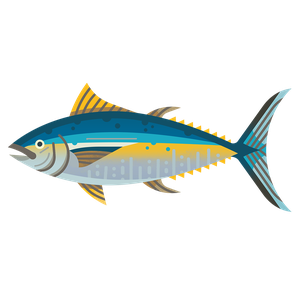
Yellowfin tuna
Thunnus albacares
What to check for
Location
Eastern Pacific
Technical location
Pacific, Eastern Central, Pacific, Southeast, Pacific, Southwest, All areas, All areas, All areas
Caught by
Net (purse seine on aggregating devices or free-schooling fish)
Rating summary
The population of yellowfin tuna in the Eastern Pacific Ocean is thought to be abundant, and fishing pressure is within sustainable limits. Few appropriate management measures are in place as there are no catch limits. Most yellowfin tuna in the eastern pacific Ocean is caught by purse seining. This can bycatch vulnerable species like sharks and turtles.Rating last updated: December 2022
Technical consultation summary
Yellowfin tuna in the Eastern Pacific Ocean is not thought to be overfished or subject to overfishing. Few appropriate management measures are in place. There are controls relating to which fishing gears can be used where and when. However, there are no catch limits and fishing mortality is increasing owing to increasing effort in the FAD purse seine fishery. Most yellowfin tuna in the eastern Pacific Ocean is caught by purse seining. It is not always possible to verify whether catches are form FAD or FAD-free fisheries, so they are both covered in this rating. A number of vulnerable shark and ray species are bycaught in this fishery. In addition, there are not enough measures to reduce the risk of turtle entanglement in FADs. Bycatch data is lacking from some parts of the fishery, i.e. small purse seiners.
How we worked out this Rating
Yellowfin tuna in the Eastern Pacific Ocean is not thought to be overfished or subject to overfishing.The Eastern Pacific Ocean (EPO) yellowfin tuna stock is managed and assessed by the Inter-American Tropical Tuna Commission (IATTC). Catches of yellowfin tuna in this area increased from 100,000t in the 1980s to over 400,000t in the early 2000s. They have since declined to around 233,000t (the average for 2015-2019).The most recent stock assessment for EPO yellowfin was carried out in 2020. As part of this, a number of stock status indicators were developed. The actual values for fishing pressure and biomass are not known, but it does assess stock status using MSY-based reference points. The next assessment is expected in 2024.The assessment concluded that at the beginning of 2020, the spawning biomass of yellowfin ranged from 49% to 219% of the level associated with Maximum Sustainable Yield (MSY). this is a wide range of values, but the probability of the spawning biomass being below MSY is low (12%), and there is a zero probability of it being below its limit reference point. Therefore, the stock is not thought to be in an overfished state.Between 2017 and 2019, the fishing mortality (F) for yellowfin ranged from 40% to 168% of the level associated with MSY. Again, this is a wide range of values but there is a low probability of F being above FMSY (9%) and zero probability of it being above the limit reference point. Therefore, the stock is not thought to be subject to overfishing.Recruitment of young fish into the stock appears to be declining, and has been below the long term average since 2000. There are occasional peaks, which may be influenced by El Nino events.Tagging studies of yellowfin throughout the Pacific indicate that they tend to stay within 1,800 km of their release positions. This tendency to stay within the same area, along with variation in characteristics of yellowfin between areas, suggests that there might be multiple stocks of yellowfin throughout the Pacific Ocean. However, movement between these potential stocks cannot be estimated with currently-available tagging data. This is the main uncertainty in the current stock assessment.
Few appropriate management measures are in place. There are controls relating to which fishing gears can be used where and when. However, there are no catch limits. Regulations are insufficient to prevent catches from increasing further and potentially exceeding sustainable limits.Tuna and swordfish are highly migratory species, found on the high seas and in numerous countries' waters. This makes harmonised and effective management challenging. Regional Fisheries Management Organisations (RFMOs) are responsible for monitoring and managing these stocks on behalf of the countries that access them. However, the degree to which management is implemented, monitored and enforced by each country varies significantly. It is important that commercial buyers choose tuna that has been caught by vessels that are well regulated by their flag state.This stock is managed and assessed by the Inter-American Tropical Tuna Commission (IATTC). Some stocks overlap with the Western and Central Pacific Fisheries Commission (WCPFC). The IATTC and WCPFC endeavour to work together to promote compatibility between their respective conservation and management measures across the Pacific, but this is not always achieved.Management of tropical tunas (bigeye, yellowfin, and skipjack) in the Eastern Pacific is through Resolutions that last for 3 years at a time. The conservation measures for tropical tunas in the Eastern Pacific Ocean during 2022-2024 (C-21-04) include a number of controls relating to which fishing gears can be used where and when. The aim is to keep fishing mortality at or below the status quo (average during 2017-2019). However, it does not include catch limits for yellowfin or skipjack. Therefore, not all appropriate management measures are in place.In 2016, interim Harvest Control Rules (HCRs) were brought in for bigeye, skipjack and yellowfin purse seine fisheries (C-16-02). The HCRs set out targets and limits for fishing mortality, which should be used as a basis for other management measures. Skipjack and yellowfin stock assessments are too uncertain to produce actual estimates of fishing mortality, although they have concluded that it is likely to be below the target reference point. However, some indicators show that fishing mortality is increasing on all three species owing to increases in purse seine fishing effort, specifically on Fish Aggregating Devices (FADs). Fishing mortality on skipjack in 2021 was above the status quo. This suggests that management may not be controlling fishing pressure, although the IATTC scientific committee have not recommended any changes to the current approach. There is a limit on the number of FADs each fishing vessel can use (varying by vessel size). FADs catch high numbers of juvenile yellowfin and bigeye, and are the main cause of increasing fishing pressure on tropical tunas. FAD limits are therefore seen as one of the most important ways to control tuna fishing. The upper limit for the largest vessels is gradually reducing from 450 in 2018-2021 to 340 by 2024, which is a 25% reduction. Recommendations were for a 30% reduction.A Management Strategy Evaluation for tropical tunas is being carried out from 2021-2024, beginning with bigeye tuna. This should provide some clarity on whether current measures can achieve their targets.Other management includes:Bigeye catch limits for longliners (varying by country). The scientific committee advises that if adequate management is in place for bigeye, this should also protect the skipjack stock.A ban on large purse seiners fishing in areas and at times when catches of small bigeye tuna are high. The closed periods are longer for vessels with higher bigeye catches.A requirement to retain and land all bigeye, skipjack, and yellowfin tuna caught by purse seiners.There is 100% observer coverage on large purse seiners to monitor catches and effort. The scientific committee continues to recommend 20% observer coverage for small purse seiners in order to get better data on discards and bycatch. Since 2011 only 5% observer coverage has been required on large longliners, considered by the scientific committee to be too low for accurate data: a minimum of 20% coverage is recommended. In addition, data recorded by longliners is considered inadequate for scientific purposes and minimum data standards must be identified and introduced.To help address IUU, the IATTC maintains an IUU Vessel List, maintains a register of authorised fishing vessels, prohibits transhipments at sea for most vessels (some exemptions apply), and requires most other transhipments to be documented and observed. Countries are required to report annually on monitoring, control and compliance of management measures. IATTC was the last tuna RFMO to adopt Port State measures (in 2021) to strengthen work to tackle IUU. IATTC does not report on countries' compliance with management measures and does not have a framework for addressing non-compliance.
Some yellowfin tuna in the eastern pacific Ocean is caught by purse seining. This can bycatch sharks, turtles and marine mammals.Most (over 90%) of yellowfin tuna catches in the Eastern Pacific Ocean (EPO) are by purse seining. This involves setting a net around a group of tuna and then tightening at the bottom, then hauling it into the boat. Most purse seining in this area uses dolphins to spot tuna aggregations. This rating covers the rest of the purse seining - either using Fish Aggregating Devices (FADs) to attract tuna to a certain area (25%) or setting nets around free-schooling tuna (10%). It is not always possible to separate FAD and FAD-free catches, so they are covered in the same rating.Purse seining is associated with bycatch of species such as sharks, turtles and marine mammals, although less so than longlining. Bycatch is higher when FADs are used. FADs are floating objects that tuna and other species tend to aggregate around. They can include hanging elements such as ropes and nets, which can entangle vulnerable species. FADs can also become lost at sea, continuing to 'ghost fish' and be a source of marine debris. Some management is in place, but better data is needed to understand and control impacts. Mitigation measures include requirements for sorting grids and non-entangling designs. Biodegradable materials are encouraged, but not required, and therefore scientific recommendations are not being followed.There is 100% observer coverage on large purse seiners, and observers provide detailed bycatch data. However, there is very little coverage on small purse seine boats and bycatch is not generally recorded in logbooks. In 2021, most trips (73%) made by smaller vessels were unobserved. Therefore, data is not good enough to fully understand impacts of this fishery on vulnerable species.The biggest concern is the bycatch of sharks, which mainly happens when FADs are used. In 2021, purse seining caught 681t of sharks. By contrast, in 2020, longlining caught 14,000t. However, purse seining catches a number of very vulnerable species. An analysis published in 2022 indicated that 20 shark species in the eastern Pacific have high fishing mortality rates, including hammerheads, requiem sharks, threshers, whale shark, shortfin mako, and blue shark. A number of these are listed as vulnerable or endangered on the IUCN Red List. Longliners and large purse seiners using FADs and dolphins contributed the most to fishing mortality of these species. Silky shark and oceanic whitetip (critically endangered) were identified as the most vulnerable species, and are common bycatch in purse seining.Rays are also bycaught by purse seining. 44 tonnes were caught in 2021. Most catches are mobulid rays, which are of particular concern because of their low reproductive rates.Management measures include a ban on landing oceanic whitetips, silky sharks, and mobula rays, and restrictions on shark finning. The scientific committee continues to advise that shark data collection is inadequate and must be improved, and better mitigation measures are needed.Turtles are occasionally caught in purse seine nets, although longlining is of greater concern. Bycatch usually happens when FADs are used. The purse seine fishery is not likely to be a significant threat to turtle populations: out of 485 recorded interactions on large purse seiners in 2021, there were 2 recorded mortalities. The data for previous years is similar. Entanglement is also a risk, and there is no data on the number of mortalities from this. As FADs are often found in turtle habitats, the scientific committee has recommended that FAD construction should exclude netting and should eliminate potential entanglement.If a turtle is caught, or encircled by a net, it must be safely released. All interactions should be recorded. There is some work underway to improve observer coverage, reduce turtle bycatch and investigate fishery closures near nesting beaches.There are no specific protections for marine mammals, and no data to assess impacts of the fishery on them.The fishery is not considered to be a threat to seabirds.FADs are also of concern due to the unknown impacts such gear might have on other tuna and fish species in relation to species composition of schools, migratory patterns, growth rates and predation rates. Juvenile and bigeye tuna are caught by purse seining, and scientific recommendations are for these impacts to be reduced to protect the stocks.

References
IATTC, 2021. Recommendations of the Scientific Advisory Committee (SAC) to the Commission (corrigendum). IATTC-97-01 presented to the 97th Meeting (Extraordinary) of the Inter-American Tropical Tuna Commission. Available at https://www.iattc.org/Meetings/Meetings2021/IATTC-97/Docs/_English/IATTC-97-01_Recommendations%20of%20the%20Scientific%20Advisory%20Committee%20(SAC)%20to%20the%20Commission%20(corrigendum).pdf [Accessed on 09.12.2021].IATTC, 2022. Inter-American Tropical Tuna Commission: IATTC Resolutions. Available at https://www.iattc.org/en-US/Resolution/Type/IATTC [Accessed on 13.12.2022].IATTC, 2022. Report on the tuna fishery, stocks, and ecosystem in the Eastern Pacific Ocean in 2021. IATTC-100-01. Inter-American Tropical Tuna Commission 100th meeting. Online, 1-5 August 2022. Available at https://www.iattc.org/GetAttachment/6aff9a86-590c-4f24-b13b-a929eb4065df/IATTC-100-01_The-tuna-fishery,-stocks,-and-ecosystem-in-the-Eastern-Pacific-Ocean-in-2021-(1).pdf [Accessed on 19.12.2022].IATTC, 2022. Staff recommendations for management and data collection, 2022. IATTC-100-04. Inter-American Tropical Tuna Commission 100th Meeting. 1-5 August 2022. Phoenix, Arizona, USA. Available at https://www.iattc.org/GetAttachment/481b159a-a831-424a-ad4d-b18092cd88fa/IATTC-100-04_Staff-recommendations-to-the-Commission.pdf [Accessed on 19.12.2022].IATTC, 2022. Vulnerability assessment of sharks caught in eastern Pacific Ocean pelagic fisheries using the EASI-fish approach. SAC-13-11. Inter-American Tropical Tuna Commission Scientific Advisory Committee 13th Meeting. 16-20 May 2022. Online. Available at https://www.iattc.org/GetAttachment/57b58325-ecdd-4133-acd0-84f0959f332b/SAC-13-11%20-%20Vulnerability%20status%20for%20sharks%20in%20the%20EPO%20EASI-fish%20assessment [Accessed on 03.01.2023].
Sustainable swaps
Learn more about how we calculate our sustainability ratings.
How our ratings work