

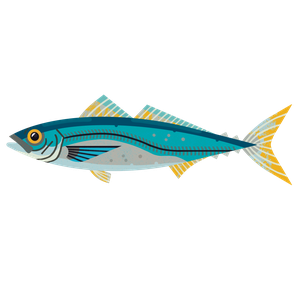
Chub mackerel
Scomber japonicus
What to check for
Location
Pacific Northwest: Japan EEZ & North Pacific Fisheries Commission (NPFC)
Technical location
61 - Pacific, Northwest, China, Japan
Caught by
Net (purse seine or ring)
Rating summary
There is concern for both the biomass and fishing pressure on the chub mackerel stock in the North Pacific. This species has a medium resilience to fishing pressure. Few appropriate managements measures exist for Japanese vessels targeting this chub mackerel stock. Most catches occur within Japan’s national waters, where no fishing days and a ban on fish aggregating lights are in place. However, the lack of coordinated management between national waters and the NPFC Convention Area creates uncertainty around the effectiveness of these measures, and the stock status remains a concern. Chub mackerel in this area is caught by purse seiners, which have minimal habitat impacts. Although available data suggests low levels of non-target bycatch, there is concern for increasing pressure on other species within this mixed fishery, and their potential overexploitation.
How we worked out this Rating
Stock status
The size and health of a fish population, or 'stock', that is being targeted by fishermen is a crucial indicator of whether a fishery is sustainable. If the stock is too small to withstand fishing, it is at risk of crashing. We look at how big the stock is, and how much pressure there is from fishing, to assess this. The target level that many fisheries aim for is 'Maximum Sustainable Yield' - the most fish that can be caught year after year whilst keeping the population at a healthy size.
There is concern for both the biomass and fishing pressure on the chub mackerel stock in the North Pacific. This species has a medium resilience to fishing pressure.The first stock assessment conducted by the North Pacific Fisheries Commission (NPFC) for chub mackerel was conducted in 2024. This assessment highlights recent changes in maturity-at-age and weight-at-age, which have made biological reference points highly variable and uncertain, reducing their reliability for assessing stock status. Although MSY-based reference points are provided, the Technical Working Group on Chub Mackerel Stock Assessment (TWG CMSA) does not recommend their use until more stable data is available. Consequently, Route 2 (data-limited) scoring has been applied for this rating, with chub mackerel considered to have medium resilience to fishing pressure.Spawning biomass (SSB) declined sharply from the 1970s to the 1990s, from an average of 1,104,000 tonnes to below 200,000 tonnes. SSB rose gradually from the early 2000s, reaching 750,000 tonnes in 2017, but has since fallen again to an estimated 454,000 tonnes in 2022. There is also concern for the spawners per recruit without fishing (SPR0). SPR0 increased from 250g to 400g between 1970 and 2005, then declined significantly after 2015, reaching a minimum of 150g in 2019 and remaining low through 2020-2023. The 2020-2022 average of 165g is roughly half that of the previous decade. These declines are linked to shifts in weight-at-age and delayed maturity. Although reference points should be interpreted cautiously, they reinforce these concerns - the 2022 SSB estimate (454,000 tonnes) is far below the estimated SSBMSY (2,905,000 tonnes). Overall, these biomass trends indicate a cause for concern.Fishing pressure and catches show similar fluctuations. Catches fell steeply from close to 900,000 tonnes in the late 1970s to under 100,000 tonnes in the early 1980s. Between 1990 and 2014, catches generally remained below 250,000 tonnes, before increasing to 516,000 tonnes in 2018, then declining again to 151,000 tonnes in 2023. Fishing mortality (F) peaked at approximately 1.1 in the late 1980s, but has declined to about 0.3 since 2010. Despite this reduction, projections based on the most recent seven years of data indicate that maintaining fishing pressure at the average 2020–2022 level would still lead to continued declines in SSB. Therefore, fishing pressure remains a concern for this stock.
Management
Good management is vital to be sure that fishing doesn't cause fish populations to decline. We look at whether regulations follow the best available scientific advice, how well compliance is monitored and enforced, and whether this is effective in maintaining healthy fish stocks.
Few appropriate managements measures exist for Japanese vessels targeting this chub mackerel stock. Most catches occur within Japan’s national waters, where no‑fishing days and a ban on fish‑aggregating lights are in place. However, the lack of coordinated management between national waters and the NPFC Convention Area creates uncertainty around the effectiveness of these measures, and the stock status remains a concern.This chub mackerel stock straddles the national waters of Japan and Russia, as well as the high‑seas Convention Area managed by the North Pacific Fisheries Commission (NPFC). Members of the Convention Area include China, Japan, the Republic of Korea, the Russian Federation, the United States, Canada, the EU, Chinese Taipei, and Vanuatu.The NPFC has established a new provisional annual Total Allowable Catch (TAC) for chub mackerel within the Convention Area. For 2025, the TAC is set at 66,740 tonnes, of which 58,800 tonnes may be taken by purse‑seiners, and 7,940 tonnes by trawlers. The EU is entitled to an additional 4,260 tonnes. The TAC represents a 9.57% reduction from the 2024 catch of 73,799 tonnes in the Convention Area. With this reduction, members are instructed to refrain from expanding the number of vessels targeting chub mackerel. For compliance with the provisional TAC, all members must report monthly catches electronically until 60% of the TAC is reached, after which reporting must shift to weekly.The Japanese chub mackerel fishery operates both within Japan’s national waters and in the NPFC Convention Area. More than half of Japan’s total chub mackerel catch is taken by purse‑seiners, and chub mackerel has made up an average of 86% of the country’s combined mackerel catch between 2014 and 2023. Despite this, Japan takes very little catch from within the Convention Area – just 1 tonne in 2024. The number of Japanese vessels authorised in the Convention Area has remained stable at 60-70 vessels between 2019 and 2024, however, activity levels are low, with only 4 of the 62 authorised vessels operating in 2024.Within its national waters, the number of active vessels has remain consistently between 52 and 60 vessels during 2019-2024. However, Japan’s catches have declined sharply, falling from over 300,000 tonnes in 2019 to just 78,487 tonnes in 2024. Chub mackerel is also a popular angling species in Japan.Alongside the management measures of the high seas Convention Area, Japan applies its own management within its national waters, including no fishing days and the ban on the use of fish aggregating lights. However, for management to be fully effective, it may need to account for the entire spatial distribution of the stock, including coordinated or joint‑management approaches among countries fishing both within national waters and in the high seas. This need is highlighted by the fact that, although chub mackerel showed signs of recovery in the early 2010s, the stock declined again once high‑seas fishing was permitted in subsequent years and management remained minimal.
Capture method
Environmental impacts of fishing vary hugely, depending on the method used and where it's happening. We look at whether the fishing gear being used could have an effect on seabed habitats, and if so, how severe might this be. We also review whether it catches any other species by accident (bycatch), and what effect this might have on those species - especially if they're Endangered, Threatened, or Protected.
Chub mackerel in this area is caught by purse seiners, which have minimal habitat impacts. Although available data suggests low levels of non-target bycatch, there is concern for increasing pressure on other species within this mixed fishery, and their potential overexploitation.Purse seines have minimal impact on the seabed as they operate in mid-water and do not contact the seafloor – unless an anchor is used in setting. The gear consists of a long wall of netting framed by floats on the top line and sinkers on the bottom. A strong cable passes through rings on the lower edge, which when hauled, closes the net into a ‘purse’, which prevents fish escaping downwards. Nets are typically set around a school of fish – making purse seining highly monospecific – or around Fish Aggregating Devices (FADs). Once the fish are crowded into the net, they are harvested with a brailer (smaller net).Although purse seining is largely monospecific, non-target species such as fish, seabirds, marine mammals, marine reptiles, and elasmobranchs may be caught by this gear type. Within the NPFC Convention Area, bycatch in the chub mackerel fishery includes blue mackerel, Japanese sardine, Pacific saury, and squids. The proportion of catches of neon flying squid and Pacific saury are very low, remaining below 2.1% and 0.3% respectively. In contrast, catches of Japanese sardine have increased since 2014, exceeding 250,000 tonnes in 2024. However, Japanese sardine is not incidental bycatch, instead it is actively targeted as part of a mixed fishery alongside chub and blue mackerel. There is currently no stock assessment for Japanese sardine available for within the NPFC Convention Area, and Japanese stock assessments indicate overfishing. Therefore, there is concern for the possible overexploitation of species within this high demand mixed fishery.Data collection on bycatch of this mixed fishery has begun to improve in recent years, but overall remains limited. In 2024, there were also reports of several sharks and turtles being released from purse‑seine and trawl fisheries operating within the NPFC Convention Area.To improve monitoring and reporting of fishing activity, MCS would like to see remote electronic monitoring (REM) with cameras implemented, used and enforced.
References
Froese, R., Pauly, D. 2025. FishBase: Scomber japonicus, chub mackerel. Available at: Scomber japonicus, Chub mackerel : fisheries, aquaculture, gamefish, bait [Accessed on 12.01.2026]
Hong, J.B., Kim, D.Y. and Kim, D.H., 2022. Stock assessment of chub mackerel (Scomber japonicus) in the Northwest Pacific Ocean based on catch and resilience data. Sustainability, 15(1), p.358. [Accessed on 12.01.2026]
NPFC, 2025. Stock assessment report for chub mackerel. Available at: Stock assessment report for chub mackerel.pdf [Accessed on 12.01.2026]
NPFC, 2025. CONSERVATION AND MANAGEMENT MEASURE FOR CHUB MACKEREL. Available at: CMM 2025-07 For Chub Mackerel.pdf [Accessed on 12.01.2026]
NPFC, 2025. Information paper submitted by the Secretariat. NPFC 2024 Fisheries Overview. Available at: Microsoft Word - NPFC-2025-TCC08-IP01 Rev.3 Fisheries Overview.docx [Accessed on 14.01.2026]
NPFC, 2025. AMENDMENTS TO CMM 2024-07 for CHUB MACKEREL. Available at: NPFC-2025-COM09-WP04 CMM 2024-07 for Chub Mackerel By Japan.pdf [Accessed on 14.01.2026]
NPFC, 2025. Data description on fisheries bycatch in the chub mackerel fisheries in China. Available at: NPFC-2025-TWG CMSA11-IP06 Data description on fisheries bycatch in the chub mackerel fisheries in China.pdf [Accessed on 19.01.2026]
NPFC, 2025. CONSERVATION AND MANAGEMENT MEASURE FOR JAPANESE SARDINE, NEON FLYING SQUID AND JAPANESE FLYING SQUID. Available at: CMM 2025-11_For Japanese Sardine, Neon Flying Squid and Japane.pdf [Accessed on 19.01.2026]
NPFC, 2025. Species summary for chub mackerel. Available at: Chub Mackerel 2026.pdf [Accessed on 12.01.2026]
NPFC, 2025. Species Summary for Japanese Sardine. Available at: Japanese Sardine 2026.pdf [Accessed on 19.01.2026]
NPFC, 2025. Species Summary for Pacific Saury. Available at: Pacific Saury 2026.pdf [Accessed on 19.01.2026]
NPFC, 2024. North Pacific Fisheries Commission 9th Meeting of the Technical Working Group on Chub Mackerel Stock Assessment 17–20 July 2024 Yokohama, Japan (Hybrid). Available at: TWG CMSA09 Report.pdf [Accessed on 12.01.2026]
NPFC. The North Pacific Fisheries Commission (NPFC). Available at: The North Pacific Fisheries Commission (NPFC) | NPFC [Accessed on 14.01.2026]
NPFC. Convention & NPFC Area of Application. Available at: Convention & NPFC Area of Application | NPFC [Accessed on 19.01.2026]
Seafish, 2025. Purse Seine. Available at: PS - Purse Seine | Seafish [Accessed on 19.01.2026]
Sustainable swaps
Learn more about how we calculate our sustainability ratings.
How our ratings work
Add impact to your inbox
Join the movement: get updates on the issues you care about.
We'll email you inspiring stories about the work we're doing to save and recover our oceans, and news about our urgent campaigns for positive change.

