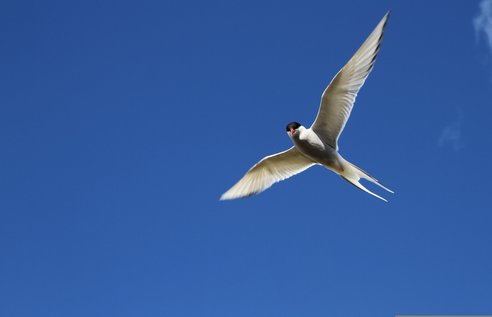
Arctic tern
Sterna paradisaea
IUCN Status:Least Concern
Travelling huge distances to breed on British shores, the Arctic tern's swallow-like streamers makes them easy to identify.
What do they look like?
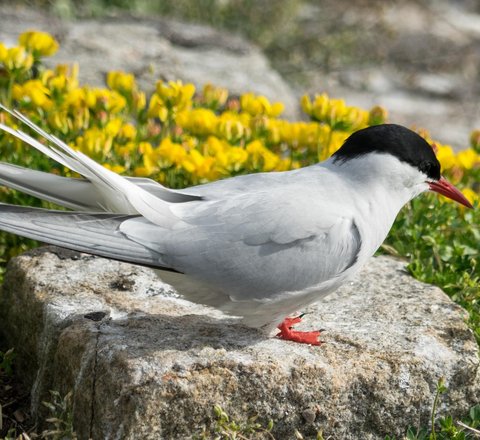
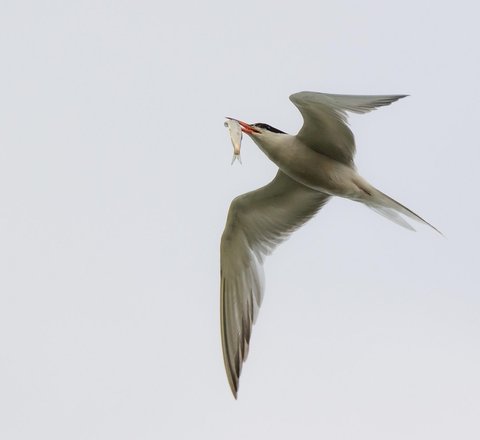
The Arctic tern is a graceful, swallow‑like seabird, instantly recognisable by its sleek white body, jet‑black cap, and bright red bill. It has long, elegant tail streamers that trail behind it as it glides over the waves. When hunting, the tern hovers briefly before diving sharply from the air, snatching small fish from just beneath the ocean’s surface with remarkable precision.
Where can they be found?
Predominantly visiting coasts in the north and west of the UK during the summer (April - September), but uses most UK coastline for migration, with a few resident populations in the Humber and Severn areas.
Did you know... The average lifespan is 13.4 years, but the oldest recorded Arctic tern was a whopping 31 years and 18 days old!
Key facts
Often celebrated as the ultimate long‑distance traveller, the Arctic tern undertakes one of the most extraordinary migrations in the natural world. Each year, these birds journey from the UK all the way to the Antarctic and back again. They arrive on British shores to breed in April and depart again by September, embarking on a round‑trip that can span 44,000 to an astonishing 59,000 miles. Over a lifetime, an Arctic tern may fly the equivalent distance of travelling to the Moon and back several times!
During the breeding season, Arctic terns nest in colonies, often on open shingle or grassy coastal areas. A typical clutch contains one to two eggs, which are carefully incubated for around 24 days. Both parents share the responsibility of warming the eggs and later feeding the chicks, which grow rapidly. Despite their delicate appearance, Arctic terns are fiercely protective of their nests and will readily dive‑bomb intruders, including humans, to defend their young.
| IUCN status | Least Concern |
|---|---|
| Size | 32-35cm with a 75-86cm wingspan |
| Weight | 95-125g |
| Speed and distance | They undertake a yearly round‑trip from the UK to the Antarctic - spanning 44,000 to an astonishing 59,000 miles. |
| Habitat | Open ocean, mudflats, sandy beaches, onland |
| Diet | Small fish such as sandeels, sprat and herring, small crustaceans such as prawns and land-based insects form the diet of the Arctic tern. |
| Age lifespan | These birds have an average age of 13 years - pretty impressive for a bird! |