Blue shark
Prionace glauca
IUCN Status:Not Evaluated
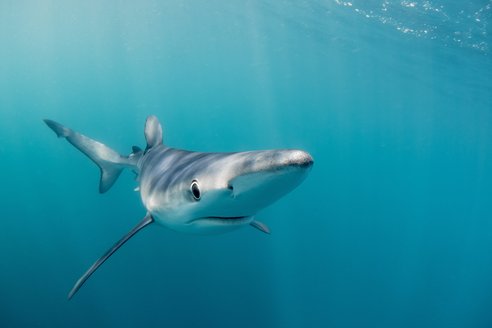
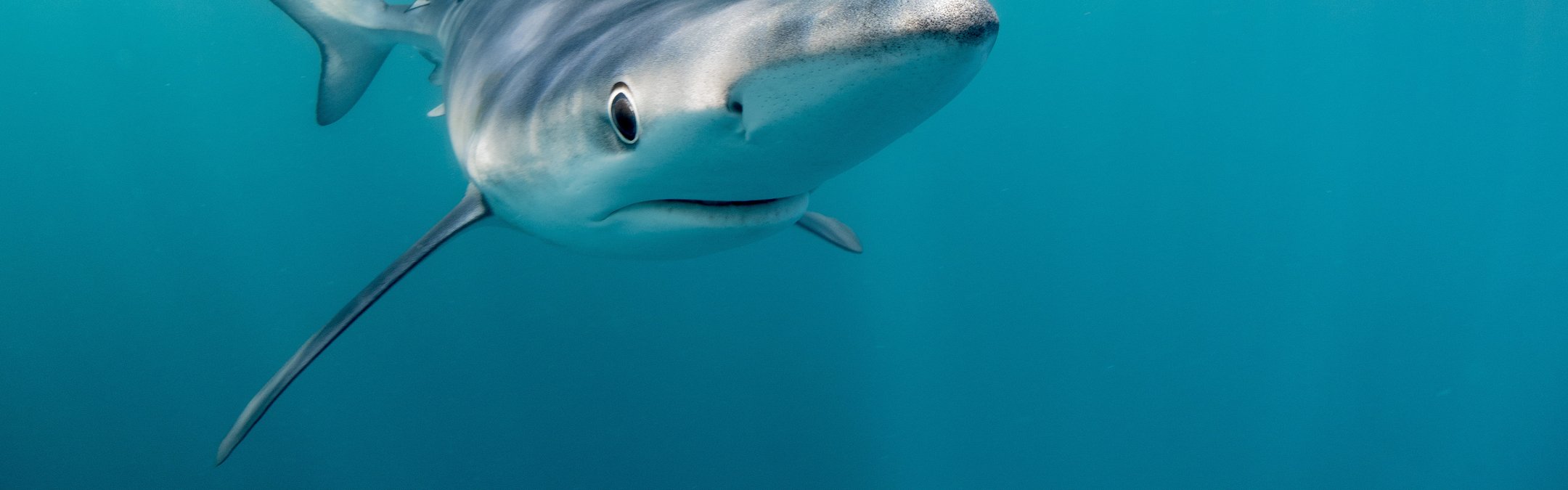
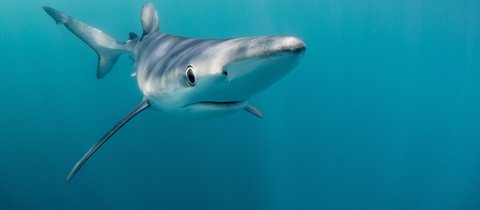
A wonderful example of 'counter shading', blue sharks are a summer Cornwall and Wales visitor.
What do they look like?
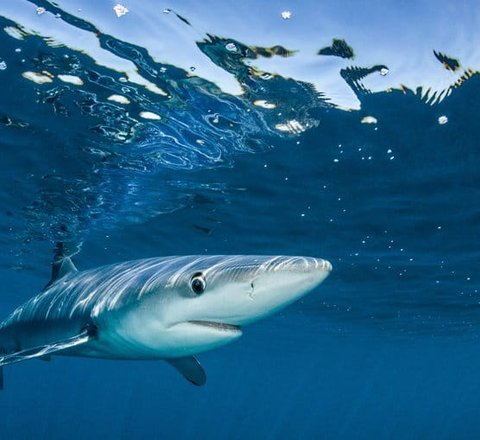
Perhaps one of the sleekest sharks, identify a blue shark by their slim, streamlined bodies with a pointed nose, long pectoral (front) fin and beautiful bright blue colouring on top with white underneath. This colouring is called counter-shading and ensures the shark is well concealed from above and below.
Where can they be found?
Visiting the UK in the summer months (June-October), blue sharks usually congregate off the southwest of England (Cornwall and Devon) and the Pembrokeshire coast in Wales. They can typically be seen 10 miles offshore where they prefer the deeper, cooler water.
They can be found worldwide and follow a clockwise migratory pattern, following the Gulf Stream from the Caribbean to the UK and back following the Atlantic North Equatorial current.
Did you know... Blue sharks give birth to large numbers of live pups – typically 35 per litter but sometimes over 100. Sadly, they are fished for their meat across the globe, so the fact they are only ‘near threatened’ is due to these large broods.
Key facts
Blue sharks are highly migratory and, each year, they make huge trans-Atlantic migrations, visiting the British Isles during the summer – offshore from Penzance is a key place to spot them. They will often travel distances of more than 5,000 miles in a single trip!
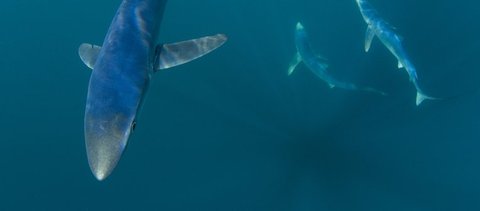
These sharks are one of the few types that migrate in a ‘school’ or large group. Interestingly, there is often a hierarchy with these schools, and they can be segregated by size or sex. Sometimes, groups of all females or all males pair up in a school.
Smaller blue sharks are sometimes prey for other larger sharks like the great white or the tiger shark (these two have not yet been spotted in UK waters).
| IUCN status | Not Evaluated |
|---|---|
| Threats | It’s estimated 100 million sharks are killed every year worldwide because of unsustainable fishing practices, shark finning, overfishing and habitat destruction. If this continues, we are in danger of losing many shark species forever. |
| Length | Females are larger and can range from 2.2 -3.3 metres, while males typically reach 1.8-2.8 metres. |
| Weight | 27-90 KG for adults, with females heavier at up to 182 KG. The verified record is 240KG. |
| Speed and distance | Highly migratory, often reaching over 5,000 miles in a single trip. |
| Habitat | Open ocean, deeper, cooler seas |
| Diet | Blue sharks will eat bony fish such as herring and mackerel, and also enjoy squid. Sometimes, they may even eat seabirds and larger fish such as cod. |
| Age lifespan | Their exact lifespan is unknown, but it is thought to be up to 20 years. |