Common starfish
Asterias rubens
IUCN Status:Not Evaluated
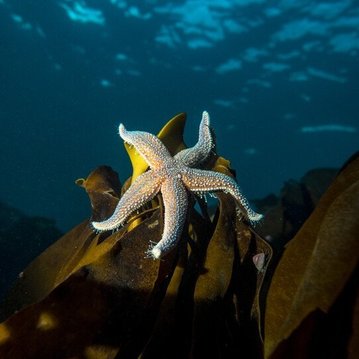
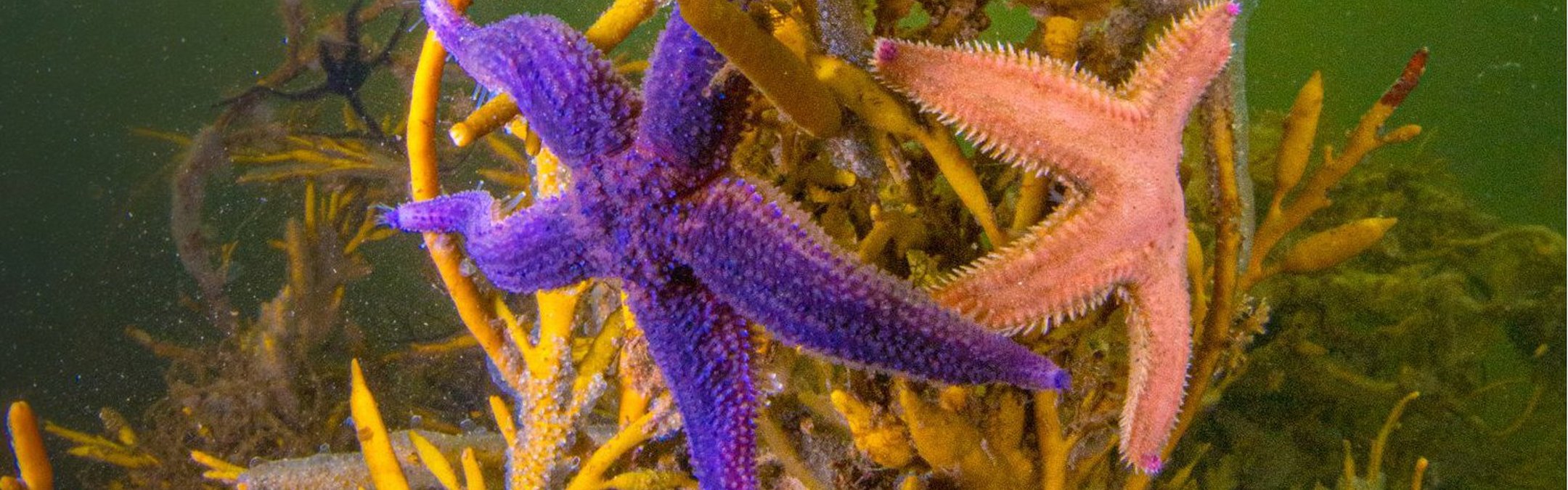
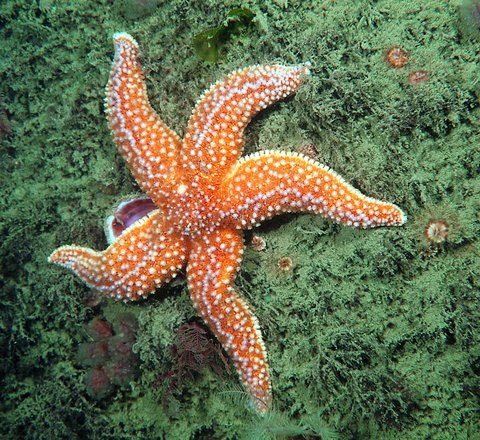
The common starfish is a widely recognised seaside species with its five-armed shape, and typical orange colour. However, the starfish that we often see on our beaches and rockpools can also be found in the sea up to around 600 metres deep – that’s approximately the same as 6.5 football pitches in length or just under double the height of the Shard in London!
What do they look like?
Though you might assume common starfish are flat on the bottom, they actually have thousands of tiny tubes which, when they push water out of them, can help them move around or stick onto rocks. These 'feet' are actually quite flexible in what they can do, with starfish being able to right themselves back up if they end up upside down.
Where can they be found?
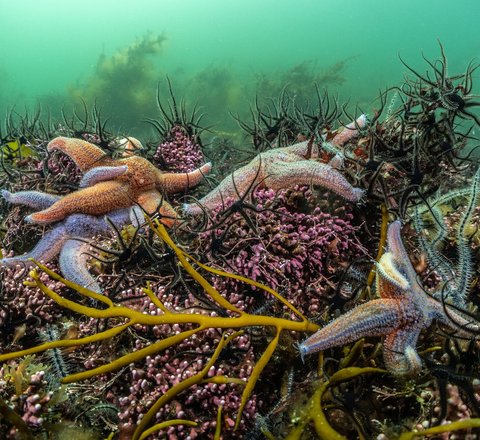
Common starfish can be found on the lower shore, all around the UK.
Did you know... The common starfish has eyes on each of its arms. However, because it has no brain, these eyes only process light and dark as well as movement. This means their eyes are limited to generally only help find shade, reefs and avoid predators. They rely on their keen sense of smell through chemical receptors in their skin and feet to find prey.
Key facts
The common starfish is a master of thriving in both high-pressure deep sea environments as well as low-pressure rockpools because it pumps seawater through its body instead of blood and does not have any internal air pockets. This means their internal pressure matches the external pressure which prevents them from being crushed.
Like most echinoderms, the common starfish can regenerate their lost limbs. They often purposefully detach their limbs as a way to escape predators much faster than them. It's actually possible for a detached arm to regenerate into an entirely new, genetically identical starfish if a part of the central nerve system or ‘central disk’ is attached.
If you see a common starfish while rockpooling, please try not to touch or pick it up as this can lead to them dying from stress or, if taken out of the water, carbon dioxide poisoning.
| IUCN status | Not Evaluated |
|---|---|
| Size | Up to 52 cm in diameter, but most grow between 10-30 cm. |
| Weight | They can weigh up to 5kg, however the majority are much lighter. Usually they weigh between 30g and 90g. |
| Speed | The common starfish is a slow creeper rather than a fast swimmer. Because of its diet of stationary shellfish and slower moving prey, and its escape tactic from predators, it does not need to move that fast. It's thought to move no more than 67 centimetres per minute. However, a video captured in Sussex in 2016 showed these starfish curling up into balls and letting strong currents roll them along the seabed so they can travel much faster to new areas. This phenomenon has come to be known as 'starballing'. |
| Lifespan | In the wild, common starfish can live up to a decade, but on average they live between 7 to 8 years. |
| Habitat | Rocky shores, seabeds and rock pools. |
| Diet | The common starfish is a voracious carnivore that prizes open its mussel prey with its arms and secretes digestive juices onto its unfortunate meal. They'll push their stomach out and insert it into the shell of the prey, releasing digestive enzymes before retracting it back into their bodies. This dissolving method can take up from a few hours to days. Because of their love for bivalves, common starfish can become a pest to the aquaculture industry by snacking on farmed oyster and mussel beds. |