Portuguese man o' war
Physalia physalis
IUCN Status:Not Evaluated
Named after an old naval ship, this jellyfish wannabe looks pretty but has a very painful sting.
What do they look like?
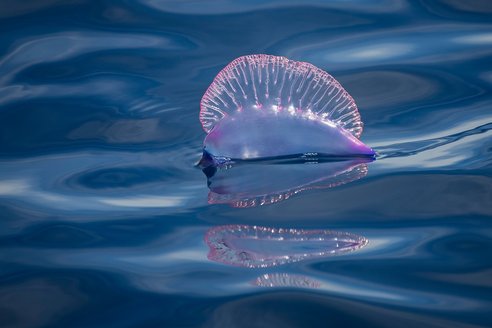
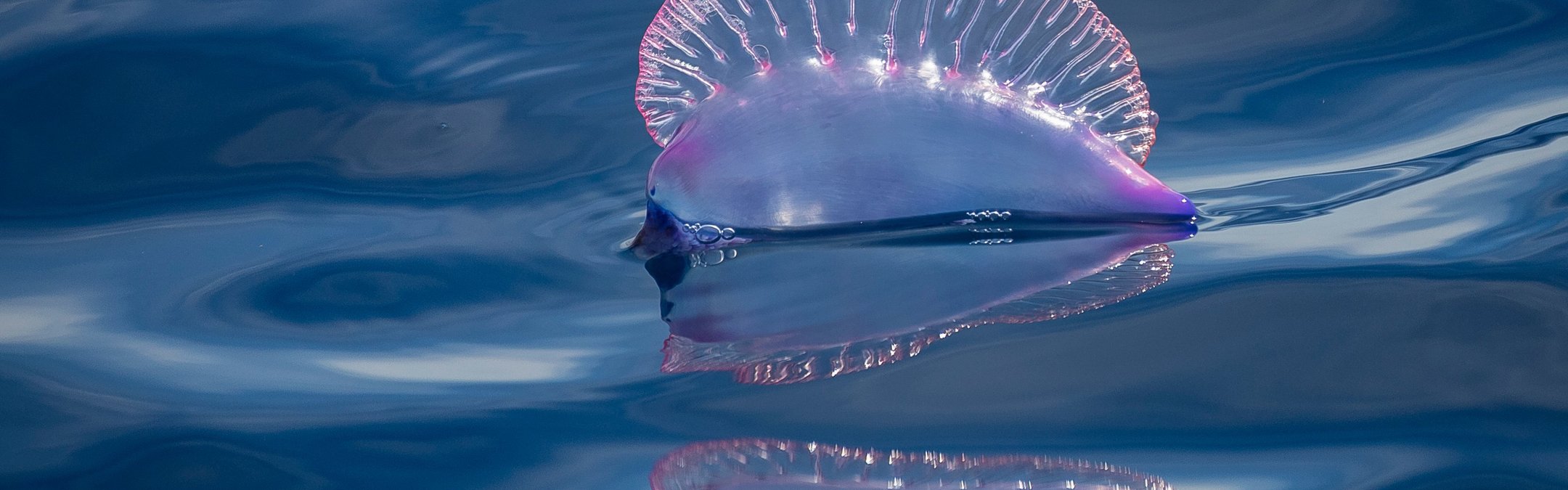
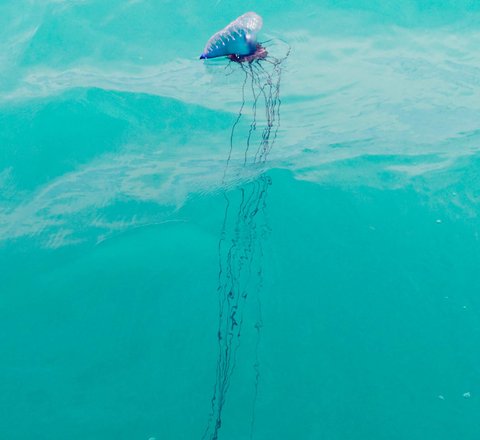
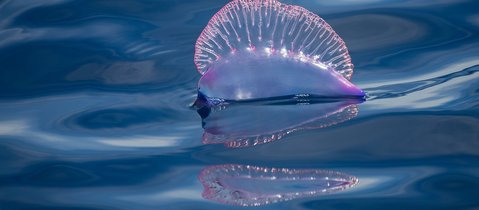
The Portuguese man o' war has a distinctive blueish purple float, or polyp, which can reach up to 30cm. It sits above the water like a sail, filled with gases such as carbon monoxide, oxygen and argon. Below the surface, the Portuguese man o' war has long venomous tentacles that can trail for over 30 metres which are used to snare fish and other small prey.
Where can they be found?
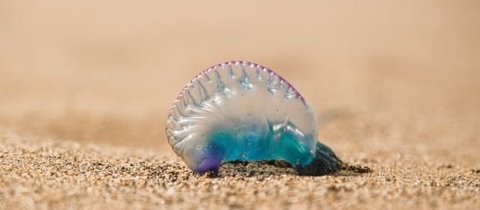
They are often found on the open ocean of the Atlantic, Indian and Pacific Oceans. They are occasionally washed onto UK and Irish shores after strong westerly winds where most pople see them.
Did you know... Marine creatures have learned to turn the Portuguese man o’ war’s powerful sting into a defence of their own. The blanket octopus will tear off the man o’ war’s tentacles and wield them like a venomous whip, using the stolen stingers as weapons. Meanwhile, the blue sea dragon sea slug eats the tentacles and stores the man o’ war’s stinging cells inside its own body, making itself even more dangerous than the creature it feeds on.
Key facts
Named after the 15th-century battleship because of how it looks at full sail, the Portuguese man o’ war is a striking open‑ocean drifter, often mistaken for a jellyfish but is actually made up of specialised animals that function together as a single organism. This floating colony is known as a siphonophore and is formed from four distinct types of tiny, specialised animals that remain permanently connected, each performing a vital role.
Though it has several creatures acting as one, it is actually at the mercy of the wind and ocean currents. These beautiful but dangerous drifters sometimes wash up on UK shores after strong westerly winds, and their tentacles can still deliver a painful sting even after death.
| Also known as | Blue bottles |
|---|---|
| IUCN status | Not Evaluated |
| Diet | It captures small fish using its tentacles (which stick to them) and injects a paralysing toxin. The tentacles will then pull the food up toward the main body where digestive polyps secrete enzymes to melt the food, then absorb it. Because the Portuguese man o'war is a colony, all the parts share the food so the whole creature gets fed. |
| Length | Though the float or sail can only grow up to the size of a regular ruler (30cms), the tentacles under the water can grow up to an astounding 50 metres. That’s longer than a blue whale! |
| Weight | The Portuguese man o' war is remarkably light since its sail is filled with gas so it floats on the water. They usually only weigh between 0.1-0.5kgs. |
| Speed and distance | They rely entirely on the wind and waves to move so they don’t usually travel very fast at all. If there are extremely strong winds, they will travel faster but in general they travel around 1-4km/h |
| Lifespan | Scientists have struggled to research how old Portuguese man o' war's can get as they are a colony of different species which can die and be replaced. However it is estimated they live for approximately a year before the colony becomes too weak and begins to break down. |