Risso's dolphin
Grampus griseus
IUCN Status:Least Concern
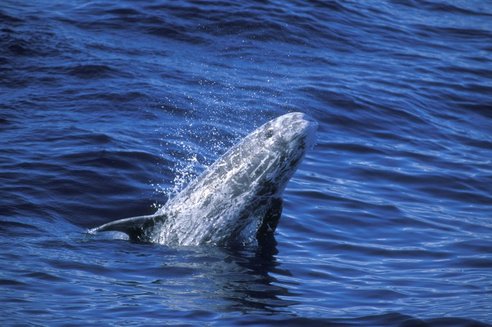
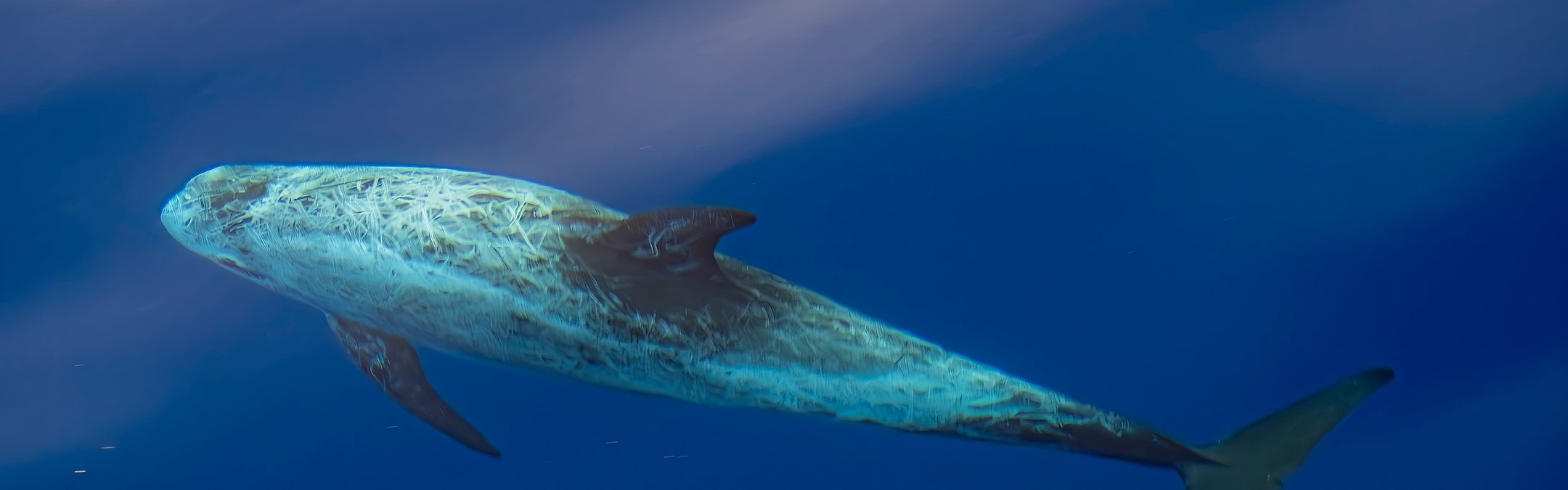
The Risso's dolphin is an easily identifiable dolphin because of its scars - inflicted as part of social bonding and by their prey. As deep sea diving experts, they provide an important indicator of the health and productivity of Britain’s deeper marine ecosystems.
What do they look like?
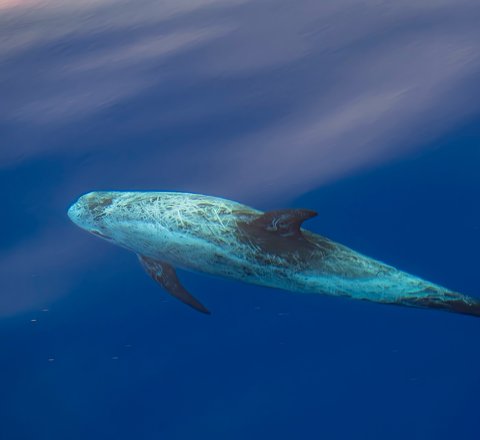
Named after the French-Italian naturalist Antoine Risso who wrote about them in the 1800s, this dolphin is most easily identified by its heavily scarred body and blunt, rounded head. Risso’s dolphin’s lack thick blubber and their skin becomes paler as they age, meaning their scars are much more noticeable as they get older.
Where can they be found?
In the UK, Risso’s dolphins are often spotted around the Hebrides, Ramsey Island in Wales, and Cornwall. In Ireland, they favour inshore waters and offshore islands and can be found off the Saltee Islands in Wexford, the Cork coast and the Blasket Islands in Kerry during the summer. Best seen from a sailing boat, off West Scotland or South West England.
Most records of Risso’s Dolphins in Britain and Ireland are within 11 km of the coast.
Did you know... Although it shares some properties with other types of dolphin, it's actually the sole member of its own group, meaning no other species shares their full set of unique traits.
Key facts
The majority of their scars are caused by other Risso’s dolphins. They inflict these scars through teeth raking (deep scratches using teeth) for a number of reasons, including play and for social dominance. In fact, these dolphins primarily use their teeth for this rather than for eating. They only have 2-7 pairs of teeth which are all found in their lower jaw which makes them unique to other dolphins. Occasionally, there are also 1-2 vestigial teeth on the upper jaw. They'll generally try to suck up their favourite prey - squid and octopus - whole, but this also allows its prey to put up quite a fight with their beaks and tentacles, further scarring the dolphin.
Risso’s dolphins prefer areas with steep underwater drop-offs, where deep water squid can be found in abundance. They're more stocky and comparatively slow-swimming compared to other dolphin species and will travel in small pods between 10-30 members. They're expert deep divers that can reach depths of over 500m deep. That’s deeper than a human can dive even with scuba equipment!
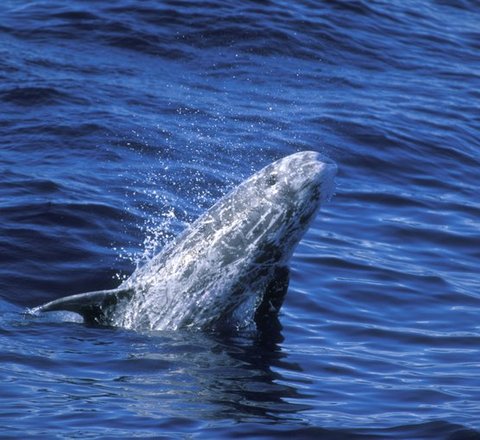
Although they tend to hunt at night, Risso’s dolphins can also be seen during the day, engaging in behaviours like spy-hopping (raising their heads above water) or leaping from the sea. They may do this for a number of reasons, including looking for seabirds, to pinpoint fruitful feeding opportunities, to assess where they are, or simply to be curious of what’s happening above the water.
Though they're classed as a species of least concern within the IUCN Red List, there are no estimates of how many there are globally. It's thought that some populations around the world have declined such as in the Northern Gulf of Mexico as well as around Sri Lanka. Though there are no specific population estimates for the UK, there are approximately just over 11,000 Risso's dolphins along the European continental shelf, with North West Scotland and the East of Ireland seeing a high density.
| Also known as | Grampus |
|---|---|
| IUCN status | Least Concern |
| Diet | Risso's dolphins mainly feed on deep sea cephalopods such as squid, cuttlefish and octopus. They will often take advantage of the night when these species migrate upwards to the surface to feed. They've also been known to eat krill too. |
| Length | Between 2.5 to 4m long (the same as bottlenose dolphins). They're a little larger than more widely recognised dolphin species such as the common (short-beaked) dolphin and one of the largest regularly seen in the UK. |
| Weight | They usually weigh between 300-500kgs. Males are larger than females. |
| Speed and distance | Risso's have a cruising speed of around 4-12 km/h making them slower than other dolphin species. However, they've been observed performing a unique dive strategy called a spin dive where they jump out of the sea and spin before 'drilling' through the ocean to reach deep depths rapidly. Using this dive, they can travel an average of 178 metres at a speed of 7 km/h. Unlike some dolphin species, Risso's arent known for long-distance seasonal migrations as they don't need to. Their favourite prey remains in the same area year-round. |
| Lifespan | At least 35 years |