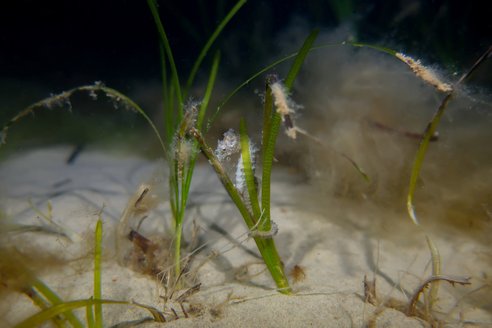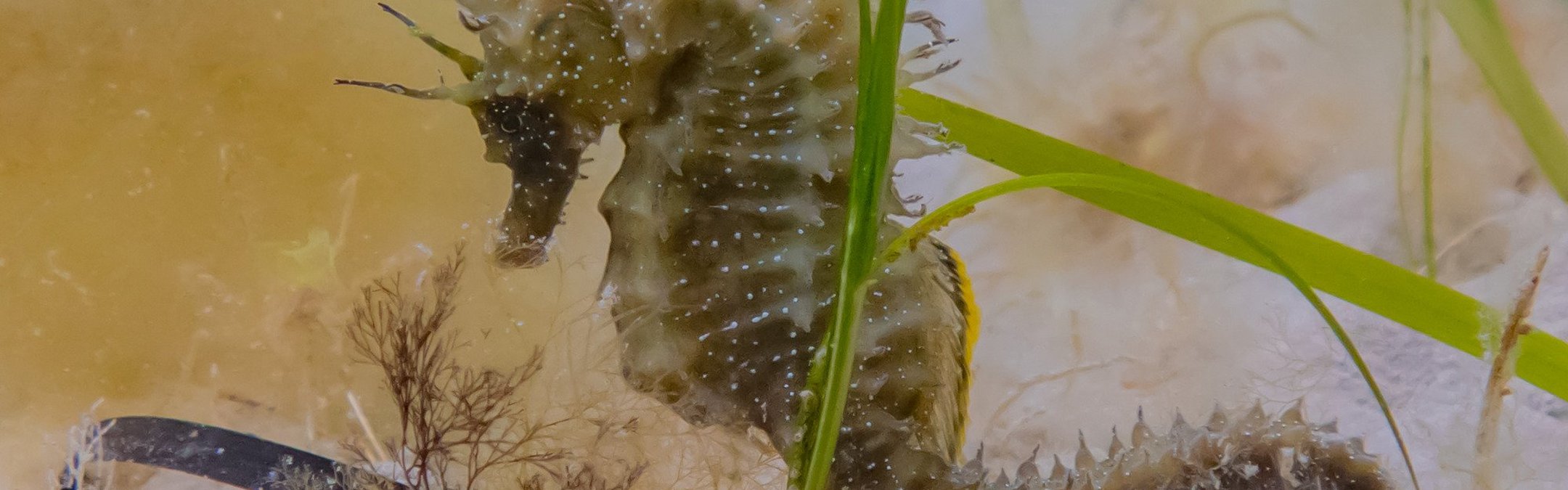
Spiny seahorse (long-snouted)
Hippocampus guttulatus
IUCN Status:Data Deficient
A beautiful sight to behold if you're lucky enough and a species that relies on seagrass - a major focus of our regeneration projects.
What do they look like?
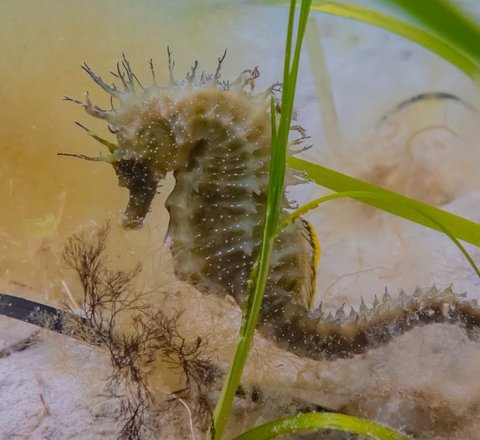
A cute, unmistakable fish. Yellow to green in colour, with prominent soft spines. Its long snout is used to suck up small crustaceans and its tail helps it cling to seagrass.
Where can they be found?
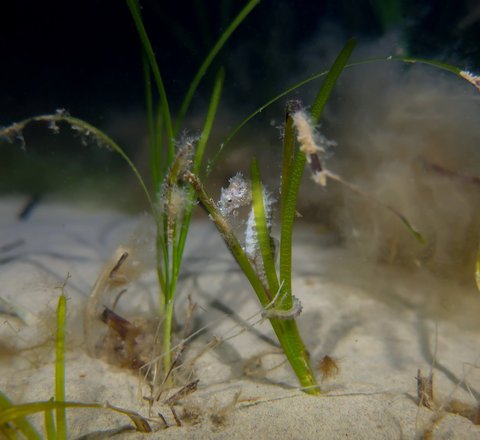
Amongst seagrass on the south coast of England. Rare and one of only two seahorses found in the UK (the short-snouted seahorse is the other).
Did you know... Seahorses don't have stomachs, so food passes through their bodies very quickly. An adult eats 30-50 times a day while seahorse fry (baby seahorses) eat an incredible 3,000 pieces of food per day!
Key facts
It's the male seahorse that becomes pregnant - they fertilise and look after the eggs in a pouch and can carry up to 2000 babies at a time.
Spiny seahorses can change colour to match their environment.
| IUCN status | Data Deficient |
|---|---|
| Length | Typically 12–15 cm (about 5–6 in). Maximum up to 21.5 cm. |
| Weight | They are very light so no accurate data exists. |
| Speed and distance | Poor swimmers; drift or anchor themselves to seagrass with their prehensile tail. |
| Habitat | Sub-tidal |
| Diet | Carnivorous: eats small crustaceans, larvae, fish eggs, and other planktonic organisms. |
| Lifespan | Around 6 years in the wild. |
| Threats | Seagrass is an essential habitat, breeding and hunting ground for seahorses and we have lost over 90% of our seagrass meadows in the UK in the last century. Through our ambitious regeneration projects we are restoring meadows across the south and Atlantic coasts. |