

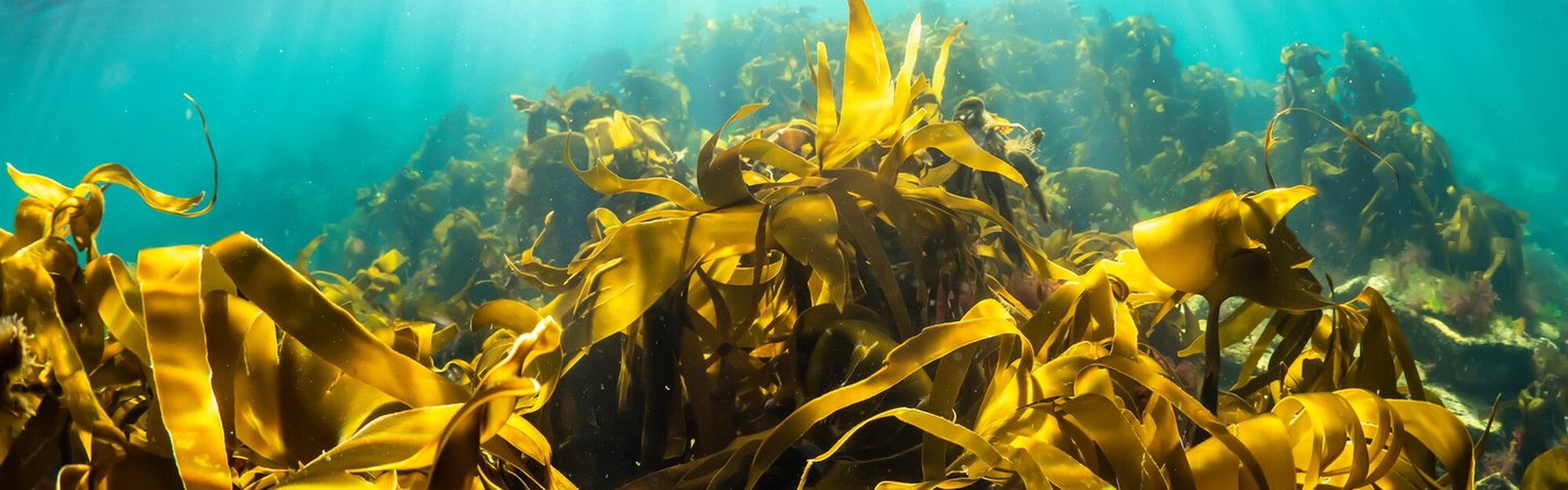
Meet the seaweed types

There are over 650 species of seaweed found around the UK and we’re on the lookout for 14 of them for The Natural History Museum and Marine Conservation Society's Big Seaweed Search.

    Why these 14 specifically?
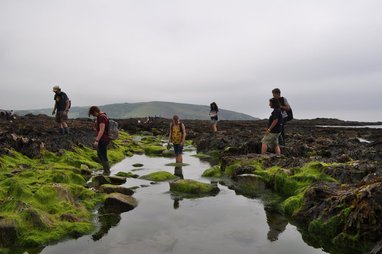
    The Big Seaweed search is a citizen science project that encourages you head to the coast and record the presence of 14 key seaweed species around the UK, contributing to scientific research on the impacts of environmental changes, such as rising sea temperatures and ocean acidification.

    The 14 species were chosen because they're good indicator species – a species whose presence, absence or abundance reflects a specific environmental factor. Indicator species can mark a change in the condition of an ecosystem.

    We've split the species into three groups to highlight the environmental change they indicate.

    A group of people participating in a Big Seaweed Search. They are exploring a rocky intertidal zone covered in bright green seaweed, with some individuals standing in shallow pools of water. Green hills are visible in the background under an overcast sky.

    A volunteer group looking for seaweed at Wembury, England  |  Image credit: Anna Holt

    Rising sea temperature

    UK sea temperatures have risen 2°C in the past 40 years. Research suggests that cold water seaweeds are moving further north where it's cooler, while the range of warm water species is expanding.

    These are 8 species which we are interested in that may respond to temperature change:
    Dabberlocks

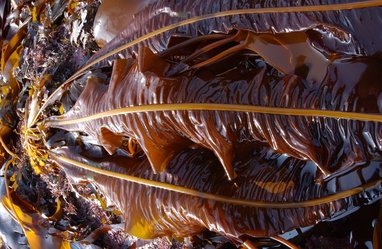
    Dabberlocks (Alaria esculenta) is a long, brown seaweed that’s easy to confuse with sugar kelp or wakame, but you can tell the difference from its structure.

    It has a strong, obvious midrib running the full length of the frond, which makes the blade twist and wrinkle rather than lie flat. At the base, it produces narrow, finger‑like side blades that form a small cluster around the holdfast.

    Dabberlocks grows on the lower shore in wave‑exposed areas, usually staying close to the sea, where its tough, rippled fronds can handle constant movement.

    Dabberlock seaweed  |  Image credit: Mike Guiry
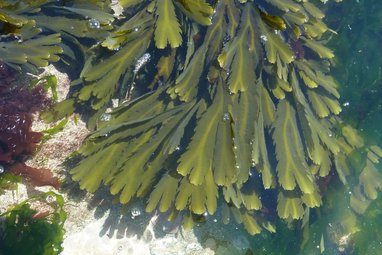
    Sugar kelp

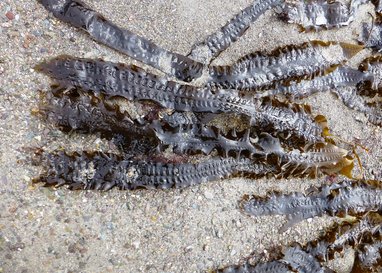
    Sugar kelp (Saccharina latissima) can be confused with dabberlocks and wakame. It is a broad, golden‑brown seaweed with a long, flat blade. Its most distinguishing feature is that it has no central midrib.

    The frond is usually smooth and flexible, with a gentle crinkling texture. When stretched out, the blade forms a single continuous ribbon that narrows slightly where it meets the short stipe.

    It grows on the lower shore and into the shallow subtidal zone, favouring cool, nutrient‑rich water and moderately sheltered conditions. Its long, flowing fronds move easily with the tide, making sugar kelp one of the most visible and recognisable seaweeds in clear coastal shallows.

    Sugar kelp  |  Image credit: Keith Hiscock
    Did you know: Sugar kelp is often farmed at sea. The natural gels and minerals it contains make it valuable in cosmetics, where it’s used for skin‑soothing and moisturising products. It’s also dried and processed for animal feed, adding nutrients to livestock diets.

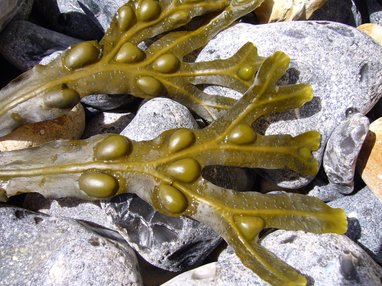
    Serrated wrack

    Serrated wrack (Fucus serratus) is a mid‑ to lower‑shore brown seaweed, usually olive‑brown but sometimes yellow‑green. Its most distinctive feature is the clean, saw‑toothed edge of each frond. The blades are flat, tough, and leathery, branching from a short stipe, and unlike bladderwrack or knotted wrack, it has no air bladders, giving it a heavier, more grounded appearance on the rocks.

    It grows in dense bands on moderately sheltered shores, often just below where bladderwrack is found. Since it spends much of the tidal cycle submerged, it often looks glossy and wet even at low tide. Once you recognise the sharp serrations and the absence of bladders, serrated wrack becomes one of the easiest rocky‑shore seaweeds to identify.

    Serrated wrack  |  Image credit: Keith Hiscock
    Bladderwrack

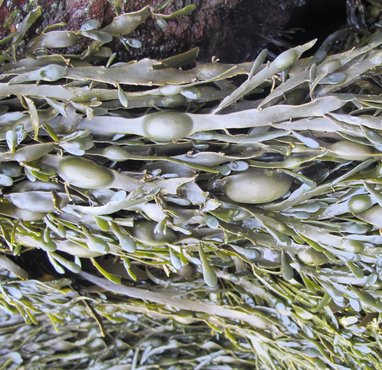
    Bladderwrack (Fucus vesiculosus) fronds are smooth, forked, and olive‑brown. Each segment has a pair of round air bladders that look like small bubbles. These bladders help the seaweed float when submerged, lifting the fronds toward the light so they can photosynthesise more effectively at the water’s surface.

    It grows in a broad band across the mid‑shore, the zone that’s covered and uncovered by every tide. The fronds are tough and slightly glossy, branching from a short stipe and forming dense mats over the rocks. Because bladderwrack is exposed and submerged twice daily, it’s well adapted to shifting conditions and is able to cope with drying, wave action, and changes in salinity.

    Bladderwrack  |  Image credit: Lucy Robinson
    Knotted wrack

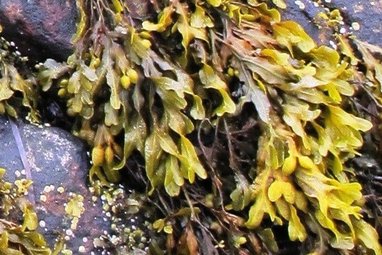
    Knotted wrack (Ascophyllum nodosum) is easy to identify by its long, rope‑like fronds and can be distinguished from bladderwrack by its single large, evenly spaced air bladders that run along their length. Each bladder sits on its own, never in pairs, and gives the seaweed a beaded or “knotted” appearance. The fronds are smooth, olive‑brown, and can grow very long, often forming thick, trailing bundles that drape over rocks.

    It grows in the mid‑shore, usually in more sheltered areas than bladderwrack, forming dense, tangled stands that dominate whole stretches of coastline. Because the fronds are tough and flexible, they withstand constant movement without tearing, and the solitary bladders help lift them toward the light during high tide.

    Knotted wrack  |  Image credit: Juliet Brodie
    Did you know: Tiny red seaweeds often hitch a ride on larger brown seaweeds like knotted wrack. The most common is Polysiphonia, a delicate, hair‑like red alga that forms wispy tufts on the fronds. It doesn’t harm its host though, it simply uses the wrack as a stable platform in the shifting tides.

    Spiral wrack

    As its name suggests, spiral wrack (Fucus spiralis) fronds often have a slight twist to them, especially near the tips giving them a subtle corkscrew look. The fronds are flat, forked, and olive‑brown with a clear midrib, and may have small, single goo-filled bladders scattered along their length.

    Because it spends long periods exposed to the air, it’s tougher and drier than lower‑shore wracks, and the fronds can look slightly shrunken or curled at low tide.

    Spiral wrack  |  Image credit: Juliet Brodie
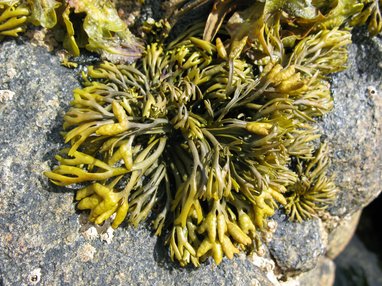
    Channelled wrack

    Channelled wrack (Pelvetia canaliculata) has a distinctive shape and texture. Its fronds are narrow, tough, and deeply grooved, with a long channel running right down the centre as if it has been folded lengthways. This continuous groove is the key feature that sets it apart from all other wracks.

    The fronds are usually dark olive‑brown to almost black, especially when dry. The end of each branch is evenly forked. Because channelled wrack lives very high on the shore, it spends long periods exposed to the air. As a result, the fronds often look dry, wiry, and slightly curled at low tide.

    Channelled wrack  |  Image credit: Juliet Brodie
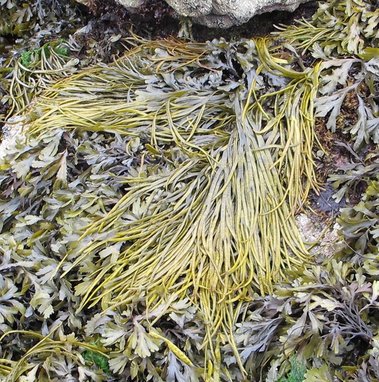
    Thongweed

    Thongweed (Himanthalia elongata) is easy to recognise due to its unusual structure. The main body of the plant is actually a small, button‑like disc attached firmly to the rock. This round, leathery button is the holdfast and reproductive organ, and it’s the first thing to look for when identifying the species.

    From this button, two long, flat strap‑like fronds grow. These ribbons can reach 1–2 metres in length and often split into multiple straps as they mature. They’re smooth, flexible, and olive‑brown, becoming darker and tougher with age. Because thongweed grows on the lower shore, the straps usually lie draped across rocks or float freely when the tide comes in.

    Thongweed  |  Image credit: Juliet Brodie

    Did you know: No other common seaweed has the distinctive button‑and‑strap form that thongweed has, making it one of the most recognisable species on the lower shore.

    Non-native species

    Non-native species are those that wouldn’t normally be found in the UK. They've found their way to our seas - mostly due to human activity - and settled here. They can outcompete other native species for food, light or space, forcing them to move or die out altogether.
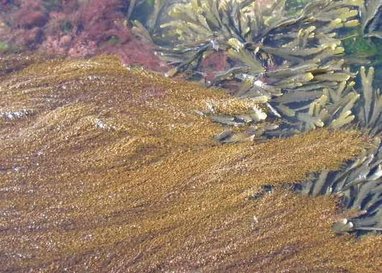
    Wireweed

    Wireweed (Sargassum muticum) is a large, olive‑brown stringy seaweed with a very distinctive, busy branching pattern. Its main stem produces regularly alternating side branches, each lined with small oval blades and tiny round air bladders that look like tiny beads. These bladders help the plant float and give the branches a characteristic dotted appearance.

    It grows attached to hard surfaces in shallow, sheltered coastal areas such as harbours, estuaries, and rocky inlets, where it can form densely beause of its fast growth and spreading capacity.

    Its originates in Japanese waters and was first recorded in the UK in 1973.

    Wireweed  |  Image credit: Juliet Brodie
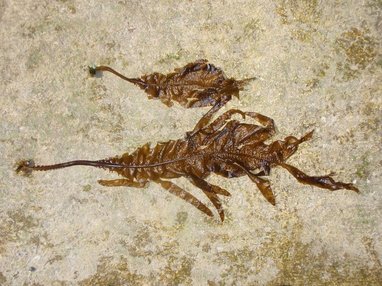
    Wakame

    Wakame (Undaria pinnatifida) is a large, golden‑brown kelp that is often confused with dabberlocks and sugar kelp. However, its very distinctive ruffled midrib tells it apart. The midrib is thick and pale, while the blade on either side forms soft, wavy frills. The frond is usually long and lance‑shaped, tapering toward the tip, and feels smooth and flexible when fresh.

    At the base, wakame has a small, branched holdfast and a short stipe that widens into the midrib. It grows on the lower shore and in shallow subtidal areas, often on rocks, harbour walls, and marina structures.

    Wakame  |  Image credit: Juliet Brodie

    Wakame was first recorded in the UK in 1994, where it arrived from the temperate waters of Japan, China and Korea. 
    Did you know: Wakame is a major food crop in Japan and Korea. It has been eaten for centuries and is a key ingredient in miso soup, seaweed salads and noodle dishes. It’s valued for its mild flavour and high nutrient content, especially iodine, calcium and vitamins.

    Harpoon weed

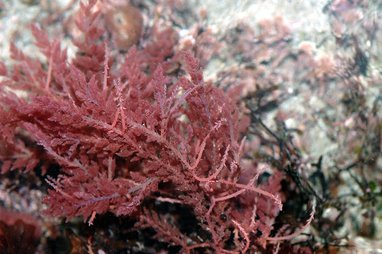
    Harpoon weed (Asparagopsis armata) is a bright red, feathery seaweed that forms soft, bushy tufts on the lower shore. Its fronds are finely branched and taper into delicate, hair‑like tips, giving the plant a fluffy texture and a vivid pink‑red to deep crimson colour that stands out. It can be confused with coral weed but its soft and flexible nature differentiates it.

    Its most distinctive feature is the presence of tiny barbed, harpoon‑like hooks on its reproductive branchlets. These stiff little projections help the seaweed latch onto other seaweeds and surfaces, and you might feel them catching slightly on your fingers when you handle the fronds.

    It originates in the Pacific and Indian oceans.

    Harpoon weed  |  Image credit: Keith Hiscock
    Bonnemaison's hook weed

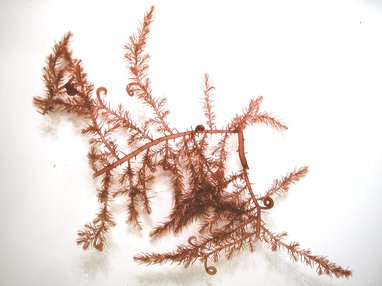
    Bonnemaison’s hook weed (Bonnemaisonia hamifera) is a delicate red seaweed that is soft to touch and forms soft, finely branched tufts in shades of pink‑red to deep crimson.

    It has tiny, curved hook‑like branchlets, which give the species its name. They allow the seaweed to cling to other algae and surfaces, allowing it to spread and anchor itself in sheltered areas. When handled, the fronds feel soft and flexible, but you may notice the subtle catching sensation of the hooked tips.

    Found on the lower shore and shallow subtidal zone, Bonnemaison’s hook weed often grows among other red and brown seaweeds.

    Bonnemaison's hook weed  |  Image credit: Francis Bunker

    It was first recorded in South West England in 1890 having been introduced from Japan.

    Did you know: Bonnemaison's hook weed produces a strong chemical that makes it taste bad and to herbivores. It also helps it compete with neighbouring seaweeds by reducing microbial growth on its surface which has even been studied for antibacterial and antiviral properties.

    Ocean acidification

    The sea is becoming more acidic as it absorbs increasing amounts of carbon dioxide in our atmosphere. Lots of ocean species, like seaweeds, struggle to grow in these conditions.
    Coral weed

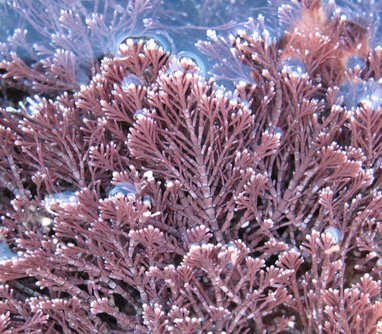
    Coral weed (Corallina officinalis) is a small, rigid seaweed that forms dense, bushy mats of pink to lavender branches on the mid to lower shore. Its fronds are made up of short, jointed segments that give it a distinctly coral‑like appearance. When fresh, it shows soft pinks and purples; when dried, it often turns chalky white.

    Unlike harpoon weed, coral weed is hard and brittle, snapping cleanly when handled due to the calcium carbonate in its walls. The branches spread in a fan‑like pattern creating a miniature underwater shrub.

    It is found on rocks, in rockpools, and among other seaweeds.

    Coral weed  |  Image credit: Jessica Wardlaw
    Calcified crust

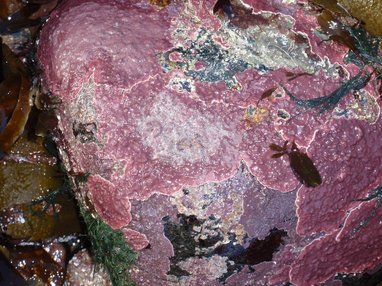
    A calcified crust is a type of seaweed growth form where the plant grows as a thin, hard, crust‑like layer tightly attached to rock. Instead of having leafy fronds or branching structures, it forms a flat, rigid coating that feels stony or chalky to the touch.

    These crusts are typically produced by calcareous red algae (coralline algae), which deposit calcium carbonate in their cell walls. This mineralisation gives them their hardness and their pale pink, lavender, or chalk‑white colouring. When exposed at low tide, they often look like someone has painted a thin, rough layer of pinkish plaster over the rock.

    Calcified crust  |  Image credit: Juliet Brodie

    Calcified crusts are common on the mid to lower shore, where they help stabilise rocky surfaces and provide habitat for small marine creatures. They are often found on harder rocks and can be seen lining rockpools. You might spot ridges where neighbouring crusts meet.

    Did you know: Even though their hard, encrusting form makes calcified crust very different from soft, leafy red seaweeds they’re actually very closely related.

    Our handy seaweed identification guide

    Identifying seaweeds on the shore can be difficult. We've created this photograph ID guide to make it a bit easier. This guide only includes the 14 species which we're looking to record, but you might find other species on the beach, too. Keep your eyes peeled for the key ID features and take lots of pictures when you submit your survey.
    This project is funded by the Government's Green Recovery Challenge Fund. The fund was developed by Defra and its Arm's-Length Bodies. It is being delivered by The National Lottery Heritage Fund in partnership with Natural England, the Environment Agency and Forestry Commission.

    Green Recovery Challenge Fund

    Report your seaweed search findings

    Tell us what you found

