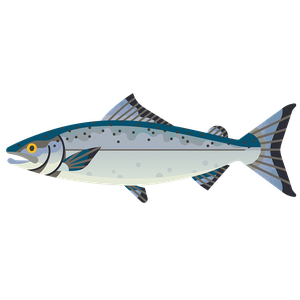
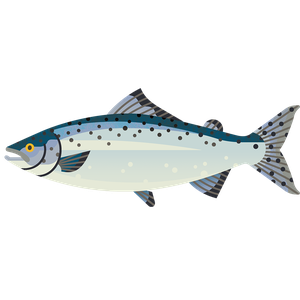
Atlantic salmon
Salmo salar
What to check for
Location
All areas
Production method
Open net pen, marine
Rating summary
Atlantic salmon in Norway are farmed in open net pens in the sea. Producing fish in open systems can cause environmental impacts such as: impacts of chemical and sea lice treatment usage; nutrient and organic waste deposition; outbreaks of disease; impacts on wild salmonids by transmission of sea lice, and escapes from farms. Salmon are carnivorous fish and rely on wild capture fisheries to produce their feed, Marine Conservation Society would like to see all these fish certified as sustainably managed. Due to the lack of data in relation to some of the environmental impacts of salmon farming, MCS is advocating a halt in industry expansion using existing practices until more evidence is available. Rating last updated May 2023.
Technical consultation summary
Atlantic salmon in Norway are farmed in open net pens in the sea. Producing fish in open systems can cause environmental impacts such as: impacts of chemical and sea lice treatment usage; nutrient and organic waste deposition; outbreaks of disease; impacts on wild salmonids by transmission of sea lice, and escapes from farms. Salmon are carnivorous fish and rely on wild capture fisheries to produce their feed, Marine Conservation Society would like to see all these fish certified as sustainably managed. Due to the lack of data in relation to some of the environmental impacts of salmon farming, MCS is advocating a halt in industry expansion using existing practices until more evidence is available.
How we worked out this Rating
Feed
What feed is given to farmed fish, where it comes from and how much is used is one of the most important aspects of fish farming. In this section we look at how sustainable the feed is and how much fish is included in the diet.
Feed used in salmon aquaculture is traceable and requirements are in place for responsible ingredient sourcing, including the use of certified ingredients. However, salmon is a net consumer of fish protein.The production of Norwegian salmon relies on a variety of different feeds, including specialist formulation. Historically, the most important ingredients in salmon feed have been fishmeal and fish oil, which provide an almost optimal complete feed in a convenient and highly digestible product form. The primary fisheries supplying fishmeal and fish oil are found globally (Ireland, Denmark, Iceland, South Africa, Norway, Peru, USA) and have a range of species (anchoveta, blue whiting, capelin, menhaden, Norway pout, sand eel, sprat). Due to a need to reduce costs and secure the protein supply, cheaper alternative ingredients (for example soybean and rapeseed oil) have been progressively substituted in commercial feed formulas. In Norway, novel feed ingredients are also being used, such as insect meals and algal oils.Four main feed manufacturers are dominant in Scotland, these are Biomar, Ewos, Skretting and MOWI. These main feed companies have policies in place to ensure that the protein and oil component of all main feeds used in Norway is traceable and responsibly sourced and this can be independently verified (MarinTrust). The dependency of wild caught fish used in fish meal and fish oil (known as the Feed Fish Dependency Ratio) for this species currently indicates that more fish protein is required in the diet than these fish produce, making them a net consumer of fish rather than a fish producer. The majority of soy and/or palm oil used by the main feed companies is also responsibly sourced.
Environment
The environmental impacts of aquaculture depend on what fish is farmed, how and where. It could be habitat damage, chemical use, pollution, freshwater use or parasites. In this section we look at the environmental impacts of greatest concern for that species and production method. Some species, such as shellfish, have very little impact, whilst others may give us cause for concern.
Salmon farming in marine open net pens has a negative impact on the environment.Habitat alteration is small scale through the use of mooring grids only and does not impact ecosystem functionality. All juveniles used in salmon aquaculture in Norway come from hatcheries, however, wild caught cleaner fish are used. Both lumpfish and wrasse are used as cleaner fish and while the stock status of lumpfish is thought to be above the long term average, the stock status of wrasse is unknown.Salmon farms in Norway rely on chemical usage. Many different chemicals are used with varying impacts on the environment. The use of antibiotics in Norway has been had a 99% reduction since the late eighties due to effective vaccines in the early stages of the salmon s lifecycle. However, there is little information available on the regulation of sea lice treatment and the susceptibility of sea lice to adapt and become resistant to different methods suggest that the use of these chemicals has been poorly regulated in the past. Discharges of waste from salmon farms also have a measurable negative effect but this is within regulation boundaries and state requirements on waste management are rigorous.There is a problem with both parasites and pathogens in salmon. Regulations relating to sea lice have been significantly tightened in Norway in recent years and currently, sea lice levels are low. Farmers must report the numbers of lice on a weekly basis and the results are publicly available. However, the impact of sea lice on wild populations is evident. Surveillance programmes have shown that levels of sea lice on wild salmonids are greater in areas with a high abundance of open net pens. The overall consequences of increased sea lice levels on wild populations are unclear and quantifying wild salmon mortality due to sea lice infections is complex, and the magnitude of lice can also depend on environmental, biological and ecological variables. Pathogenic disease outbreaks also occur on salmon farms in Norway, in particular Pancreas Disease (PD) and Infectious Salmon Anaemia (ISA). It has been found that these pathogens can impact wild species and may result in mortality but this is not thought to be at a population level and not thought to threaten regional level operations.There is a risk of escapes of farmed salmon with evidence of negative ecological effects. Open net pens used in salmon farming are vulnerable to escapes and large numbers have escaped in the last 10 years. Escaped farmed salmon can alter the natural environment by indirectly affecting aspects of the wild population behaviour, predators and disease interaction. In Norway, salmon predators are lethally controlled. Norway employs a regionally administered licensing system for seal shooting, however, seal populations in Norway are relatively low and highly dispersed and a greater impact on their population comes from the ongoing seal hunting practices
Fish health and welfare
Fish health and welfare is a concern for many consumers. High welfare standards are an indication of good farm management, we look to see if there are industry wide welfare standards in place, and if these include humane slaughter.
There are practices in place to ensure animal welfare and humane slaughter.In Norway, farmed fish are subject to the Animal Welfare Act 2009 and have the same rights as other domestic animals to an environment which ensures that farmed salmon are protected from danger of unnecessary stress and strains. Slaughter of salmon in Norway is now highly automated, however there is legal training required for all personnel involved, to increase focus on animal welfare.
Management
How aquaculture is regulated and how effective those regulations are is an important aspect of farmed fish production. We also look to see if aquaculture is included in broader environmental management plans. In this management section we also award scores for globally recognised certification standards, as certified seafood requires verification of environmental performance and traceability.
This assessment scores well for management measures but would benefit from third party certification.This assessment is for Atlantic salmon that are not producing to independently on site audited 3rd party certification standards. In Norway, management of marine areas is broken down into three areas: the Barents Sea, the Norwegian Sea, and the North Sea, that combined cover the entire Norwegian Exclusive Economic Zone (EEZ). Marine spatial plans have been developed for these three regions and these include the impact of aquaculture on the marine ecosystem. They also identify valuable and vulnerable areas that require special management measures.In Norway, there is regulatory framework in place that addresses Environmental Impact Assessment, which is required for farms over 36,000m3. There is also protection in place for valuable habitats and species and the use of land and water. Chemical use is permitted and permits must also be obtained in order to discharge into a receiving water body. Further regulations in place are the management of disease under the Food Safety Act (2003) and protection from species introduction through the Aquaculture Act (2005). However, regulations are not always effective. For example, open net pens used in salmon farming are experiencing large escape events and despite management action, the numbers are not decreasing. There is also little information available on the regulation of sea lice treatment and the susceptibility of sea lice to adapt and become resistant to different treatment methods suggests that their use has been poorly regulated.
References
Aas, T. S., Åsgård, T. and Ytrestøyl, T. 2022. Utilization of feed resources in the production of Atlantic salmon (Salmo salar) in Norway: An update for 2020. Aquaculture Reports, 26, 101316. Available at https://www.sciencedirect.com/science/article/pii/S235251342200312X [Accessed on 01.05.2023].
Barents Watch. Available at https://www.barentswatch.no/en/ [Accessed on 01.05.2023].
BioMar, 2022. Global Sustainability Report. Available at https://www.biomar.com/globalassets/.global/sustainability-report/biomar-global-sustainability-report-2022.pdf [Accessed on 28.04.2023].
BioMar, 2022. Marine Ingredients Position Statement. Available at https://www.biomar.com/globalassets/.global/pdf-files/2022-03-en_position-statement_marine-ingredients_ver.1_digital.pdf [Accessed on 01.11.2022].
Cargill, 2021. Cargill Aqua Nutrition Sustainability Report. Available at: https://www.cargill.com/doc/1432219325606/cargill-aqua-nutrition-sustainability-report-2021.pdf [Accessed on 01.11.2022].
European Commission, 2012. Guidance on Aquaculture and Natura 2000. Available at https://oceans-and-fisheries.ec.europa.eu/system/files/2016-09/guidance-aquaculture-natura2000.pdf [Accessed on 24.02.2023].
FAO, 2023. United Kingdom. Text by Spreij, M.. Fisheries and Aquaculture Division. Rome. Available at https://www.fao.org/fishery/en/legalframework/gb/en?lang=en [Accessed on 24.02.2023].
Fiskeridirektoratet. Environmental monitoring. Available at https://www.fiskeridir.no/Akvakultur/Drift-og-tilsyn/Overvaaker-miljoepaavirkningen [Accessed on 01.05.2023].
Gonzalez, E. B. and de Boer, F. 2017. The development of the Norwegian wrasse fishery and the use of wrasses as cleaner fish in the salmon aquaculture industry. Japanese Society of Fisheries Science. 83:661-670. Available at https://uia.brage.unit.no/uia-xmlui/bitstream/handle/11250/2490465/The%2Bdevelopment%2Bof%25C2%25A0the%25C2%25A0Norwegian%2Bwrasse%2Bfshery.pdf?sequence=1 [Accessed on 01.05.2023].
Hannisdal, R., Nøstbakken, O. J., Hove, H., Madsen, L., Horsberg, T. E. and Lunestad, B. T. 2020. Anti-sea lice agents in Norwegian aquaculture; surveillance, treatment trends and possible implications for food safety. Aquaculture. 521. Available at https://reader.elsevier.com/reader/sd/pii/S0044848619322057?token=4BCB742FBCE3675004A0CB69EE5ECA40C9B0196BC69CF983CB07A3E2BEBD8043EF1FE60F621A02F46F3D5C1192FDA582 [Accessed on 01.05.2023].
Hoel, A. H. and Olsen, E. 2010. Marine Spatial Planning: Norways management plans. Available at https://imr.brage.unit.no/imr-xmlui/bitstream/handle/11250/102586/O0510.pdf?sequence=1&isAllowed=y [Accessed on 05.01.2023].
Keystone Dialogues. 2019. The Phuket Dialogue. Antibiotics in Aquaculture. Available at http://keystonedialogues.earth/wp-content/uploads/2019/12/Brief4-Antibiotics-in-Aquaculture.pdf [Accessed on 05.01.2023].
Luthman, O., Jonell, M. and Troell, M. 2019. Governing the salmon farming industry: Comparison between national regulations and the ASC salmon standard. Marine Policy, 106. Available at https://www.sciencedirect.com/science/article/pii/S0308597X1830842X [Accessed on 05.01.2023].
Marine Spatial Planning Programme. Norway. Available at http://msp.ioc-unesco.org/world-applications/europe/norway/ [Accessed on 01.05.2023].
Monterey Bay Aquarium Seafood Watch. 2021. Atlantic Salmon: Salmo salar. Norway Marine Net Pens. Available at https://www.seafoodwatch.org/globalassets/sfw-data-blocks/reports/s/mba_seafoodwatch_atlantic_salmon_norway.pdf [Accessed on 01.05.2023].
MOWI, 2021a. Integrated Annual Report 2021. Available at https://corpsite.azureedge.net/corpsite/wp-content/uploads/2022/03/Mowi_Annual_Report_2021.pdf [Accessed on 02.11.2022].
MOWI, 2021b. Policy on sustainable salmon feed. Available at https://mowi.com/wp-content/uploads/2022/06/220624-Mowi-Sustainable-Salmon-Feed-Policy.pdf [Accessed on 02.11.2022].
MOWI, 2022a. MOWI Emerging Feed Raw Materials Policy. Available at https://mowi.com/wp-content/uploads/2022/06/220624-Mowi-Emerging-Feed-Raw-Materials-Policy.pdf [Accessed on 02.11.2022].
MOWI. 2022. Annual Report 2022. Available at https://mowi.com/wp-content/uploads/2023/03/Mowi-Integrated-Annual-Report-2022.pdf [Accessed on 11.01.2023].
Norwegian Institute for Water Research. 2017. Anti-sea lice chemicals could be hazardous to other creatures. Available at https://partner.sciencenorway.no/agriculture--fisheries-fish-farming-forskningno/anti-sea-lice-chemicals-could-be-hazardous-to-other-creatures/1442441 [Accessed on 01.05.2023].
Olaussen, J. O. 2018. Environmental problems and regulation in the aquaculture industry. Insights from Norway. Marine Policy. 98. pp 158-163. Available at https://www.sciencedirect.com/science/article/pii/S0308597X18300794 [Accessed on 01.05.2023].
Powell, A., Tresurer, J., Pooley, C., Keay, A., Lloyyd, R., Imsland, A. and Garcia de Leaniz, C. 2018. Use of lumpfish for sea lice control in salmon farming: challenges and opportunities. Reviews in Aquaculture, Volume 10, pp.683-702. Available at https://doi.org/10.1111/raq.12194 [Accessed on 16.01.2023].
Sim-Smith, C. J. and Forsythe. 2013. Comparison of the international regulations and best practice management practices for marine finfish farming. MPI Technical Paper No: 2013/47. Available at https://www.researchgate.net/publication/308315221_Comparison_of_the_international_regulations_and_best_management_practices_for_marine_finfish_farming/link/57e06f8a08aec6ce9f28e83a/download [Accessed on 02.04.2020].
Skretting. 2019. Sustainability Report. Available at https://www.skretting.com/siteassets/global-files/nuterra/sustainability-report-2019/skretting-sustainability-report-2019.pdf [Accessed on 09.09.2020].
Skretting. 2020. Sustainable soy. Available at https://www.skretting.com/en/sustainability/ingredients/sustainable-soy/ [Accessed on 12.02.2020].
Statistics Norway. 2019. Aquaculture. Available at https://www.ssb.no/en/fiskeoppdrett/ [Accessed on 23.01.2020].
Sundt-Hansen, L., Huisman, J., Skoglund, H. and Hindar, K. 2015. Farmed Atlantic salmon Salmo salar L. parr may reduce early survival of wild fish. Journal of Fish Biology, 86, pp. 1699-1712. Available at https://onlinelibrary.wiley.com/doi/abs/10.1111/jfb.12677 [Accessed on 01.05.2023].
Sustainable swaps
Learn more about how we calculate our sustainability ratings.
How our ratings work
Add impact to your inbox
Join the movement: get updates on the issues you care about.
We'll email you inspiring stories about the work we're doing to save and recover our oceans, and news about our urgent campaigns for positive change.